A few reactions on topics related to psychiatry from the past week:
An example of a transitional object in baseball. The catcher for the Seattle Mariners, Cal Raleigh, did not play a few games due to injury concerns. Early in the game against the Atlanta Braves, the camera operator lingered on him in the dugout:
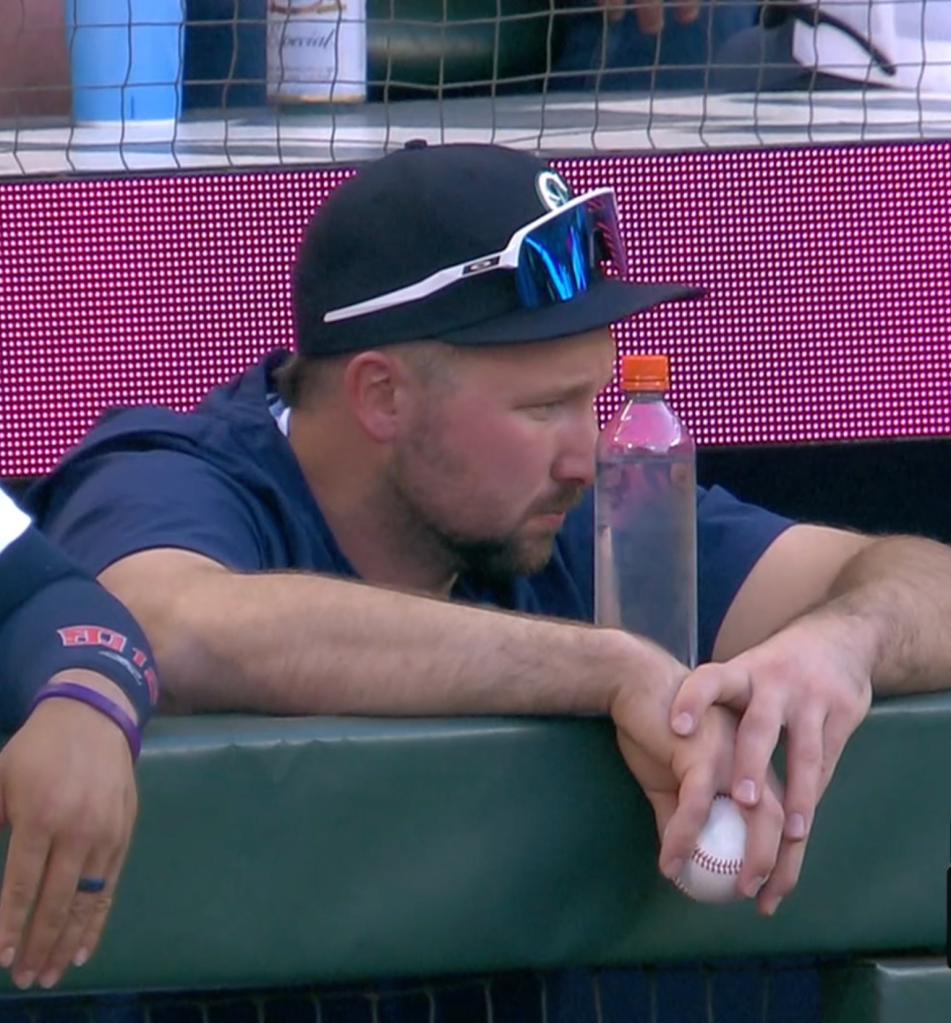
Notice that he’s not dressed to play. An unmarked bottle keeps him company. In his right hand is a baseball.
The Wikipedia page about transitional objects is pretty good (though psychobabbly). The best explanatory example of transitional objects is Linus and his security blanket:

Transitional objects give us comfort and a sense of security. Maybe the baseball gave Cal comfort and security during his mandatory time off. (Some players can hold six or seven baseballs in one hand. That’s probably more about showing off!)
The MAHA Action Plan to Curb Psychiatric Overprescribing. Per the HHS press release:
HHS Secretary Robert F. Kennedy, Jr. laid out a new action plan to promote appropriate psychiatric prescribing and drive deprescribing when clinically indicated.
Does “inappropriate” psychiatric prescribing happen? Yes. Does deprescribing, whether clinically indicated or not, already happen? Yes.
Back in 2015, while mulling over the value of psychiatrists, I commented:
When people think about medication management, they often think only of adding medications or exchanging one for another. Medication management also includes helping people come off of medications.
Many psychiatrists practice “deprescribing”. In 2019 I wrote about the ongoing difficulties in treating psychosis. There I commented on my own deprescribing experiences:
One of my early jobs was working in a geriatric adult home. My work there taught me that people with psychotic disorders can and do get better. The burdens of antipsychotic medications—paying for medications, the actual act of swallowing the pills every day, the side effects, some mild, some intense—add up. I was fortunate to work with some people to successfully reduce the doses of their antipsychotic medications and, in some cases, stop them completely! (There [was] also at least one instance when tapering medications was absolutely the wrong thing to do; that person ended up in the hospital. I felt terrible.)
Psychiatry is an easy target. Psychiatric medications, especially antidepressants, are common prescriptions. Many factors contribute to this: Health care appointments are short. (There’s not enough time for deep conversations.) It’s hard to access non-medication treatments. (Most rural areas do not have experts in evidence-based therapies.) Emotion literacy is not where we all want it to be.
For several decades psychiatry has focused on biological causes of psychological symptoms. The natural corollary is medications fix biological problems. As I noted in 2019, “Medications are a biological solution, though our understanding of the biology of the brain and mind remains limited.”
To be clear, I am not anti-medication. Psychiatric medications can not only save lives, but also improve quality of life. However, medications are not the only tool psychiatrists have to help people. Most of us do prescribe appropriately. (Some people are vexed when we decline to write prescriptions.) Many of us do deprescribe when clinically indicated. (Some people express anxiety when they want to stay on their medications.)
Ongoing hypocrisy related to “ending crime and disorder on America’s streets”. The primary community psychiatry journal published this (free) article: The Executive Order on “Crime and Disorder”: An Affront to Policy, Law, and Ethics.
I agree with the authors. I previously shared my reactions to the executive order here.
It’s fresh that the federal administration cannot recognize the crime and disorder they bring to America’s streets:
- Immigration and Customs Enforcement (ICE) and Border Patrol killing and injuring people.
- The dismantling of US public health infrastructure. There will be more preventable disease (see measles). More illness brings disruptions and heartbreak to patients and those who care about them.
- The dismantling of US science research infrastructure. Solutions to important problems won’t be studied, tested, or implemented.
- The initiation of a war with Iran, which has led to higher gas and food prices.
- The dismantling of programs that have literally reduced crime and increased public safety.
… among many other federal actions that reduce stability and increase anxiety. Choose your issue.

