Categories
Consult-Liaison Education

On the Emotion of Anger.

I have no idea if the vicissitudes of life at this moment are more challenging than times past. Perhaps the intensity and quality of suffering in humanity remains unchanged, but now, due to technology and the increased breadth of our situational awareness, we are simply more aware of the degree and scale of human suffering. Our ancestors had no way of knowing as much as we do now.

(Humans, though, have suffered individual and local tragedies for as long as we have existed. Sometimes—often?—these individual tragedies induce greater suffering than we can ever imagine. Consider the parent whose spouse and child have both died. Surely deaths from disease and war affect this person, too, but how do those compare to the indescribable grief and heartbreak from the loss of kin? I don’t know. Someone out there does know. For them, I wish them peace, even if this wish is functionally just a spindly raft in a deep sea of sorrow.)

The range of human emotions is vast. In American culture, certain emotions are more acceptable than others. (This is likely true across all cultures.) And perhaps I should be more precise here: American culture tolerates the expression of certain emotions more than others. For example, American culture is intolerant of men weeping for any reason. We have been conditioned to consider that men who are crying—even for the most valid of reasons—are weak, incompetent, and incapable.

These social norms influence the individual and shape our behavior. If society cannot tolerate my tears, then I will do what I can to avoid crying. This can involve psychological acrobatics to avoid feeling the emotion that induces crying.

The problem is that emotions serve a function. Emotions give us information about the people we are around, the situations we are in, and what matters to us. They help us choose and express our behaviors, even if some of these choices don’t happen entirely consciously.

There’s a concept called “secondary emotions”, which are emotions we feel (and then express) as a result of other emotions. Some examples will help clarify this. (The emotion of anger—and we see so much anger these days—is what prompted this post, so I will use anger in these examples.)

American culture often discourages women from expressing anger. Women who express anger are often called “bitches”, even if their anger is justified. The (antiquated?) phrase “resting bitch face” illustrates this: That woman isn’t really an angry “bitch”, that’s just her face. If a woman feels and expresses the primary emotion of anger, she may then quickly feel and express the secondary emotion of guilt: “I shouldn’t feel anger; it makes me seem like I’m not a nice person. But I want to be a nice person. But maybe I’m not a nice person because nice people don’t get angry like this. So maybe I’m a terrible person. Oh no.” Society is more accepting of a woman’s deferential behavior that may follow. (Those familiar with CBT will recognize black-and-white thinking happening here.)

Similarly, American culture discourages men from expressing sadness. Our culture instead tolerates men expressing anger. Thus, men may actually feel a primary emotion of sadness, but the secondary emotion is anger. Maybe they express anger to counteract their perceived “weakness” for feeling sadness. Maybe they express anger because they know, whether consciously or not, that they are less likely to get want (including respect) if they express sadness.

Anger is also an activating emotion. Recall that emotions can and do drive behavior. When feeling sad, people are generally more likely to withdraw and isolate. Some people who feel sad will reach out to others for support, but sadness usually pulls people inward. When feeling angry, people are generally more likely to do something and take initiative. Feeling angry makes people feel more powerful.

Consider someone stomping down a hallway and throwing open a door while exiting. This behavior may seem like a withdrawal from people, but they busted out the door. Such a behavior requires initiative and energy, and often benefits from an audience. We turn our heads when we see someone storm out of a building while muttering profanity; we don’t when someone slips out the back door in tears.

There is little utility in denying our emotions. You feel what you feel. Sometimes, though, we resist feeling the primary, foundational emotion, maybe one that is too tender for us to acknowledge. It forces questions to the surface that we may not want to answer: What does it mean if I am unwilling or unable to feel sad? What would I discover if I sat with my anger and felt its sharp, jagged edges? What would I learn about myself if I explored this contempt? What things would I have to change about myself if I understood that there is something soft and vulnerable under this rage?


Categories
Education Public health psychiatry

What Should I Talk About?

Dear reader, what do you suggest I talk about during a presentation about homelessness and mental illness?

I’ve been invited to talk to a small class at the large local university about homelessness and mental illness. The overall course is about homelessness (I think) and the students apparently range from undergraduates to medical students to faculty. It sounds like it’s one of those seminar courses that is not required for anyone, which means that the students presumably have an active interest in this topic and want to be there.

It seems that an introductory overview, 101-level talk might make the most sense, but I only have one hour and this topic is vast. While I always do my best to make statistics and data interesting, I don’t know that rattling off percentages is the best use of time. Anecdotes and cases are compelling, though I worry about missing larger points about the intersection of homelessness and mental illness.

Some of you have been reading my writing online for years (decades?–thank you for the gift of your attention!) and some of you have not, though I get the sense that most of you have some interest in psychiatry and homelessness. If we work with the assumption that this class has similar interests as yours, what do you suggest I talk about? What would be most interesting or compelling to you about the topic of homelessness and mental illness? If I’ve written something here in the past on this topic that you found useful and could share in this class, could you let me know?

It’s been years since I’ve opened comments on my blog (due to spam comments and some veiled death threats), but it’s a new year and I would like to learn from you. Please leave a comment below with your advice and suggestions. Thank you!

Categories
Consult-Liaison Education Observations

Racial Slurs and Psychiatric Illness.

Photo by Mary Jane Duford

It doesn’t happen often, but it does happen: People have directed racial or misogynist slurs at me. (I’m an equal opportunity target!) When they announce their perspectives, they are almost always shouting and their tones of voice suggest anger and disgust.

Rarely do people with psychiatric conditions, such as schizophrenia or bipolar disorder, express displeasure with my race or sex. I can only think of three examples when this occurred (though, to be fair, I just don’t remember the other times when this has happened):

  • A woman in a crisis center who insisted that I was Bruce Lee’s sister, then proceeded to scream, “Chink!“, when I told her I was not;
  • A man with dementia in a hospital who felt compelled to tell me (and only me) in a loud voice about the “gooks” he killed during war; and
  • A man in a jail cell in psychiatric housing who, upon seeing me walk onto the unit, made loud comments about “fucking dykes with short hair“.

It is far more common for people out in the community to shout racial and misogynistic slurs to me in passing. Sometimes their apparel is shabby and soiled; more often, their clothes are clean and their cars are shiny.

My data comes from an N of 1, but this is how I think about it: Yes, it is possible for someone with a psychiatric condition to use speech brimming with prejudice only when they are experiencing acute symptoms. However, most people with psychiatric conditions, in my anecdotal experience, do not, regardless of acute or chronic psychiatric symptoms. If they do have prejudices, they are able to keep them to themselves, even when they are unable to contain any delusions. If they are expressing ideas about people, they tend to be specific to how an individual relates to them (e.g., that person is trying to kill me; that person knows I don’t have internal organs; those people can hear my thoughts; etc.).

Could it be that the use of racial slurs in of itself reflects mental illness? I don’t think so. Humans are adept at creating and using categories. We have all created and applied useless categories. For example, I am on Team Candy Corn. This team serves no purpose and it should not be a point of pride, but here we are. There is, of course, a difference between Team Candy Corn and Team Nazis, though the underlying principle of creating categories and then putting people into them is the same. (On Team Candy Corn, we do not hate and dehumanize.)

People with psychiatric conditions like schizophrenia, like most other people, can feel hate. People with psychiatric conditions like schizophrenia, like most other people, are not hateful.

Categories
COVID-19 Education Medicine Nonfiction Observations

Three Observations.

I. He was standing outside of the homeless shelter. The bouquet of bright tulips in his hand were splashes of color against the tired cement walls and grey skies.

A man staying in the shelter ambled towards him. “Hi,” he greeted, his eyes gazing at the buds of the young tulips. “Is today a good day or a bad day?”

The shelter manager laughed and warmly responded, “Why are you asking me that?”

“Because you got flowers….” the man said.

After a pause, the shelter manager reassured, “These are ‘congratulations’ flowers.”

“Oh, okay, good,” the man said. The wrinkles around his eyes revealed the smile that his mask obscured. “Congratulations.”


II. Earlier this year, I wrote:

We know from history that pandemics do not last forever. The 1918 flu pandemic lasted just over two years. The 2002 SARS outbreak was declared over in less than two years. The 2013 Ebola epidemic persisted for less than three years. All things change, all things end.

By the end of 2020, I had already read some literature about protecting mental health during epidemics. This information gave me confidence to share with others that, yes, pandemics do end in two to three years’ time.

Last month, I finally embraced “that the Covid pandemic will likely end for the majority of people in the US before it ends for those of us who work in and use safety net programs“. And only in the past week did I finally recognize that these past epidemics and pandemics of course did not end in two to three years. That just seems to be the duration of time that societies can tolerate abrupt social restrictions and consequences.

I interpreted the published timelines as start and end dates of biological phenomena.

I feel foolish for having done so. Time is an artificial construct, so of course the expiration dates of pandemics are artificial constructs, too.

Someone somewhere can explain why two to three years is the maximum amount of time that people and societies can tolerate drastic changes before reverting “back to normal”. Of course, there is no way any of us can ever go “back”, pandemic or not.


III. The author of this tweet has since deleted it for reasons that will be apparent (profile photo modified by yours truly):

The tweet is dehumanizing, but that’s not actually the chief reason why this struck me.

The author of this tweet is a Big Name in the field of psychiatry. He is the chair of a Fancy Pants psychiatry department at a Hoity-Toity institution. He’s published seminal papers in the field related to psychotic disorders.

Over ten years ago I completed a fellowship at this institution (this is not meant to be a humblebrag, I promise) and I have a distinct memory from when Dr. Big Name when he spoke at the graduation ceremony. He grasped both sides of the lectern, leaned forward in his dark suit, and glowered at the audience.

“As a graduate of This Place, you now have a responsibility to This Place. Whatever you say, whatever you do, is a reflection on us. Make sure you don’t ever do anything that will reflect poorly on This Place.”

It was strange and uncomfortable. His warning about reputation management during a rite of passage was, in of itself, something that didn’t reflect well on That Place. Which is exactly why this memory resurfaced when I saw his tweet.

May God spare all of us and may we all avoid these errors, in public and in private.

Categories
COVID-19 Education Public health psychiatry

Reactions and Behavioral Health Symptoms in Disasters.

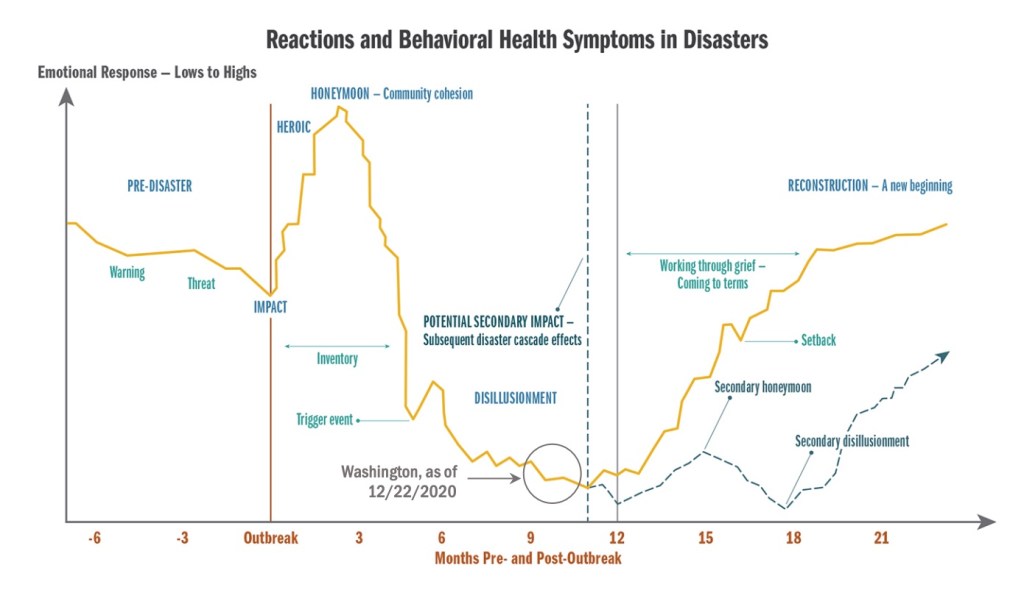
The Washington State Department of Health started posting Behavioral Health Monthly Forecasts in April 2020. Two disaster psychologists, along with other staff, compile and share useful information such as the anticipated course of psychiatric symptoms across the population, how different populations might manifest their distress (e.g., children), and data related to changes in substance use and firearm purchases. It makes for interesting reading, though it’s frequently a bummer.

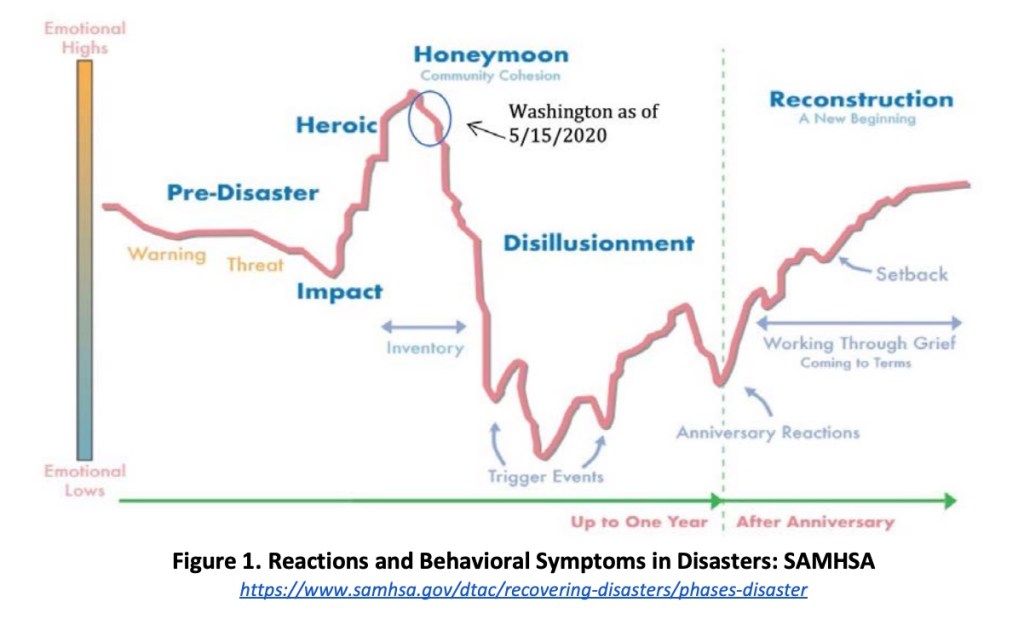
One chart that appears every month is “Reactions and Behavioral Health Symptoms in Disasters”. In the inaugural issue in April 2020, the forecast oriented readers to general model from SAMHSA[1. SAMHSA is the Substance Abuse and Mental Health Services Administration. What a shame that it is a distinct department from the Centers of Disease Control and Prevention (CDC). The mind remains split from the body in our administrative and health care systems, which is why there is no formal framework for public health psychiatry.] of reactions in disasters:

Note that there is no indicator here about where Washingtonians were at that time. The Y axis uses color to depict emotional states and the X axis, so optimistic, has only a notation to mark one year.

In May 2020, the forecast made a proclamation about where Washingtonians were. It was a warning: We were on the precipice of disillusionment:

We braced ourselves for this. Yes, we had witnessed heroism from so many, whether health care workers or first responders or neighbors dropping off food for those who were medically vulnerable or distilleries producing hand sanitizer or seamsters and seamstresses joining brigades to make cloth masks. Of course this level of concern and anxiety was unsustainable. How bad could it get?

Well.

By December 2020, we were in a trough of disillusionment and it felt like it:

Thousands of people were dying a day in the US and other countries around the world. Hospitals were overrun with sick people. People were starting to leave their jobs due to overwhelm. When would the vaccines become available? I remember looking at this graph and thinking, “I thought the graph last month had us in the nadir of disillusionment.” But there was a branching of lines! Maybe we, as a state, would follow the yellow line and things would improve for us all, regardless of station in life.

Well.

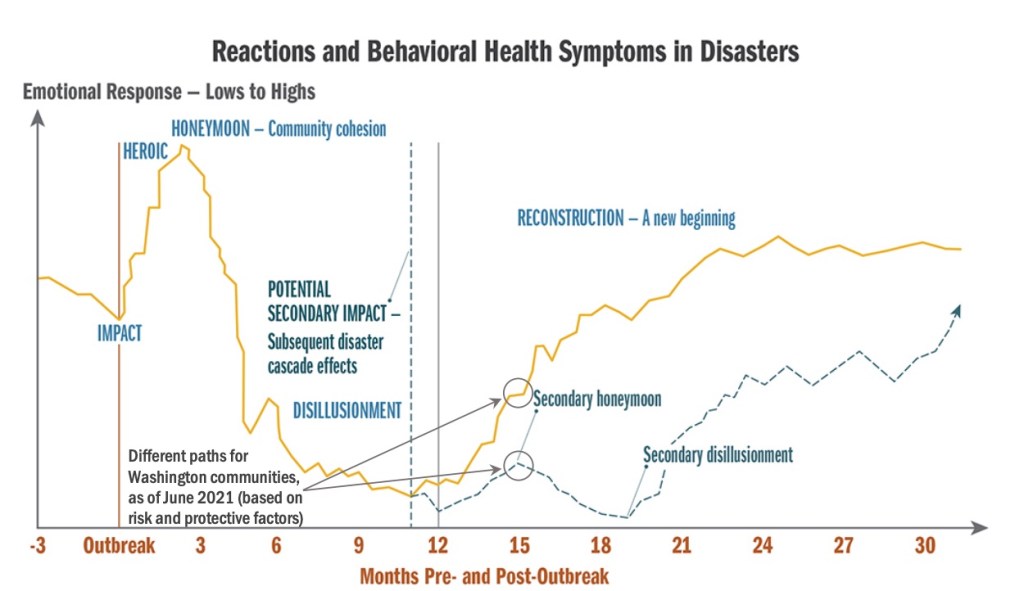
A terrible winter passed. The days got longer, there were more opportunities to be outside, many people got vaccinated… but the yellow line never manifested for those in my professional and personal communities. By June 2021, we were still in a trough:

In retrospect, that “secondary honeymoon” was accurate. All the numbers we hoped would drop, did: Reproductive number, cases, hospitalizations, and deaths. People in the Seattle-King County area were getting vaccinated. But so many of the people under our care were dying from overdoses, suicide, and chronic medical diseases.

Then came Delta, Omicron, more cases, hospitalizations, and deaths. Health care workers and others left their jobs out of frustration and demoralization. A contingent of people continued to decline vaccinations, despite knowing the possible outcomes… including chronic disease and impairment that still has no effective treatment.

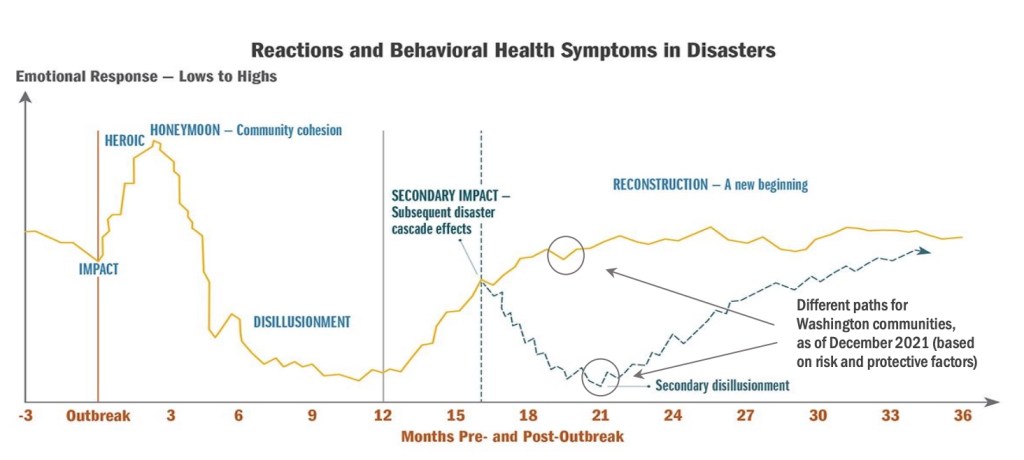
When the December 2021 graph came out, someone observed, “The trough just keeps getting longer.” I wondered who on Earth was experiencing the benefits of “reconstruction”.

I have never had so many people under my care die during a comparable period of time. At least 10 of my patients have died since the beginning of the pandemic; the first death occurred in July 2020. The most recent death (that I am aware of) happened in November 2021. None of these people died from Covid. They either died by suicide, overdose, or their chronic illness collided with an acute, fatal event.

We know from history that pandemics do not last forever. The 1918 flu pandemic lasted just over two years. The 2002 SARS outbreak was declared over in less than two years. The 2013 Ebola epidemic persisted for less than three years. All things change, all things end.

I, like so many others, hope that we all will exit this trough sooner than we anticipate. I worry about the psychological consequences of this pandemic in the years to come. We continue to focus on the viral pandemic; the psychological pandemic has already arrived. We have yet to see an organized response to that.