Categories
COVID-19 Nonfiction Observations Reflection Seattle

The Things We See and Don’t See.

It was my father who alerted me about the “white lives matter” protest scheduled today in Huntington Beach, California.

“I’m so glad you don’t live there anymore,” I sighed. We both knew that this protest would likely occur around Pacific Coast Highway and Main Street, an intersection we had crossed hundreds of times in our lives. When I was a child, each parent grasped one of my hands and ushered me across PCH to access the famous Huntington Beach pier. As a youth, I rode my Schwinn 10-speed bicycle underneath the pier, usually my father ahead of me and my mother behind me. As a younger adult, the three of us walked to the end of the pier, where my parents had scattered the ashes of my paternal grandparents. Six months after my mother died, my father and I, along with a few other distant relatives, scattered her ashes into the rolling waves.

In high school, I learned to avoid the pier after dusk because skinheads were often around Main Street. At the time, I did not fully understand their beliefs nor the danger they represented. Now, as I read about the recent KKK propaganda and white supremacy violence from the years I lived there, I wonder how much racism we experienced during my youth that neither my parents nor I recognized. There was (and is) great pressure to assimilate. For many years, I attributed my discomfort to personal defects. Perhaps ignorance is bliss: Had I recognized and acknowledged the atmosphere of white supremacy, would I have done anything different? Could I have done anything differently?


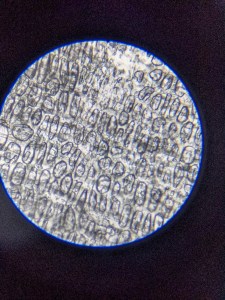
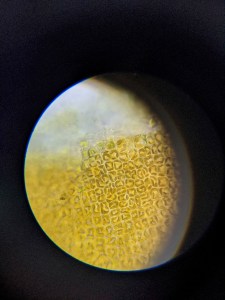
The pandemic has forced us all to view everything through a different perspective. We recently got a microscope in an effort to offset the crushing psychological weight of illness, isolation, suffering, and death. The microscope also forces a different perspective.

Here’s an image of fresh seaweed from Puget Sound (400x):

Here’s an image of garlic skin (100x):

Plant cells continue to build organized structures; chlorophyll continues to convert sunlight into sugars; carbon continues to cycle in and out of life forms. The seasons will continue to change; this season of grief, loss, and sadness will also pass.

Categories
Homelessness Nonfiction Observations Seattle

Leaves of Remembrance.

Throughout Seattle there are small metal plates in the shape of maple leaves that are embedded into the sidewalk. These are “Leaves of Remembrance” that “bear names of homeless women and men who’ve died, so that every person will have a place to be remembered”. People walk on and around them all the time, unaware of the purpose or significance of the leaves.

Only a few people were on the block that morning. It was not yet 8am, so the offices were still closed. The door to the corner store was open, though no customers were inside. A man was leaning against the building on the far end of the block, smoking a cigarette. The light of the sun was just starting to break through the grey clouds.

A man was squatting on the ground, inspecting the Leaves of Remembrance surrounding him. Near him was a styrofoam container of Cup Noodles, the lid removed. He dipped a white napkin into the ramen cup and rubbed it on a metal leaf. He leaned forward to inspect his work, leaned back to change his perspective, then wiped the entire leaf clean. After rotating his body, he began washing and wiping the neighboring leaves.

I’m not sure if he ever lived outside, though he has had his own apartment for years now. Does he recognize the names on the leaves? Was this his way of commemorating someone he once knew? Was this his way of helping to beautify the neighborhood? Is this part of his routine and I simply had not noticed until that morning?

He looked up when I walked past, though he did not recognize that I work as his psychiatrist. I did not greet him, though thanked him silently for his act of kindness during this time of calamity.

Categories
COVID-19 Homelessness Nonfiction Seattle

Dear Maria in March 2020.

Dear Maria in March 2020,

Hi. This is Maria in March 2021. I just want to let you know that you will be alive and well a year into the Covid-19 pandemic. Said nicely: You aren’t prepared for the next 12 months. To be fair, no one is prepared. You and your colleagues who serve people living outside, in shelters, and in permanent supportive housing are going to have a rough year.

First of all, remember that relentless fatigue you felt while you were in training, particularly as an intern? The constant realization that there was so much you didn’t know, the chronic anxiety of what harm you might cause because of your inexperience, and the physical exhaustion that came from working long hours and trying to keep yourself together? There will be many days in 2020 when you will feel something like that. The quality, though, will be different for two main reasons: One, because you do have more experience now, you will have more confidence in what you do and do not know. Two, you unfortunately will not be able to escape this fatigue. It will only worsen as the year goes on. There will be no resolution in March 2021. You won’t be able go off service; there will be no “golden weekends”. You will think about the pandemic and consider what you could or should do about it every single day.

People who receive services in the agency you work in will die from Covid-19. The number will be small—not even double digits—which will surprise everyone, especially you. Initially, you will think the low numbers must be due to luck. Once a Covid outbreak happens in the White House, however, you will recognize the value of the policies and procedures you and the team enacted. You will feel bountiful gratitude to staff for their willingness to follow these protocols, as annoying and inconvenient as they will be. It is because of staff efforts that so few people will get sick.

An uplifting event—one of only a few, I’m sorry to say—will happen in early 2021. You and your teams will establish an in-house Covid-19 vaccination clinic! During those vaccination clinics, staff from all over the agency—older people with various medical conditions, young people who just got out of school, people who left other careers to work in social services, people who do not speak English as their primary language—will come to receive vaccinations. They will express the hearty thanks to you and your staff. You will recognize the depths of their thanks because you will have felt the same way when you get your vaccinations from the beloved county hospital. By March 2021, you and your teams will be eager to vaccinate people receiving care from the agency, but the agency won’t have either the supply or permission to do so just yet.

It will be a terrible year. For many weeks, you will worry you will burst into tears at work. Instead, you will weep at home. It’s the kind of crying where you need to breathe, but all the muscles in your torso contract, so nothing moves. Anger and frustration are your constant companions; what will happen if you let them go? Must you be alone with the grief that you and everyone else feels?

Though few people will die from Covid, people will die. Data will show that the number of people who died in 2020 isn’t greater than the number of people who died in years past, but there will be more deaths on site. People will tumble from windows. The Women in Black will state a stunning number of people—young people, all under the age of 30—died from apparent suicides. The medical examiner will report again and again that someone died from an overdose. Older people won’t exit their apartments; their bodies will be found inside when they don’t respond to door knocks and phone calls.

You will feel anger towards a federal administration that will not demonstrate any concern towards the health and well-being of the nation’s residents. You will witness multiple system failures because there will be no federal coordination or planning. In conversations with state and local public health officials, you will preface your comments with an acknowledgment that they cannot provide optimal support to the community when they are not receiving support or information from the federal government.

Despite your grief and anger, you will often feel gratitude. Is this is a coping mechanism or a genuine reaction? It doesn’t matter. You will be grateful for the generous, non-reactive, and dedicated natures of the colleagues on your teams. You will express thanks that staff don’t quit in droves. You will feel gratitude to people under your care who follow guidance and demonstrate astonishing resilience. You will feel ongoing thanks that no one on staff gets sick and dies. You will be grateful that you still have a a job and are able to buy food and pay your bills when so many others cannot.

I am sorry to say that the pandemic is still ongoing in March 2021. Maria in March 2022 may be able to say more about how much you (and I) have learned and changed. (Perhaps it will be Maria in 2023 or 2025 who will comment on this.)

Do what you can to take care of yourself every day. I might even suggest that you write more, though will understand why if you don’t.

Sincerely,
Maria in March 2021
Categories
Consult-Liaison Nonfiction Reflection

Doors and Ducks.

Three people were standing outside of his apartment. His voice was muffled, though it was clear that he had no intention of opening his door. One person recrossed his arms; this group of young staff had already spent about 15 minutes trying to persuade him to open his door.

I offered to try; they obliged. In less than 60 seconds, he opened his door, showed his face, and greeted me with warmth.

Their face masks did not conceal their surprise.


This is how I did it. I:

  • read many books that describe different ways to listen and talk to people
  • watched many people (professionals and otherwise) talk to other people (patients or otherwise) and stole successful strategies
  • received and incorporated feedback from teachers who watched and listened to me talk to people
  • sat through hours of watching videotapes of myself talking to other people
  • have spent literally years talking to people who often did not want to talk to me

They didn’t see:

  • the many, many errors I have made in trying to connect with people
  • patients telling me directly how my approach was offensive and disrespectful
  • that one time someone threw a shoe at me because I wouldn’t leave him alone
  • the many times patients said nothing to me despite all my efforts to encourage them to talk to me
  • all the times I said something stupid that ruined any rapport we had
  • the times patients have yelled at me to leave because I didn’t respect their requests
  • that other time when the guy in the wheelchair literally rolled out of his room at high speed to get away from me (and I couldn’t find him anywhere on that floor in the hospital)
  • the variety of insults I have received (and will continue to receive) from people for reasons both valid and invalid

They also did not realize that:

  • luck played a large role in this outcome
  • the clinical relationship I have with him is different from the relationships they have with him (i.e., to him, I am novel)
  • I have been doing this sort of work for many more years than they have
  • I still consider everyone my teacher and continue to learn from them all
  • they can and will learn skills to achieve similar outcomes in the future

Now that winter is upon us, ducks called Barrow’s Goldeneye have arrived in Puget Sound. Sometimes a male and female swim together as an isolated pair; sometimes a flock of 10 to 20 ducks will paddle around the piers.

They look serene while gliding across the surface of Sound. We don’t see their legs and feet constantly pushing against the water.

Categories
Consult-Liaison COVID-19 Homelessness Medicine Nonfiction Seattle Systems

“The Impact of Covid-19 on Homeless Services in Seattle.”

On Friday, I presented Grand Rounds to an agency in New York City. The title of my presentation was “The Impact of Covid-19 on Homeless Services in Seattle, Washington”. The audience was comprised mostly of psychiatrists who also work with people who are currently unhoused or have been homeless in the past.

In some ways, this presentation was easy to create: I simply described the agency I work for and walked the audience through the timeline of events:

While the Seattle-King County region was scrambling due to the first death from Covid-19, the first case of Covid-19 was diagnosed in New York City on March 1.

In other ways, this presentation is the only one I’ve made where I had to take breaks while making it because of anger, grief, and sadness.

The month of March was hectic for us and everyone else: We tossed routine policies out the window and scribbled new ones down. We shattered many of our old habits and hastily introduced new practices. Our collective workload increased significantly as we tried to be as flexible and responsive to the changes that were coming at us. We watched systems grind to a halt because systems can’t change that fast: We had to buy hand sanitizer from local distilleries and we donated N95 masks to hospitals. Systems that had long failed us suddenly had the harsh glow of media light on them: In all of Seattle, there were only five bathrooms with hand-washing sinks that were open 24/7. Congregate shelters, where over 200 people had no choice but to share one giant room and one bathroom, suddenly became unacceptable because the beds were not at least six feet apart.

And, yet, eight months later, not much changed. We haven’t had the opportunity to abandon restrictions; many of these new practices are now status quo because the situation hasn’t gotten better. I was honest with the audience: There was no resolution or hopeful conclusion at the end of my talk. Why was that? How could it be that, eight months later, things hadn’t actually changed much?

The audience said nothing. What is there to say? The lack of ownership and coordination at the federal level is the same now as it was in March/April. New York City has significantly more resources than Seattle, though those resources only go so far while SARS-CoV2 can cross state lines and national boundaries when no barriers are erected and no interventions happen. If people in a boat are not rowing in the same direction—or if people aren’t rowing at all—then the boat and everyone in it wastes a lot of time and energy.

I was surprised by the gifts of validation from the audience. Yes, we all work as psychiatrists and the last time most of us saw someone get intubated was when we were residents. However, we all recall doing consults on people in the ICU who were sick. Ostensibly, we were there to take care of the patient and maybe their family members. We also know, though, that an important (and often unspoken) part of psychiatric consults is to support the treating team.

We all have a sense of how terrible it is for the treating teams. These are the reasons why we desperately try to keep people healthy and out of hospitals. We know that our contributions are small—most people don’t live on the streets, in shelters, or in supportive housing; most people don’t have diagnoses of schizophrenia or severe substance use disorders—but we also know that our people are often maligned when they pass through the doors into traditional health care systems. We all have a sense of how terrible it is for our people. We also know that, due to the stress of living marginalized lives, our people often have more severe health conditions. They already have many risk factors that increase the likelihood of complications and death due to Covid-19. We’re trying to mitigate the stress of everyone involved.

It’s heartbreaking, terrible, and unfair.

To end the talk on a positive note, I mentioned several things I am grateful for:

  • The rainy season has arrived in Seattle and I get to sleep in a dry bed indoors.
  • I have confidence in where I am going to sleep tonight.
  • I have a job and can pay my bills.
  • I know I will eat (again!) today.
  • There now exists technology where I can speak to an audience of colleagues on the other side of the continent!

These both mean a lot and nothing at the same time.

In the meantime, we continue to do what we can while we wait.