Categories
Consult-Liaison Observations

Observations from the Trump-Zelensky Meeting.

For your consideration, here are a few observations about the Trump-Vance-Zelensky argument in the Oval Office today from a psychiatrist:

Vice President Vance began attacking President Zelensky after Zelensky suggested that American diplomacy was not working. Vance started with: “What makes America a good country is America engaging in diplomacy. That’s what President Trump is doing.” After some back and forth, Zelensky said: “But after that, [Putin] broke the ceasefire, he killed our people, and he didn’t exchange prisoners. We signed the exchange of prisoners. But he didn’t do it. What kind of diplomacy, JD, you are speaking about? What do you mean?”

The insinuation here is that if the diplomacy of Trump, the face of America, was effective, Putin would have not broken the ceasefire and killed people. Vance reacted to Zelensky without providing an actual description of diplomatic efforts. He instead immediately pivoted: “Mr. President, with respect, I think it’s disrespectful for you to come into the Oval Office to try to litigate this in front of the American media.”

A couple things here: Zelensky’s body language prior to Vance’s reaction is open and engaged. He is leaning forward and making solid eye contact in Vance’s direction. He is making emphatic gestures. The tone of his voice when he asks, “What kind of diplomacy, JD, you are speaking about?” suggests disagreement, but not hostility.

When Vance responds, Zelensky’s body language immediately shuts down: He sits back and crosses his arms. He looks away. His eyebrows do heavy lifting here; he looks perplexed. His mouth hangs open a bit. Perhaps he is restraining himself from saying things he will later regret. Vance, for his part, gets pointy, both in his speech and with his index finger.

There is little that is respectful in Vance’s statement of “Mr. President, with respect, I think it’s disrespectful for you to come into the Oval Office to try to litigate this in front of the American media”. To criticize a leader’s character in front of cameras is not respectful. To physically point and wag the pointing finger at the president is not respectful. Just because you say “with respect” doesn’t make it respectful. Whenever speech and behavior contradict each other, behavior is more likely to convey the true sentiment.

President Trump began to attack President Zelensky after Zelensky used the word “feel”. Here’s the exchange:

Zelenskyy: “First of all, during the war, everybody has problems, even you. But you have nice ocean and don’t feel now. But you will feel it in the future. God bless –”

Trump: “You don’t know that. You don’t know that. Don’t tell us what we’re going to feel. We’re trying to solve a problem. Don’t tell us what we’re going to feel.”

It’s not even clear what feelings either man is talking about. Zelensky tries to elaborate by saying “You will feel influenced.” Trump immediately disagrees: “We are going to feel very good and very strong.”

Let me get pedantic here: “Influenced” is not an emotion. Neither is “very good” or “very strong”. In reading context clues, my guess is that Zelensky was trying to convey that the United States would feel “threatened” (which is not an emotion, either; fear is the emotion that underlies threats). Trump, whose behavior consistently reveals that he is obsessed with status, can’t tolerate the idea of feeling fear. He seems to believe that feeling fear means you are a beta.

Furthermore, Trump likely views Zelensky as having lower status than him. How dare someone who is “lower” than him tell him how he is going to feel! And in front of cameras! You are not the boss of me!

Maybe I am reading too much into Trump’s reactions to “feelings”, but…

President Trump gets red in the face as they continue to talk about feelings. They don’t linger on feelings for long; soon the conversation shifts to the metaphor of playing cards.

Trump becoming red in the face at this point is noteworthy because once Trump and Zelensky are talking at and over each other, Zelensky’s body language opens up. He uncrosses his arms, drops them to his lap, and makes some gestures. His eyebrows return to heavy labor; he again looks perplexed and ultimately looks away. These changes in body language indicate an effort (maybe nonconscious, though Zelensky has a history as an actor) to de-escalate the situation. What we learn here is that Zelensky is showing some deference to Trump that he did not show to Vance. Trump either doesn’t recognize or acknowledge Zelensky’s efforts to re-establish rapport. He gets red in the face, his voice gets louder, and he becomes more animated. What button did Zelensky push? Was the button labeled “feelings”?

President Trump settles down after Vice President Vance intervenes. What breaks the cross-talk between Trump and Zelensky is Vance asking Zelensky, “Have you said thank you once?”

I wonder if Vance has learned when to intervene to uphold Trump’s perceived status. Maybe Vance knew that, if this interaction continued, Trump would say or do something foolish that would result in an undeniable drop in his status in front of cameras. Zelensky’s body language was beginning to match Trump’s, suggesting that his deference from moments before was disappearing. What better way to artificially elevate one person’s status by coercing the other person to say “thank you”?

Among pro-social people, saying “thank you” is a gracious way to promote and sustain social bonds. We say “thank you” because it is an expression of cooperation, not conflict. However, some people view the phrase “thank you” as an act of submission: YOU are thanking ME because I bestowed something on YOU which means I have more power than YOU.

Following this cue, we hear Trump make comparisons to elevate his status because Zelensky does not say “thank you” to Trump; he does not submit. Trump says Biden is “not a smart person” (implying that he is); Trump asserts that “Obama gave sheets, and Trump gave Javelins”.

Zelensky, ambushed and outnumbered, looks resigned: His shoulders droop, he slowly rubs his fingers over his clasped hands. His eyebrows can no longer do all the work, so the worry spills all over his face.


What we witnessed today, like so many days in the past month, was ugly and cruel. Cowards only jeer when they are playing at home.


Categories
Homelessness Observations

Tents.

A tent in the woods is a symbol of defiance. Whether among towering trees, on a rocky beach, or next to an icy lake, it is a marker of someone intruding upon the natural world. Even if the tent and its occupants leave no trace, the tent itself is a trace, a brightly colored sign of someone who is passing through and does not naturally belong there.

A tent on a cracked sidewalk, underneath a concrete bridge, or tucked into the corner of a parking lot is a symbol of resignation. The tent and its occupants often have no other place to go. They do not belong there and everyone—including them—wishes that they were only passing through. Alas, the tent is their home.

A tent on a college campus is a symbol of defiance. It is not their home. The tent is a vivid icon of someone who is expressing their displeasure with the status quo. The occupants want progress, they want change. Through occupying their tent in a place where it does not belong, they hope that change will come to pass.

A tent in a besieged city, its buildings in ruins and its surviving residents terrified, is a symbol of resignation. They, too, have nowhere to go. Alas, the tent is their home.

I worry how people in power, people who lie, and people who have agendas kept in shadows will manipulate the symbol of the tent. It is much easier to target tents than to recognize the humans within.

Categories
Education Observations Public health psychiatry

What is Mental Health? (03)

Let’s take a look at the last figure from the paper What is mental health? Evidence towards a new definition from a mixed methods multidisciplinary international survey. The authors call this the Transdomain Model of Health:

I like this model. (Do note, though, that the map is not the territory.) It reminds us of the interdependencies between and within ourselves. If our community isn’t doing well, that will affect our individual mental health. To intentionally use a trivial example (because there are WAY too many heavy things happening these days), consider a city’s baseball team. A not-so-fictional team called the Tridents has had some embarrassing games; hits are uncommon, fielding errors abound, and pitchers are giving up a lot of runs. Grumpy viewers write corrosive comments about the Tridents in the city’s newspaper. Suckers like me read the comments and feel a disjointed sense of “us”. Maybe some of these grumpy viewers are in foul moods for other reasons and they direct their ire at the Tridents because that’s easier to talk about than their alcohol or gambling problems. They would go to Cell Phone Carrier Stadium to grumble at the Tridents directly, but they are dealing with illnesses that limit their abilities to navigate social spaces. Most of us don’t feel psychologically fine when we are physically unwell.

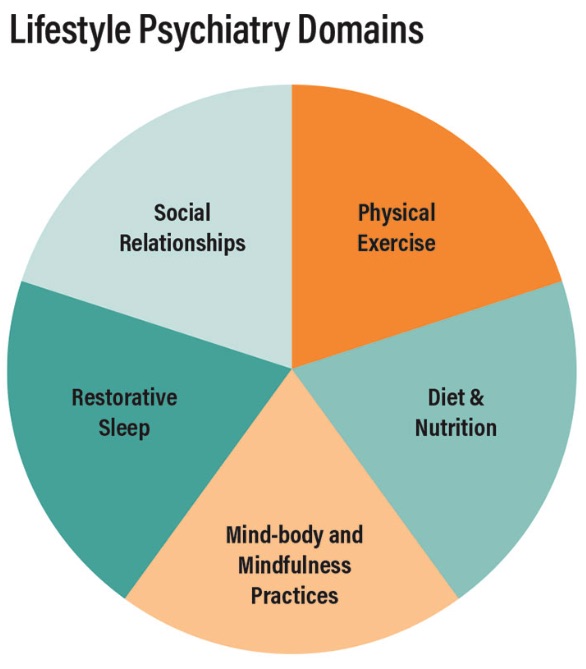
Contrast this Transdomain Model of Health with this recent Psychiatric News article, Lifestyle Psychiatry Emphasizes Behaviors Supporting Mental Health.

The authors define “lifestyle psychiatry” as seeking

to cultivate well-being and support individuals in preventing and managing psychiatric disorders and optimizing their brain health.

(Editorial comment: I feel some vexation about “lifestyle psychiatry” because I don’t think “lifestyle psychiatry” should be a specialty with its own textbook. Every psychiatrist should practice “lifestyle psychiatry”.) While the authors concede that “patients may have cost or access barriers to traditional care” and conclude the article with a proclamation that lifestyle psychiatry is “a vital component in improving the health and well-being of people around the world”, the final sentence gives away the underlying sentiment of bootstrapping: supporting “individuals in taking ownership of their mental health and well-being” (emphasis mine).

The “social health” component from the Transdomain Model of Health is missing from “lifestyle psychiatry”, even though addressing social health will make it much easier for people to succeed in the “lifestyle psychiatry domains”:

It’s much easier to get physical exercise when there are generous green spaces, plenty of intact sidewalks, and public safety isn’t a concern. Healthy diets and nutrition are easier to achieve when fresh food is available and affordable. It’s easier to be mindful and take yoga classes when you don’t have to work two jobs to make rent. People sleep better when there’s no noise pollution; what if the affordable housing wasn’t only close to airports, trains, and freeways? Neighborhoods with “third spaces” make social relationships more likely to bloom.

To be fair, the lifestyle psychiatry authors do write of “consultation and leadership to governments, corporations, and health care systems” and informing “public education programs and community planners to support the creation of healthy communities [and] employers in creating healthy workplaces”. Their definitions, though, ultimately focus on individuals and do-it-yourself interventions with some consultation with your local lifestyle psychiatrist. (And, to be clear, I’m not saying that systems are the only issue. People do still need to make their own choices, but we can shift systems so it’s not as hard for people to make healthier choices. Life is already hard enough.)


Seattle was not anywhere near the path of totality for the total solar eclipse today. Over lunch I watched part of NASA’s live broadcast. And what a mush ball I am: I cried into my meal as I watched the skies turn to black, heard the crowds cheer and gasp, and saw the dancing corona of the Sun.

I’m not so naive to believe that being in community solves everything. However, I do believe that being in community–contributing to social health–can powerfully change the way we view and feel about ourselves, others, and the world around us. Millions of people witnessed a total solar eclipse in person or in two-dimensions today. I’m pretty sure I wasn’t the only one who cried while watching the broadcast. Three things had to be in place for this celestial event to occur: The Sun, the Moon, and the Earth. To witness this stellar occasion, we all had to be on the same planet. Maybe this is naive: I’d like to think that the shared experience of a total solar eclipse boosted our planetary social health. And, as a result, we individually experienced higher mental health today.

Categories
Medicine Observations

H/ours Lost.

Most people in ten countries lost an hour of time between yesterday and today in the name of Daylight Saving. (Nearly 30 nations in the Northern Hemisphere will lose an hour by the end of March.)

Among the many who woke up at a later clock time today are the seven million or so Americans who have dementia. They opened their eyes and their gazes passed over the clocks in their worlds. The faces of those with dementia may have matched the faces of analog clocks: Flat, blank, lacking emotion.

There were fewer sparks of electricity this morning in these brains speckled with scar tissue. Amyloid plaques and tau tangles are the remnants of neurons that once vibrated with vitality. The hues of their hair have faded to gray; the gray matter of their brains continues to disappear.

When they looked at their cell phones, they may have forgotten that their phones automatically adjusted the time at 2:00am. The steps of logic are missing from these brains; the staircases of reasoning have crumbled. When someone mentioned “Daylight Saving”, they sprang forward with their praxis memory, similar to “muscle memory”: They can no longer explain the steps to search the internet on their phone, but their fingers reflexively swipe and type.

Their aged fingers tapped out the word “time”, trusting that Google would orient them to this moment.

Except their query was unsuccessful. With the decay of the gray matter in their brains, their abilities to give and hold attention, to notice details, have also deteriorated. Their single word question didn’t go to Google; it went into a text message:

Time

And then again, since Google did not respond:

Time

Daylight Saving Time may have stolen one hour of our time, but dementia has stolen hours and ours from us.

Categories
Observations Reflection

Mental Habits.

We got on the topic of nightclubs.

“I’ve never been to that nightclub,” I said.

“Yeah, I’ve never seen you there,” The Person replied, before adding, without any malice, “… you seem like you’d go to the Wildrose.”

I couldn’t help but laugh. That allowed the moment to pass, a question to leave unanswered.

The Wildrose is a lesbian bar in Seattle. (It’s apparently the oldest lesbian bar in the US.)

The Person’s error wasn’t about my sexual preferences; it was that they thought I go to nightclubs!†


What impression do you have of The Person?

Would your impression change if The Person is:

  • a man?
  • a woman?
  • the teenage child of a friend?
  • a stranger over the age of 70?
  • a white person? a non-white person?
  • a straight person? a queer person?
  • my boss?

As much as we try, we can never really get away from ourselves. We all think we view the world through relatively impartial lenses. Then we encounter people and situations that trigger our mental habits.

Like viewing the world and the people in it through the lens of sexual preferences.

Or believing that blog posts are only worthwhile if they resemble articles.


† Long-time readers know my opinions about dancing.