Categories
Education Medicine Policy Public health psychiatry Systems

What is Mental Health? (02)

To continue from my last post about “what is mental health?” and “what am I doing?”, let’s look at another figure from the paper What is mental health? Evidence towards a new definition from a mixed methods multidisciplinary international survey:
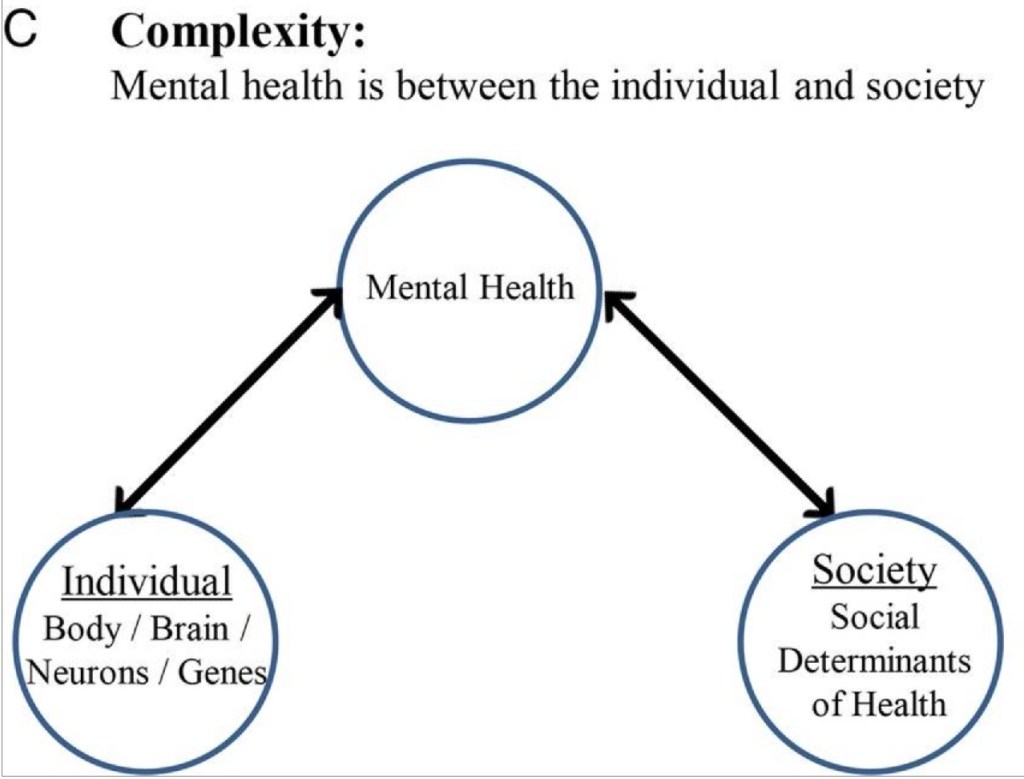
Figure 2C

This model argues that an individual’s mental health isn’t the sole product of that single person (because, yes, things are complex). “Society” also contributes to and affects a person’s mental health.1

The Covid pandemic provided plenty of empirical evidence that “society” has enormous influence on the mental health of individuals. Over a third of young people reported “poor mental health” and nearly half reported they “persistently felt sad or hopeless” in 2021. There were nearly 30,000 (!) more deaths related to alcohol when comparing 2019 to 2021. Two out of every five adults reported “high levels of psychological distress” at some point during the pandemic.2

The pandemic isn’t the only example of the power of “society” on mental health. Survivors of mass shootings can develop psychiatric symptoms or disorders. Residents of Flint, Michigan, could only access drinking water contaminated with bacteria, disinfectants, and lead. This contributed to elevated rates of psychological conditions like depression and PTSD. Poverty increases the likelihood of depression and anxiety.

“Imagine how many people I wouldn’t need to see if people never experienced homelessness!” I mutter (or exclaim) at least once a month. It’s not just homelessness: It’s working three jobs to make rent; it’s trying to keep the family fed and housed when one parent has major medical problems; it’s trying to leave an abusive partner; it’s trying to keep things together when a family member has an alcohol or gambling problem. Because much of my career has been in the “deep end” of the system, I often witness how misaligned and rigid institutions often bruise and scar the psyches of individuals and populations of people.

Maybe context matters more in psychiatry than in other fields of medicine. When I think, “What am I doing?”, I often wonder if I should work “upstream” in prevention and early intervention to help change these contexts. This includes advocacy for action that is outside the purview of medicine, such as lowering barriers to housing or increasing regulation of firearms.

Some physicians (and others) have argued that doctors should “stay in our lane”, that we should focus on treating conditions that we are trained to treat. Medical school didn’t teach me how to prevent psychotic disorders; it trained me to identify and treat schizophrenia. In residency I didn’t learn how to develop policy and programming to prevent war and rape; I was trained to provide care and support to someone with PTSD. I can help someone choose to put their gun away so they don’t shoot themselves; I don’t know how to organize people to persuade elected officials to change gun regulations.3

Of course, there’s a middle ground. My clinical experience and expertise give me the anecdotes and data to advocate for system changes. These system changes can improve the health of individual people. Furthermore, there are real people who have real psychiatric problems who need real help right now. As Paul Farmer said,

To give priority to prevention is to sentence them to death—almost to urge them to get out of the way so that the serious business of prevention can start.

I once worked for a medical director who often said, “I’d love to work myself out of a job.” It sounds disingenuous, but it’s true: I completely agree. How wonderful would it be if fewer people experienced psychological distress and problems with living! (Given the ongoing shortage of psychiatrists and other mental health professionals, this would be a win for literally everybody.) What if people didn’t believe that suicide was the best option? Or if people didn’t have to grapple with unending worry about where they will sleep tonight or when their next meal would be? I wholeheartedly concede that crafting legislative language and designing policies and programs are not my strengths. However, it also makes little sense to me to keep my head down and simply treat illnesses and suffering that can be prevented. Things don’t have to be this way.


(1) Again, if we’re going to be picky about words, I prefer the word “context” over “society”. “Society” suggests something uniform, when there exist microcultures within one society. For example, I’ve worked as a homeless outreach psychiatrist in New York City and Seattle. In New York I wore bright blouses with large ascots. In Seattle I wear dark hoodies. Same job, same society, different contexts.

(2) We can argue about whether these reports of distress and their associated behaviors reflect “mental illness” versus “mental unwellness”, in reference to part one of this series.

(3) While media reporting often focuses on guns and homicide, firearms cause more suicides than homicides.

Categories
Consult-Liaison Education Medicine Public health psychiatry Reading

What is Mental Health? (01)

To try to answer the perennial question I ask myself (“what am I doing?”), I recently read this 2015 article, What is mental health? Evidence towards a new definition from a mixed methods multidisciplinary international survey.

As a psychiatrist1, do I treat mental illness? What is mental illness? What is mental health?

The paper comments on the ambiguity in the definition of “mental health”:

Mental health can be defined as the absence of mental disease or it can be defined as a state of being that also includes the biological, psychological or social factors which contribute to an individual’s mental state and ability to function within the environment.

Upon reading this I recognized that I define “mental health” according to the second definition, “a state of being…”. This also explains why I internally bristle when people say “mental health” when they actually mean “mental illness”. (Example: The Lancet Commission on ending stigma and discrimination in mental health.)

Figure 2B, the Two Continua Model, resonates with me:

There are people with diagnoses of significant mental illnesses who have “high mental health”. (If we’re going to be picky about words, I’m not sure that I like grading mental health as “high” or “low”. Maybe “well” versus “unwell”? It is more common to hear “I’m physically doing well,” rather than “My physical health is high.”)

Consider the person with a diagnosis of schizophrenia who has been hospitalized multiple times in the past. However, now they go about their lives and only make contact with their healthcare team every few months for routine check-ins.2

Then there are people with no diagnosable mental illness who have “low mental health”. Consider the many people who felt psychologically unwell during the Covid pandemic.

I started doodling to try to determine where psychiatry should intervene along the axes of mental illness and mental wellness:

I have yet to come up with any convincing answers. This doodling did offer clarity, though:

My professional interest has been the diagnosing and treatment of (often severe) mental illness. There are many reasons for this. One compelling reason is that the severity of symptoms makes it unmistakable that professional intervention is warranted.3

Only after years had passed did I recognize that this worldview is why I chafed at some requests patients brought to me early in my career. I once went through an entire diagnostic interview with a guy who worked as a game designer. Nothing came up; according to the Two Continua Model, he had neither a mental illness nor low mental health. Only at the end did he reveal why he had sought care from a psychiatrist: “My girlfriend takes Prozac and it made her more creative. I thought that if I take Prozac, that might make me creative, too, which can help me with my work.”

My goal was to diagnose and treat a mental illness. His goal was mental enhancement.

Are these two goals mutually exclusive? I don’t think so, though I want to noodle on this more.

The history of psychiatry holds these two goals in tension, too: On one end are the state psychiatric hospitals (also called asylums) where some people with severe symptoms (or not) were held (warehoused?) prior to the elimination of these institutions. On the other end are the psychoanalysts, where the typical patient was “a college-educated, upper-middle class professional who paid for service out of pocket.

More to follow as I continue to wonder what I am doing.


  1. It was never part of The Plan to become a psychiatrist. This is part of the reason why I ask myself the perennial question, “What am I doing?”
  2. When asked, “What is your best life?”, no one responds, “I want to spend as many precious moments of my existence in hospitals and clinics.”
  3. A choice quote from the paper that highlights why I personally like clarity about where professional intervention is warranted: “Lots of things can cause people problems—poverty, vices, social injustice, stupidity—a definition of health should not end up defining these as medical problems.”
Categories
Medicine Observations

H/ours Lost.

Most people in ten countries lost an hour of time between yesterday and today in the name of Daylight Saving. (Nearly 30 nations in the Northern Hemisphere will lose an hour by the end of March.)

Among the many who woke up at a later clock time today are the seven million or so Americans who have dementia. They opened their eyes and their gazes passed over the clocks in their worlds. The faces of those with dementia may have matched the faces of analog clocks: Flat, blank, lacking emotion.

There were fewer sparks of electricity this morning in these brains speckled with scar tissue. Amyloid plaques and tau tangles are the remnants of neurons that once vibrated with vitality. The hues of their hair have faded to gray; the gray matter of their brains continues to disappear.

When they looked at their cell phones, they may have forgotten that their phones automatically adjusted the time at 2:00am. The steps of logic are missing from these brains; the staircases of reasoning have crumbled. When someone mentioned “Daylight Saving”, they sprang forward with their praxis memory, similar to “muscle memory”: They can no longer explain the steps to search the internet on their phone, but their fingers reflexively swipe and type.

Their aged fingers tapped out the word “time”, trusting that Google would orient them to this moment.

Except their query was unsuccessful. With the decay of the gray matter in their brains, their abilities to give and hold attention, to notice details, have also deteriorated. Their single word question didn’t go to Google; it went into a text message:

Time

And then again, since Google did not respond:

Time

Daylight Saving Time may have stolen one hour of our time, but dementia has stolen hours and ours from us.

Categories
Observations Reflection

Mental Habits.

We got on the topic of nightclubs.

“I’ve never been to that nightclub,” I said.

“Yeah, I’ve never seen you there,” The Person replied, before adding, without any malice, “… you seem like you’d go to the Wildrose.”

I couldn’t help but laugh. That allowed the moment to pass, a question to leave unanswered.

The Wildrose is a lesbian bar in Seattle. (It’s apparently the oldest lesbian bar in the US.)

The Person’s error wasn’t about my sexual preferences; it was that they thought I go to nightclubs!†


What impression do you have of The Person?

Would your impression change if The Person is:

  • a man?
  • a woman?
  • the teenage child of a friend?
  • a stranger over the age of 70?
  • a white person? a non-white person?
  • a straight person? a queer person?
  • my boss?

As much as we try, we can never really get away from ourselves. We all think we view the world through relatively impartial lenses. Then we encounter people and situations that trigger our mental habits.

Like viewing the world and the people in it through the lens of sexual preferences.

Or believing that blog posts are only worthwhile if they resemble articles.


† Long-time readers know my opinions about dancing.