Categories
Homelessness Nonfiction Observations Seattle

Leaves of Remembrance.

Throughout Seattle there are small metal plates in the shape of maple leaves that are embedded into the sidewalk. These are “Leaves of Remembrance” that “bear names of homeless women and men who’ve died, so that every person will have a place to be remembered”. People walk on and around them all the time, unaware of the purpose or significance of the leaves.

Only a few people were on the block that morning. It was not yet 8am, so the offices were still closed. The door to the corner store was open, though no customers were inside. A man was leaning against the building on the far end of the block, smoking a cigarette. The light of the sun was just starting to break through the grey clouds.

A man was squatting on the ground, inspecting the Leaves of Remembrance surrounding him. Near him was a styrofoam container of Cup Noodles, the lid removed. He dipped a white napkin into the ramen cup and rubbed it on a metal leaf. He leaned forward to inspect his work, leaned back to change his perspective, then wiped the entire leaf clean. After rotating his body, he began washing and wiping the neighboring leaves.

I’m not sure if he ever lived outside, though he has had his own apartment for years now. Does he recognize the names on the leaves? Was this his way of commemorating someone he once knew? Was this his way of helping to beautify the neighborhood? Is this part of his routine and I simply had not noticed until that morning?

He looked up when I walked past, though he did not recognize that I work as his psychiatrist. I did not greet him, though thanked him silently for his act of kindness during this time of calamity.

Categories
COVID-19 Homelessness Nonfiction Seattle

Dear Maria in March 2020.

Dear Maria in March 2020,

Hi. This is Maria in March 2021. I just want to let you know that you will be alive and well a year into the Covid-19 pandemic. Said nicely: You aren’t prepared for the next 12 months. To be fair, no one is prepared. You and your colleagues who serve people living outside, in shelters, and in permanent supportive housing are going to have a rough year.

First of all, remember that relentless fatigue you felt while you were in training, particularly as an intern? The constant realization that there was so much you didn’t know, the chronic anxiety of what harm you might cause because of your inexperience, and the physical exhaustion that came from working long hours and trying to keep yourself together? There will be many days in 2020 when you will feel something like that. The quality, though, will be different for two main reasons: One, because you do have more experience now, you will have more confidence in what you do and do not know. Two, you unfortunately will not be able to escape this fatigue. It will only worsen as the year goes on. There will be no resolution in March 2021. You won’t be able go off service; there will be no “golden weekends”. You will think about the pandemic and consider what you could or should do about it every single day.

People who receive services in the agency you work in will die from Covid-19. The number will be small—not even double digits—which will surprise everyone, especially you. Initially, you will think the low numbers must be due to luck. Once a Covid outbreak happens in the White House, however, you will recognize the value of the policies and procedures you and the team enacted. You will feel bountiful gratitude to staff for their willingness to follow these protocols, as annoying and inconvenient as they will be. It is because of staff efforts that so few people will get sick.

An uplifting event—one of only a few, I’m sorry to say—will happen in early 2021. You and your teams will establish an in-house Covid-19 vaccination clinic! During those vaccination clinics, staff from all over the agency—older people with various medical conditions, young people who just got out of school, people who left other careers to work in social services, people who do not speak English as their primary language—will come to receive vaccinations. They will express the hearty thanks to you and your staff. You will recognize the depths of their thanks because you will have felt the same way when you get your vaccinations from the beloved county hospital. By March 2021, you and your teams will be eager to vaccinate people receiving care from the agency, but the agency won’t have either the supply or permission to do so just yet.

It will be a terrible year. For many weeks, you will worry you will burst into tears at work. Instead, you will weep at home. It’s the kind of crying where you need to breathe, but all the muscles in your torso contract, so nothing moves. Anger and frustration are your constant companions; what will happen if you let them go? Must you be alone with the grief that you and everyone else feels?

Though few people will die from Covid, people will die. Data will show that the number of people who died in 2020 isn’t greater than the number of people who died in years past, but there will be more deaths on site. People will tumble from windows. The Women in Black will state a stunning number of people—young people, all under the age of 30—died from apparent suicides. The medical examiner will report again and again that someone died from an overdose. Older people won’t exit their apartments; their bodies will be found inside when they don’t respond to door knocks and phone calls.

You will feel anger towards a federal administration that will not demonstrate any concern towards the health and well-being of the nation’s residents. You will witness multiple system failures because there will be no federal coordination or planning. In conversations with state and local public health officials, you will preface your comments with an acknowledgment that they cannot provide optimal support to the community when they are not receiving support or information from the federal government.

Despite your grief and anger, you will often feel gratitude. Is this is a coping mechanism or a genuine reaction? It doesn’t matter. You will be grateful for the generous, non-reactive, and dedicated natures of the colleagues on your teams. You will express thanks that staff don’t quit in droves. You will feel gratitude to people under your care who follow guidance and demonstrate astonishing resilience. You will feel ongoing thanks that no one on staff gets sick and dies. You will be grateful that you still have a a job and are able to buy food and pay your bills when so many others cannot.

I am sorry to say that the pandemic is still ongoing in March 2021. Maria in March 2022 may be able to say more about how much you (and I) have learned and changed. (Perhaps it will be Maria in 2023 or 2025 who will comment on this.)

Do what you can to take care of yourself every day. I might even suggest that you write more, though will understand why if you don’t.

Sincerely,
Maria in March 2021
Categories
COVID-19 Education Medicine Seattle

Information about the Covid-19 Vaccines for a Non-Medical Audience.

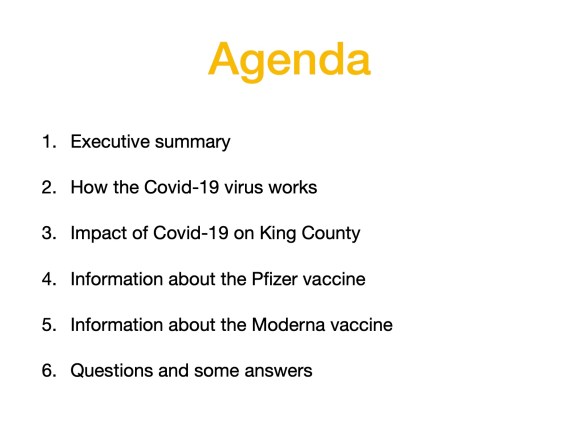
For work, I created a presentation about the current Covid-19 vaccines for a non-medical audience. Maybe you will find it helpful, too. Here’s the agenda:

… where King County refers to the county in Washington State where Seattle is located. The presentation reviews the New England Journal of Medicine paper on the vaccine from Pfizer, as well as the data Moderna shared with the FDA. (Note that I made this slide deck near the end of December, so, if you are reading this in the distant future, data included may be different.)

I usually don’t include so much text in my slides. I made an exception here, as there are nearly a thousand people working at the agency and many may not be able to watch and hear me present this live. Enjoy.

Categories
Consult-Liaison COVID-19 Systems

Protecting Mental Health During a Pandemic.

For context for this post: In my opinion, the federal government under the 45th President failed in its pandemic response. The lack of federal leadership, coordination, and interventions have led to ongoing disorganization that adversely affects every single essential worker who currently provides health care and social services.

As the federal government has not provided any coherent response to the actual disease pandemic, I do not expect that it will provide any response to the psychological suffering that has already occurred and will continue to occur due to Covid-19. Since this administration ignored the National Security Council playbook on fighting pandemics, it seems likely that they will ignore resources that describe how to boost the morale and promote the mental health of its citizens.

As I work as a psychiatrist, I wondered in the early months of the pandemic what strategies nations had used in the past to support psychological health. My hope had been to apply these nation-level strategies to the organization I work in.

The resources weren’t hard to find. There were three documents that I found helpful:

Of the three, I found the Pan American Health Organization document to be the most useful. (One wonders if U.S. officials did not deign to read something from “those” countries.) It helped me frame challenges when talking with individuals and teams. It also helped me grasp the horrifying reality and anticipate heartbreaking consequences.

… not all the psychological and social problems that occur can be described as diseases; the majority are normal reactions to an abnormal situation.

This JAMA paper describes an increase in the prevalence of depression symptoms due to the pandemic. I appreciate that the authors did not state that there has been an increase in the prevalence of major depressive disorder. The pandemic is an abnormal situation. We cannot apply our usual definitions when nothing about this year is usual.

In a major catastrophe, grieving means dealing with many other losses and implies a broader, more community-oriented feeling. It implies interrupting a life plan that not only has a family dimension, but also a social, economic, and political one.

We’ve all lost so much. Some people have lost their lives; others have lost their health and wonder if they will ever get it back. People have lost jobs and are distressed about how they will pay for rent and food. Others have lost time and wonder how they will pay attention to things other than work and disease. Kids miss their friends and classmates; parents miss things that their kids don’t realize they’re missing. The use of screens has made life more two-dimensional, though many have lost more than one dimension in their lives.

… mental health plans cannot be limited to expanding and improving the specialized services offered directly to the people affected…

There are multiple reasons for this:

  • There aren’t enough mental health professionals to serve the entire population.
  • Many (most?) people do not need specialized services; they (we) just need more support.
  • Some professionals will diagnose illness and treat accordingly, when illness may not be present. (“When you only have a hammer, everything is a nail.”)
  • Specific communities will often provide more tailored and meaningful support to their members than professionals, specifically when grief is the diagnosis and support is the treatment. (What I say to an Irish dancer may not be as helpful as the support from the rest of the Irish dance troupe.)
  • Mental health professionals should focus their specialized expertise on people who are experiencing more severe symptoms and conditions.

Can and should people with specialized expertise, like psychiatrists, teach and train laypeople to provide support to their communities during and after a pandemic? I think so. (While not related to a pandemic, the Friendship Bench is an excellent example of training laypeople to provide valuable support to others.)

There are three basic messages:
1. We should not think only in terms of psychopathology, but also in broad terms about collective problems.
2. The area of expertise of mental health professionals needs to be expanded.
3. The majority of psychosocial problems can and should be addressed by nonspecialized personnel.

Most psychiatrists, like most physicians, are trained to treat individuals. Pandemics affect populations and our individual interventions are often ineffective and do not scale. Furthermore, some interventions done without care can cause harm (“benzos for everyone!”). Collective problems require collective solutions; expertise must be decentralized and shared; community members can provide good enough, if not better, support. The Psychological first aid during Ebola virus disease outbreaks provides a useful framework for this support.

A good mass communication strategy is critical to maintaining calm and an appropriate emotional state; a well-informed population can act appropriately, protect itself better, and be less vulnerable in terms of psychosocial aspects.

The federal administration has already demonstrated no interest in a “good mass communication strategy”, whether related to Covid-19 or other events. It didn’t have to be this way.

My hope is that, as the “C.D.C. and other public health institutions awaken from their politics-induced coma,” we will see not only the execution of a federal strategy to address the Covid-19 pandemic, but also the implementation of a federal strategy to support the nation’s mental health. We’ve already witnessed psychological stumbling across the population; none of us want to see ourselves, our neighbors, our communities, and those beyond beyond fall further.

Categories
Consult-Liaison Nonfiction Reflection

Doors and Ducks.

Three people were standing outside of his apartment. His voice was muffled, though it was clear that he had no intention of opening his door. One person recrossed his arms; this group of young staff had already spent about 15 minutes trying to persuade him to open his door.

I offered to try; they obliged. In less than 60 seconds, he opened his door, showed his face, and greeted me with warmth.

Their face masks did not conceal their surprise.


This is how I did it. I:

  • read many books that describe different ways to listen and talk to people
  • watched many people (professionals and otherwise) talk to other people (patients or otherwise) and stole successful strategies
  • received and incorporated feedback from teachers who watched and listened to me talk to people
  • sat through hours of watching videotapes of myself talking to other people
  • have spent literally years talking to people who often did not want to talk to me

They didn’t see:

  • the many, many errors I have made in trying to connect with people
  • patients telling me directly how my approach was offensive and disrespectful
  • that one time someone threw a shoe at me because I wouldn’t leave him alone
  • the many times patients said nothing to me despite all my efforts to encourage them to talk to me
  • all the times I said something stupid that ruined any rapport we had
  • the times patients have yelled at me to leave because I didn’t respect their requests
  • that other time when the guy in the wheelchair literally rolled out of his room at high speed to get away from me (and I couldn’t find him anywhere on that floor in the hospital)
  • the variety of insults I have received (and will continue to receive) from people for reasons both valid and invalid

They also did not realize that:

  • luck played a large role in this outcome
  • the clinical relationship I have with him is different from the relationships they have with him (i.e., to him, I am novel)
  • I have been doing this sort of work for many more years than they have
  • I still consider everyone my teacher and continue to learn from them all
  • they can and will learn skills to achieve similar outcomes in the future

Now that winter is upon us, ducks called Barrow’s Goldeneye have arrived in Puget Sound. Sometimes a male and female swim together as an isolated pair; sometimes a flock of 10 to 20 ducks will paddle around the piers.

They look serene while gliding across the surface of Sound. We don’t see their legs and feet constantly pushing against the water.