Categories
Nonfiction Seattle

Blue of the Sky.

Photo by Johann Piber

The bus stop is at 145th Street and Aurora Avenue. There was a city bus there; if I run the two blocks fast enough, I thought, maybe I can catch it.

Then I noticed the two law enforcement vehicles, sturdy vans with red and blue lights flashing from the windows. One was parked directly in front of the bus; the other was in the driveway of a nearby storefront.

The bus remained at the stop as a third law enforcement vehicle made an assertive U-turn in the middle of the street to join the other two.

I stopped walking. I took a few steps forward, then stopped again.

“No, this doesn’t seem right… I can catch the bus at the next stop,” I muttered out loud.

It was a few minutes after 11am on Tuesday, November 8th, in the year of our Lord 2022.


There is essentially no sidewalk on the west side of Aurora Avenue. I reached the bus stop at 135th Street on Aurora; no bus was coming. I kept walking, squeezing myself between the parked cars and the businesses along the street. I had faith that a sidewalk would soon appear.

I heard the rumbling first. A bulky black box with thick treads on its large wheels approached. A man wearing a helmet and sunglasses inside the armored vehicle glanced out the open window. The red and blue lights in the front and on top of the vehicle were not on. The white “SWAT” lettering on its side gleamed in the late morning sunlight.

A few minutes later, a second armored SWAT vehicle rumbled past.

“What is happening?” I asked.


A photo of the 14-year-old was distributed to all Seattle police and an officer located the two teens on a Metro bus at North 145th Street and Aurora Avenue North at 11:02 a.m., the charges say.

Seattle Times: What prosecutors say happened at Ingraham High before the fatal shooting

I had to cut through a car dealership on Aurora because there still wasn’t a sidewalk. Despite the sun floating in the blue of the sky, I put the black beanie back on my head. Underneath my black wool winter coat was a black puffer jacket; a grey scarf was knotted around my neck. I continued to look for a sidewalk. I was apparently unwilling to cross the street.

The young women already knew that there is no sidewalk on Aurora, so they stood in the street. Their hands, adorned with colorful fingernails, tossed their shiny, long hair over their shoulders. Their shorts and skirts stopped just past the curvature of their hips, exposing the bare skin of their legs to the gaze of drivers and the cold morning air. The cropped jackets covered their arms, but not their cleavage. Their eyelashes looked like small, dark butterflies on their cheeks. Shades of red, pink, and purple were on their lips.

They weren’t yet waving at cars passing by.

One of them waved at me as I approached and called, “Hey!”

We made eye contact; she grinned. “What do you call those big cats that live in the hills?”

I reflexively smiled back at her, though did not stop walking. “Mountain lions?” I guessed.

Her rosy lips bloomed into a satisfied smile. She nodded, pointed at me, and said, “I like that.”

I shrugged and kept walking. I wished she and her peers weren’t standing out there. I wondered what their circumstances were. I prayed for their health and safety. I thought about why she asked me this peculiar question. (I only learned about REST, real escape from sex trafficking, after this conversation.)

I continued to look for a sidewalk.


About a week later, I boarded the light rail at the most northern stop. It was another sunny and cold day.

Many young people were on the train. Some of them had signs. I couldn’t read all of them; I spied one that was upside down that included the word “GUNS”.

They poured out of the train at Pioneer Square. Many of them had traveled over 130 blocks to join other students at Seattle City Hall to

[call] for better mental health support, more restrictions on gun access and more training for security staff in the wake of a shooting Tuesday at Ingraham High that left one student dead.

Seattle Times: At rally, Seattle students demand more mental health resources, gun safety measures

I looked up, shielded my eyes from the sun, and squinted at the blue of the sky, white of the snow, and grey of the mountains.

Categories
Informal-curriculum Medicine Reading Systems

Recent Readings.

Stack of read newspapers.
Photo by brotiN biswaS

On medicine being agents of social control. These three news articles highlight the misuse of authority within the context of medicine:

Delta ‘weaponized’ mental health rules against a pilot. She fought back. In short, a woman named Karlene Petitt was (and remains) a pilot for Delta airlines. In response to a general exhortation from Delta leadership to speak up about safety issues, she submitted reports that did just that. In return, Delta leadership sought to silence her and initiated a process to deem her “too mentally unstable” to be a pilot. Delta recruited a psychiatrist who provided a diagnosis to support this argument. (The psychiatrist apparently diagnosed her with bipolar disorder because of her many accomplishments—“well beyond what any woman [he’s] ever met could do”.) She contested this and took legal action. She won.

How a Chinese Doctor Who Warned of Covid-19 Spent His Final Days. This 16-minute video investigation includes remarks from a physician who provided care to Dr. Li Wenliang, the ophthalmologist in China who tried to alert the public about Covid-19 before he died from the infection himself. Around minute 11 of the video, both the narrator and the physician comment that hospital administrators wanted the health care team to provide an intervention (ECMO) that was not clinically indicated. However, it would buy the hospital administrators time and allow the hospital to report that the health care team “did everything”. The physician states that using ECMO would have been both a violation of medical care and medical ethics. This is an example of “reputation management” superseding clinical judgment.

Woman’s legal quest illuminates the rights of hospital patients who want to leave. Here, a woman voluntarily agreed to enter a psychiatric hospital for care, but was not permitted to leave upon request. Available documentation suggests that she was not at risk of harming herself or others at the time of her request to leave. Under these circumstances, that means the hospital was essentially holding her captive. (This is reminiscent of “On Being Sane in Insane Places“, where context affects how we evaluate situations.) Even worse:

“All patients admitted to the facility,” the manager said, meet the criteria to be involuntarily committed, “even voluntarily admitted patients.”

The manager told DOH investigators that staff “do not orally notify voluntary patients” of their right to be released immediately, despite a state law requiring this disclosure. If they did, he said, “Everybody would be asking to leave.”

Those two short paragraphs reflect poorly on the hospital in question.

On the death penalty. The first two articles present opposing perspectives on the death penalty. The third article provides a first-person account of being in prison, which adds context to the first two articles.

If Not the Parkland Shooter, Who Is the Death Penalty For? Here, the author describes justifications for punishment:

Society embraces four major justifications for punishment: deterrence, rehabilitation, incapacitation and retribution.

I’ve not seen it described this way and appreciate the framework. This might be a red herring: The author also argues that the Parkland shooter’s “human dignity requires his just punishment [with the death penalty] as an end in itself”. I struggled to wrap my head around this one: We usually cite people’s humanity and dignity as reasons to keep them alive, not to kill them.

I Wish the Jury Had Not Sentenced My Family’s Killer to Death. In contrast, the author here argues how the death penalty, while maybe just, doesn’t actually solve any problems. It instead only prolongs suffering for the families of victims. Also, “death by incarceration” is still death. (I also appreciated her firm recommendations about how to support people who experience unspeakable tragedies.) While the author of the previous pro-death penalty piece focuses more on theory and logic, the author here focuses more on practicalities and emotions. Both models have value. Both articles made me consider my own stance on the death penalty.

Prisoners Like Me Are Being Held Hostage to Price Hikes. The author of this piece is currently in prison. Though I have never worked in prison, I have worked in jail. His descriptions about commissaries, food items, and access to various items seem similar to what I have observed in jail settings. (It also continues to baffle me how businesses are allowed to make money off of people in jail—including medical care!!!) Nobody is spared from inflation and price hikes.

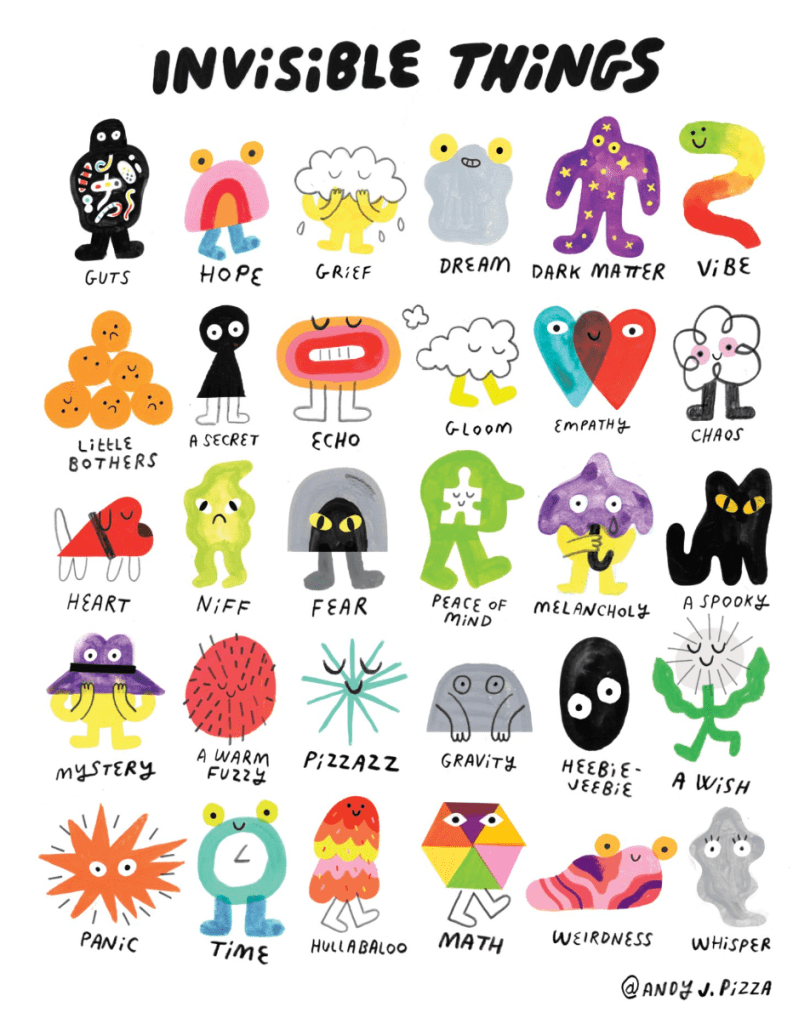
To end this on a lighter note: This artwork from Andy J. Pizza made me feel a variety of invisible things:

Categories
Consult-Liaison Nonfiction Public health psychiatry Seattle

Constraining Choice Sets.

The rains have finally returned to Seattle, though the wildfires continue to burn:

Wildfires from Google Maps as of the morning of 2022 Oct 24.

That map does not include the entirety of Washington State (there are more fires outside the boundaries of that image), or the fires burning in neighboring Idaho and Oregon.

While we did not experience the blood red skies that San Francisco experienced from the wildfires of the summer of 2020, the air was looked and smelled thick. Each whiff contained fragrant notes of Douglas Fir and perhaps Western Red Cedar, all overwhelmed by charred carbon. Landmarks disappeared into a gritty haze of grey. The evenings featured a crimson sun sinking into ashy layers of peach, pink, and coral.

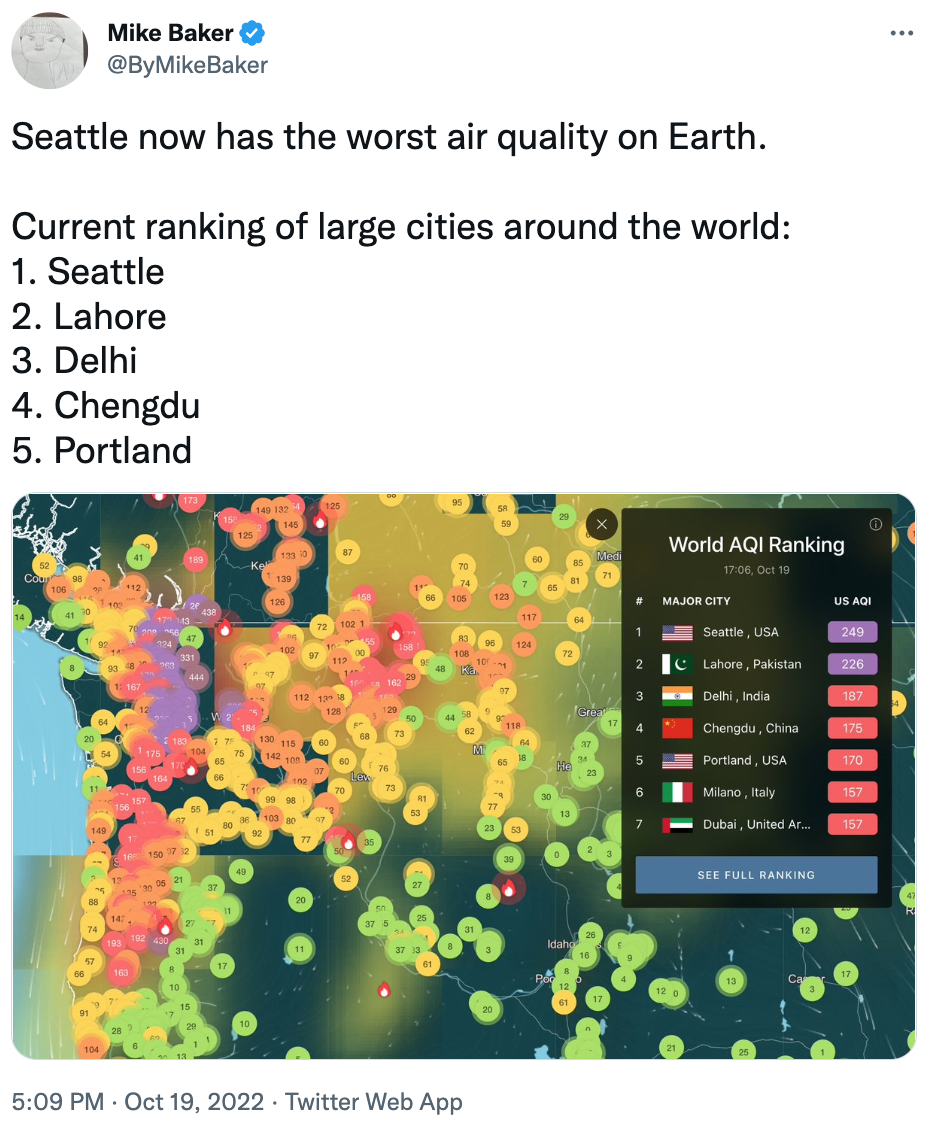
By October 19th, Seattle had the worst air quality on the planet:

Conditions did not improve the next day. The Space Needle has a webcam (more precisely a “panocam”, as it provides a 360-degree view). Go take a look at it now; this is the grey pall that we embrace for much of the year. Despite this pewter drape, one can still see the surrounding buildings, lakes, and trees. Compare this to the view on October 20th:

(“Is the Mountain Out?” refers to glorious Mt. Rainier, the 14,410-foot tall stratovolcano that looms over the region.)

The rain finally arrived on October 21 and displaced the smoke:

Unfortunately, it did not extinguish the wildfires. Our neighbors to the east have yet to escape the smoke.

In addition to headaches, congestion, and watery eyes, people also experience psychological effects due to wildfires. I came across this paper in Nature Human Behavior from July 2022 that reports on one aspect of this: Exposures and behavioural responses to wildfire smoke (no paywall as of this writing). While the paper doesn’t quite answer the question I want to answer, it did report:

… during large wildfire smoke events, individuals in wealthy locations increasingly search for information about air quality and health protection, stay at home more and are unhappier. Residents of lower-income neighbourhoods exhibit similar patterns in searches for air quality information but not for health protection, spend less time at home and have more muted sentiment responses.

(For those who consider how your digital data gets used, the data for this paper came from Twitter, Google searches, and a real-time air quality monitor called PurpleAir, along with geographic income data.)

As we also have seen during the pandemic, people with lower incomes have less choices, even if they have access to similar information (emphasis mine):

Why do wealthier locations respond differently to smoke exposure? The measured differences do not appear to reflect differences in exposure information or in overall internet activity, given the consistent response of air-quality-related searches across income groups. Rather, the responses are consistent with lower incomes constraining choice sets and behaviours, including less flexibility in working from home, fewer resources with which to consider purchasing protective technology and (regarding the sentiment results) having other more pressing matters to worry about.

The Seattle Times published an article on October 20th that highlighted “constraining choice sets”. The King County Regional Homelessness Authority opened a “smoke shelter“, though few people used it. Why?

“The long-term effects of breathing in smoke is not going to be like the most highest of priority,” said an outreach worker. This is consistent with the findings from the article: While people living outside may have access to the internet, they likely are not seeking air quality monitors or information about filtration, as they do not have their own windows to close or own spaces to filter.

One of the conclusions of the article about wildfires could very well be applied to the pandemic: a “policy approach of promoting private provision of protection could be biased against disadvantaged groups”. I also suspect that the unhappiness the wealthier respondents reported as a result of wildfire smoke is not dissimilar from the ongoing unhappiness we all are seeing as a result of the pandemic and its social consequences. (It is likely that people who are poor are also experiencing unhappiness; they simply may not have the time, energy, or resources to feel it.)

Categories
Consult-Liaison Observations

Floating and Sinking Boats.

Photo by Pixabay

I recently gave a presentation called “Difficult Interactions in Clinical Settings” and, in that talk, made a comment about how, in Western medicine, we often focus on the Physical Thing and do not attend to the Psychological Things. Physical Things often affect Psychological Things (and vice versa) and sometimes the Psychological Things cause more distress than the Physical Thing.

This is one reason why some (many?) people don’t like to take medicine, even for chronic conditions that will get worse without treatment. This is especially true when people have limited to no symptoms. If people hold the idea that they are healthy, the act of taking medicine is a direct contradiction to this idea. If you are sick, then why do you feel fine? does that mean that your illness might get worse? that you might die from this illness? This fear—this Psychological Thing—is compelling enough to chase people away from health care of any flavor: If no one tells me that there is something wrong with me, then there is nothing wrong with me. (Even this framing of “wrong” is interesting: Is illness “wrong”?)

Psychological Things often drive behavior, though the engine might seem like a tangible, Physical Thing, like money or power. We also rarely escape our own Psychological Things, even if we are able to name it, greet it warmly, and understand how it makes things difficult for us. (“Insight alone does not result in behavior change.”)

Sometimes, when we cannot escape our own Psychological Things, our inability to face and embrace these Things spills out for the rest of the world to see. Sometimes this makes us write 14-page letters.

Relationships, specifically those involving platonic or romantic love, while meaningful and rewarding, can also be challenging. It requires spending time and energy considering what floats your boat, as well as what floats the other person’s boat. It is hard to think about what floats someone else’s boat when your boat feels like it is constantly sinking.

Sometimes things will happen, though, that bring buoyancy to your boat, things that are immediate, measurable, and seemingly indisputable. Thousands of people chanting in a national park? Millions of ballots with notations next to your name? A chart with ratings from a television program? These are concrete, Physical Things.

Consider the fuzzy factors in Psychological Things: How amorphous they are! How much do you love your children? Is your spouse actually devoted to you? How do you know that your friends actually care about you? None of these are iron anchors that will bring you confidence in who or where you are; they are unreliable, invisible winds that you cannot control. The winds might help you, but they might also strand you.

The boat seems to sink faster when you lack esteem and respect for yourself. When you are uncertain about who you are and your status among people, how are you supposed to trust and respect uncertain forces like the wind?

Power and authority confer Physical Things, but these Physical Things cannot fill the gaping wound(s) left behind from the Psychological Things.

Who are you if you don’t have a title? Do you exist if no one is paying attention to you? What is your identity if no one tells you who you are?

How do you tolerate silence? What are your thoughts when you are by yourself? What if you can’t tolerate your own thoughts about yourself?

(Who are you between your thoughts?)

Maybe write a letter. Letters and words and sentences on paper are Physical Things. Letters are immediate, measurable, and seemingly indisputable. Make them see and respect you when you can’t see and respect yourself. When they react, you might know that you still exist, that your boat is still afloat.

Categories
Consult-Liaison Education Observations

Racial Slurs and Psychiatric Illness.

Photo by Mary Jane Duford

It doesn’t happen often, but it does happen: People have directed racial or misogynist slurs at me. (I’m an equal opportunity target!) When they announce their perspectives, they are almost always shouting and their tones of voice suggest anger and disgust.

Rarely do people with psychiatric conditions, such as schizophrenia or bipolar disorder, express displeasure with my race or sex. I can only think of three examples when this occurred (though, to be fair, I just don’t remember the other times when this has happened):

  • A woman in a crisis center who insisted that I was Bruce Lee’s sister, then proceeded to scream, “Chink!“, when I told her I was not;
  • A man with dementia in a hospital who felt compelled to tell me (and only me) in a loud voice about the “gooks” he killed during war; and
  • A man in a jail cell in psychiatric housing who, upon seeing me walk onto the unit, made loud comments about “fucking dykes with short hair“.

It is far more common for people out in the community to shout racial and misogynistic slurs to me in passing. Sometimes their apparel is shabby and soiled; more often, their clothes are clean and their cars are shiny.

My data comes from an N of 1, but this is how I think about it: Yes, it is possible for someone with a psychiatric condition to use speech brimming with prejudice only when they are experiencing acute symptoms. However, most people with psychiatric conditions, in my anecdotal experience, do not, regardless of acute or chronic psychiatric symptoms. If they do have prejudices, they are able to keep them to themselves, even when they are unable to contain any delusions. If they are expressing ideas about people, they tend to be specific to how an individual relates to them (e.g., that person is trying to kill me; that person knows I don’t have internal organs; those people can hear my thoughts; etc.).

Could it be that the use of racial slurs in of itself reflects mental illness? I don’t think so. Humans are adept at creating and using categories. We have all created and applied useless categories. For example, I am on Team Candy Corn. This team serves no purpose and it should not be a point of pride, but here we are. There is, of course, a difference between Team Candy Corn and Team Nazis, though the underlying principle of creating categories and then putting people into them is the same. (On Team Candy Corn, we do not hate and dehumanize.)

People with psychiatric conditions like schizophrenia, like most other people, can feel hate. People with psychiatric conditions like schizophrenia, like most other people, are not hateful.