Categories
Consult-Liaison Education

On the Emotion of Anger.

I have no idea if the vicissitudes of life at this moment are more challenging than times past. Perhaps the intensity and quality of suffering in humanity remains unchanged, but now, due to technology and the increased breadth of our situational awareness, we are simply more aware of the degree and scale of human suffering. Our ancestors had no way of knowing as much as we do now.

(Humans, though, have suffered individual and local tragedies for as long as we have existed. Sometimes—often?—these individual tragedies induce greater suffering than we can ever imagine. Consider the parent whose spouse and child have both died. Surely deaths from disease and war affect this person, too, but how do those compare to the indescribable grief and heartbreak from the loss of kin? I don’t know. Someone out there does know. For them, I wish them peace, even if this wish is functionally just a spindly raft in a deep sea of sorrow.)

The range of human emotions is vast. In American culture, certain emotions are more acceptable than others. (This is likely true across all cultures.) And perhaps I should be more precise here: American culture tolerates the expression of certain emotions more than others. For example, American culture is intolerant of men weeping for any reason. We have been conditioned to consider that men who are crying—even for the most valid of reasons—are weak, incompetent, and incapable.

These social norms influence the individual and shape our behavior. If society cannot tolerate my tears, then I will do what I can to avoid crying. This can involve psychological acrobatics to avoid feeling the emotion that induces crying.

The problem is that emotions serve a function. Emotions give us information about the people we are around, the situations we are in, and what matters to us. They help us choose and express our behaviors, even if some of these choices don’t happen entirely consciously.

There’s a concept called “secondary emotions”, which are emotions we feel (and then express) as a result of other emotions. Some examples will help clarify this. (The emotion of anger—and we see so much anger these days—is what prompted this post, so I will use anger in these examples.)

American culture often discourages women from expressing anger. Women who express anger are often called “bitches”, even if their anger is justified. The (antiquated?) phrase “resting bitch face” illustrates this: That woman isn’t really an angry “bitch”, that’s just her face. If a woman feels and expresses the primary emotion of anger, she may then quickly feel and express the secondary emotion of guilt: “I shouldn’t feel anger; it makes me seem like I’m not a nice person. But I want to be a nice person. But maybe I’m not a nice person because nice people don’t get angry like this. So maybe I’m a terrible person. Oh no.” Society is more accepting of a woman’s deferential behavior that may follow. (Those familiar with CBT will recognize black-and-white thinking happening here.)

Similarly, American culture discourages men from expressing sadness. Our culture instead tolerates men expressing anger. Thus, men may actually feel a primary emotion of sadness, but the secondary emotion is anger. Maybe they express anger to counteract their perceived “weakness” for feeling sadness. Maybe they express anger because they know, whether consciously or not, that they are less likely to get want (including respect) if they express sadness.

Anger is also an activating emotion. Recall that emotions can and do drive behavior. When feeling sad, people are generally more likely to withdraw and isolate. Some people who feel sad will reach out to others for support, but sadness usually pulls people inward. When feeling angry, people are generally more likely to do something and take initiative. Feeling angry makes people feel more powerful.

Consider someone stomping down a hallway and throwing open a door while exiting. This behavior may seem like a withdrawal from people, but they busted out the door. Such a behavior requires initiative and energy, and often benefits from an audience. We turn our heads when we see someone storm out of a building while muttering profanity; we don’t when someone slips out the back door in tears.

There is little utility in denying our emotions. You feel what you feel. Sometimes, though, we resist feeling the primary, foundational emotion, maybe one that is too tender for us to acknowledge. It forces questions to the surface that we may not want to answer: What does it mean if I am unwilling or unable to feel sad? What would I discover if I sat with my anger and felt its sharp, jagged edges? What would I learn about myself if I explored this contempt? What things would I have to change about myself if I understood that there is something soft and vulnerable under this rage?

Categories
Consult-Liaison Homelessness Public health psychiatry Systems

On “Involuntarily Removing Mentally Ill People from Streets”.

Photo by Mart Production

There’s been buzz about the report of New York City to Involuntarily Remove Mentally Ill People From Streets. The comments section of the article as well as letters to the editor articulate the complexities around this issue. I also appreciate that the New York Times solicited perspectives from people experiencing homelessness themselves.

In trying to think through this myself, I turn to two mental models: First, what problem are “we” trying to solve? Second, can health care ethics provide guidance here?

What problem are “we” trying to solve? This requires reading the mind of New York City Mayor Eric Adams, which I cannot do. He has argued that The Royal We have a “moral obligation” to solve the problem of “assist[ing] those who are suffering from mental illness”. If we take him at his word, then we can fold his argument within the framework of medical ethics.

If, however, Mayor Adams is trying to solve a different problem (e.g., make homelessness invisible; reduce the number of complaints from the public about people exhibiting unusual or dangerous behaviors; demonstrate that he is “doing something” about homelessness, etc.), then the framework of medical ethics may not apply. If he is trying to solve a different problem, then instead of assisting those who suffer from mental illness, he is using those who suffer from mental illness to assist him and his actual agenda.

Of course, he may be trying to solve multiple problems through the guise of only one.

Can health care (or medical) ethics provide guidance here? One model used in medical ethics is called the four box model. Of note, the four boxes focuses on individual patients, not on populations of people.


Medical Indications
(Beneficence and Nonmaleficence)
Patient Preferences
(Respect for Autonomy)

Quality of Life
(Beneficence, Nonmaleficence,
and Respect for Autonomy)

Contextual Features
(Justice and Fairness)

Medical indications asks what benefits and harms the patient might experience from interventions. Would involuntary psychiatric hospitalization help people with mental illness who are homeless? Some of them, yes. Would it help all of them? Maybe, maybe not. Could involuntary psychiatric hospitalization cause harm? That is not the intention, but sometimes it does. For reasons valid and invalid, it might discourage people from engaging in psychiatric services ever again. Anything involuntary always involves some degree of coercion, which people generally dislike.

Just because people are behaving in unusual ways and are living outside does not mean that psychiatric hospitalization is guaranteed to “fix” them. I do not mean to diminish the care people receive in psychiatric hospitals. People often need more than involuntary psychiatric hospitalization to get and stay well. Sometimes there is no medical indication for psychiatric hospitalization (involuntary or otherwise) for people with mental illness who are experiencing homelessness. Sometimes they just need a stable place to live.

Patient preferences refers to the dignity and choices people should have in living their lives. Some people would rather take pills by mouth every day than receive a monthly injection of medicine. Some people would prefer not to take any medicine at all. Patient preferences matter.

Some people who are living outside and behaving in unusual ways may not want to be in a hospital. Or maybe they are willing to be in a hospital, but not at that moment—maybe they have other things to take care of that day. Or maybe they are only willing to go to certain hospitals on their own, not at the behest of law enforcement. By definition, involuntary removal of people from the streets disregards patient preferences. Options other than psychiatric hospitalization, such as crisis centers, partial hospital programs, or day programs, can help preserve patient preferences and hence their dignity.

Quality of life describes the patient’s quality of life. Interventions should provide benefit, minimize harm, and maximize the dignity and choices of patients. This does not refer to the quality of life of the general public. If involuntary removal and psychiatric hospitalization are the means to the end of improved quality of life, how can these improvements be sustained following hospitalization?

It is absolutely true that psychiatric hospitalization can be life-saving and life-improving. However, people need and benefit from ongoing care and services following hospitalization. Mayor Adams’s target population also need places to live to maintain their gains. If you’ve ever been hospitalized for any reason, can you imagine the course of your recovery if you had no place to go upon leaving the hospital? How are you supposed to rest when you don’t know where you will sleep that night? Quality of life requires planning and sustained care; acute interventions alone rarely produce improvements in quality of life.

Contextual features are the intersections of a patient’s care with the rest of the world. There are a multitude of contextual features in Mayor Adams’s plan (and it makes me wonder if the mayor consulted with any partners prior to making his announcement). Here are a smattering of contextual features that come to my mind:

  • How will first responders decide if someone has a mental illness? What if they think someone has an “attitude problem” and instead refers them to jail? How severe do psychiatric symptoms have to be? Will only those who attract the attention of law enforcement be involuntarily removed? (What about the elderly woman who keeps to herself and has been homeless for decades and won’t move indoors because the voices tell her that she will die if she does?)
  • How will hospital psychiatrists react to people who, in their professional opinion, do not need hospital-level care, though the law argues otherwise? Will psychiatrists become agents of social control on behalf of the jurisdiction? There are some parallels here to the overturning of Roe v. Wade: Some gynecologists are not performing abortions, even though there are medical indications to do so, because of the law. Here, psychiatrists may proceed with involuntary treatment even though there are no medical indications to do so… because of the law.
  • Let’s say someone experiencing homelessness is involuntarily removed from the street and is psychiatrically hospitalized. Where will they go upon discharge? What if they prefer returning to the street instead of a shelter? What if they have no sources of income and there is insufficient affordable housing? (This is not actually a “what if” question.)
  • What about all the people who are homeless, but do not demonstrate symptoms of mental illness? Are there any opportunities to prevent or reduce the chances of mental illness in this population? (Yes, by increasing access to stable housing.)
  • What about all the people with severe mental illness who are not homeless? Are there any opportunities to prevent or reduce the chances of homelessness in this population? (Yes, by increasing access to and flexibility of psychiatric services.)

The four box model here highlights some ethical problems with Mayor Adams’s plan, though there are solutions to increase beneficence, autonomy, and justice while reducing non-maleficence. My hope is that Mayor Adams and leaders of other jurisdictions with similar ideas will take heed.

Categories
Consult-Liaison Nonfiction Public health psychiatry Seattle

Constraining Choice Sets.

The rains have finally returned to Seattle, though the wildfires continue to burn:

Wildfires from Google Maps as of the morning of 2022 Oct 24.

That map does not include the entirety of Washington State (there are more fires outside the boundaries of that image), or the fires burning in neighboring Idaho and Oregon.

While we did not experience the blood red skies that San Francisco experienced from the wildfires of the summer of 2020, the air was looked and smelled thick. Each whiff contained fragrant notes of Douglas Fir and perhaps Western Red Cedar, all overwhelmed by charred carbon. Landmarks disappeared into a gritty haze of grey. The evenings featured a crimson sun sinking into ashy layers of peach, pink, and coral.

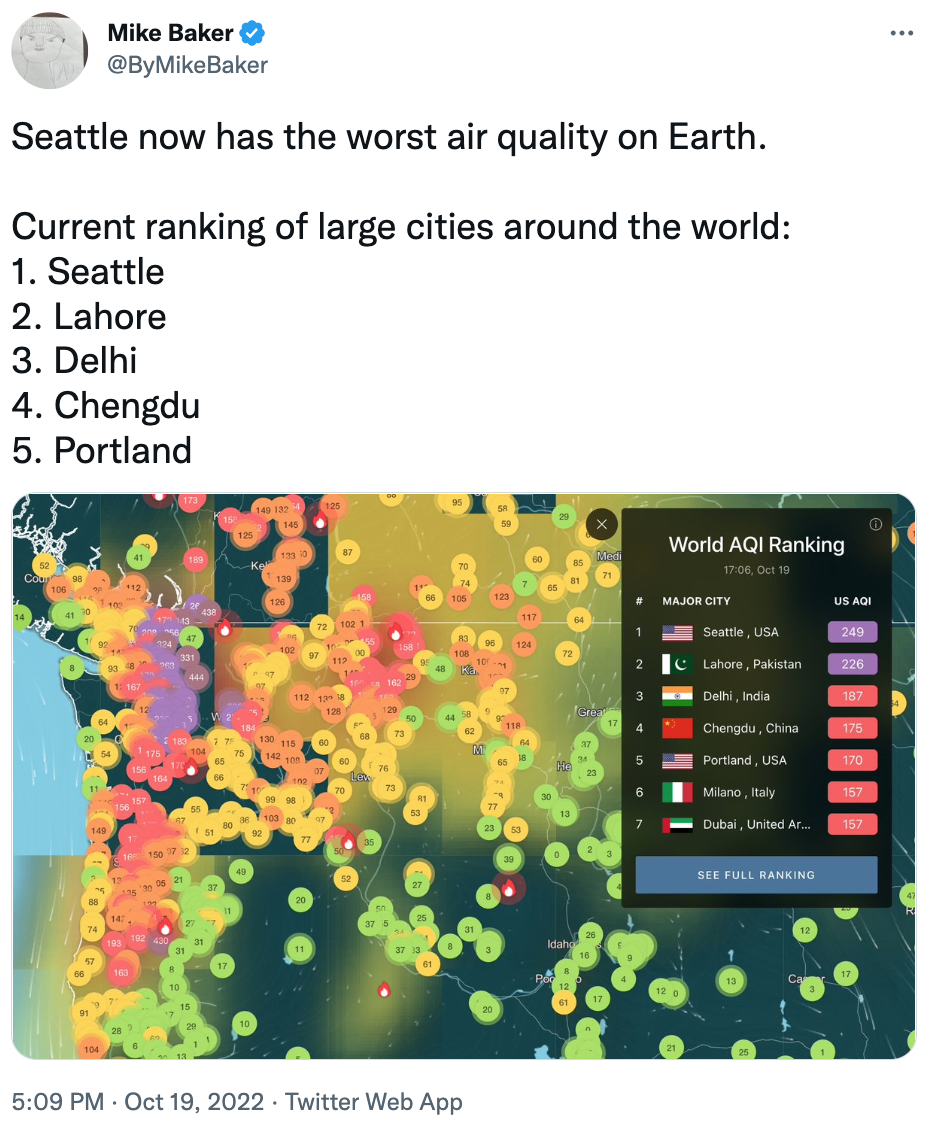
By October 19th, Seattle had the worst air quality on the planet:

Conditions did not improve the next day. The Space Needle has a webcam (more precisely a “panocam”, as it provides a 360-degree view). Go take a look at it now; this is the grey pall that we embrace for much of the year. Despite this pewter drape, one can still see the surrounding buildings, lakes, and trees. Compare this to the view on October 20th:

(“Is the Mountain Out?” refers to glorious Mt. Rainier, the 14,410-foot tall stratovolcano that looms over the region.)

The rain finally arrived on October 21 and displaced the smoke:

Unfortunately, it did not extinguish the wildfires. Our neighbors to the east have yet to escape the smoke.

In addition to headaches, congestion, and watery eyes, people also experience psychological effects due to wildfires. I came across this paper in Nature Human Behavior from July 2022 that reports on one aspect of this: Exposures and behavioural responses to wildfire smoke (no paywall as of this writing). While the paper doesn’t quite answer the question I want to answer, it did report:

… during large wildfire smoke events, individuals in wealthy locations increasingly search for information about air quality and health protection, stay at home more and are unhappier. Residents of lower-income neighbourhoods exhibit similar patterns in searches for air quality information but not for health protection, spend less time at home and have more muted sentiment responses.

(For those who consider how your digital data gets used, the data for this paper came from Twitter, Google searches, and a real-time air quality monitor called PurpleAir, along with geographic income data.)

As we also have seen during the pandemic, people with lower incomes have less choices, even if they have access to similar information (emphasis mine):

Why do wealthier locations respond differently to smoke exposure? The measured differences do not appear to reflect differences in exposure information or in overall internet activity, given the consistent response of air-quality-related searches across income groups. Rather, the responses are consistent with lower incomes constraining choice sets and behaviours, including less flexibility in working from home, fewer resources with which to consider purchasing protective technology and (regarding the sentiment results) having other more pressing matters to worry about.

The Seattle Times published an article on October 20th that highlighted “constraining choice sets”. The King County Regional Homelessness Authority opened a “smoke shelter“, though few people used it. Why?

“The long-term effects of breathing in smoke is not going to be like the most highest of priority,” said an outreach worker. This is consistent with the findings from the article: While people living outside may have access to the internet, they likely are not seeking air quality monitors or information about filtration, as they do not have their own windows to close or own spaces to filter.

One of the conclusions of the article about wildfires could very well be applied to the pandemic: a “policy approach of promoting private provision of protection could be biased against disadvantaged groups”. I also suspect that the unhappiness the wealthier respondents reported as a result of wildfire smoke is not dissimilar from the ongoing unhappiness we all are seeing as a result of the pandemic and its social consequences. (It is likely that people who are poor are also experiencing unhappiness; they simply may not have the time, energy, or resources to feel it.)

Categories
Consult-Liaison Observations

Floating and Sinking Boats.

Photo by Pixabay

I recently gave a presentation called “Difficult Interactions in Clinical Settings” and, in that talk, made a comment about how, in Western medicine, we often focus on the Physical Thing and do not attend to the Psychological Things. Physical Things often affect Psychological Things (and vice versa) and sometimes the Psychological Things cause more distress than the Physical Thing.

This is one reason why some (many?) people don’t like to take medicine, even for chronic conditions that will get worse without treatment. This is especially true when people have limited to no symptoms. If people hold the idea that they are healthy, the act of taking medicine is a direct contradiction to this idea. If you are sick, then why do you feel fine? does that mean that your illness might get worse? that you might die from this illness? This fear—this Psychological Thing—is compelling enough to chase people away from health care of any flavor: If no one tells me that there is something wrong with me, then there is nothing wrong with me. (Even this framing of “wrong” is interesting: Is illness “wrong”?)

Psychological Things often drive behavior, though the engine might seem like a tangible, Physical Thing, like money or power. We also rarely escape our own Psychological Things, even if we are able to name it, greet it warmly, and understand how it makes things difficult for us. (“Insight alone does not result in behavior change.”)

Sometimes, when we cannot escape our own Psychological Things, our inability to face and embrace these Things spills out for the rest of the world to see. Sometimes this makes us write 14-page letters.

Relationships, specifically those involving platonic or romantic love, while meaningful and rewarding, can also be challenging. It requires spending time and energy considering what floats your boat, as well as what floats the other person’s boat. It is hard to think about what floats someone else’s boat when your boat feels like it is constantly sinking.

Sometimes things will happen, though, that bring buoyancy to your boat, things that are immediate, measurable, and seemingly indisputable. Thousands of people chanting in a national park? Millions of ballots with notations next to your name? A chart with ratings from a television program? These are concrete, Physical Things.

Consider the fuzzy factors in Psychological Things: How amorphous they are! How much do you love your children? Is your spouse actually devoted to you? How do you know that your friends actually care about you? None of these are iron anchors that will bring you confidence in who or where you are; they are unreliable, invisible winds that you cannot control. The winds might help you, but they might also strand you.

The boat seems to sink faster when you lack esteem and respect for yourself. When you are uncertain about who you are and your status among people, how are you supposed to trust and respect uncertain forces like the wind?

Power and authority confer Physical Things, but these Physical Things cannot fill the gaping wound(s) left behind from the Psychological Things.

Who are you if you don’t have a title? Do you exist if no one is paying attention to you? What is your identity if no one tells you who you are?

How do you tolerate silence? What are your thoughts when you are by yourself? What if you can’t tolerate your own thoughts about yourself?

(Who are you between your thoughts?)

Maybe write a letter. Letters and words and sentences on paper are Physical Things. Letters are immediate, measurable, and seemingly indisputable. Make them see and respect you when you can’t see and respect yourself. When they react, you might know that you still exist, that your boat is still afloat.

Categories
Consult-Liaison Education Observations

Racial Slurs and Psychiatric Illness.

Photo by Mary Jane Duford

It doesn’t happen often, but it does happen: People have directed racial or misogynist slurs at me. (I’m an equal opportunity target!) When they announce their perspectives, they are almost always shouting and their tones of voice suggest anger and disgust.

Rarely do people with psychiatric conditions, such as schizophrenia or bipolar disorder, express displeasure with my race or sex. I can only think of three examples when this occurred (though, to be fair, I just don’t remember the other times when this has happened):

  • A woman in a crisis center who insisted that I was Bruce Lee’s sister, then proceeded to scream, “Chink!“, when I told her I was not;
  • A man with dementia in a hospital who felt compelled to tell me (and only me) in a loud voice about the “gooks” he killed during war; and
  • A man in a jail cell in psychiatric housing who, upon seeing me walk onto the unit, made loud comments about “fucking dykes with short hair“.

It is far more common for people out in the community to shout racial and misogynistic slurs to me in passing. Sometimes their apparel is shabby and soiled; more often, their clothes are clean and their cars are shiny.

My data comes from an N of 1, but this is how I think about it: Yes, it is possible for someone with a psychiatric condition to use speech brimming with prejudice only when they are experiencing acute symptoms. However, most people with psychiatric conditions, in my anecdotal experience, do not, regardless of acute or chronic psychiatric symptoms. If they do have prejudices, they are able to keep them to themselves, even when they are unable to contain any delusions. If they are expressing ideas about people, they tend to be specific to how an individual relates to them (e.g., that person is trying to kill me; that person knows I don’t have internal organs; those people can hear my thoughts; etc.).

Could it be that the use of racial slurs in of itself reflects mental illness? I don’t think so. Humans are adept at creating and using categories. We have all created and applied useless categories. For example, I am on Team Candy Corn. This team serves no purpose and it should not be a point of pride, but here we are. There is, of course, a difference between Team Candy Corn and Team Nazis, though the underlying principle of creating categories and then putting people into them is the same. (On Team Candy Corn, we do not hate and dehumanize.)

People with psychiatric conditions like schizophrenia, like most other people, can feel hate. People with psychiatric conditions like schizophrenia, like most other people, are not hateful.