Categories
Lessons Nonfiction

Thanks, Speedy Old Man.

When I lived in New York, my then boyfriend and I ran races with the New York Road Runners. Boyfriend was a much faster runner than me, but, given the literal thousands of other runners in each race, there were always people faster than him… including an elderly man.

One of the people who consistently finished ahead of Boyfriend was a man who was 30 years older than him! We’ll call this person Speedy Old Man. Sometimes Boyfriend was quick enough to finish seconds behind Speedy (Old Man), so we eventually learned what he looked like. (To be fair, this wasn’t hard: The wrinkles in Speedy’s skin and his thinning white hair exposed his geriatric status.) Speedy became both a target and an inspiration: Could Boyfriend outrun Speedy this time? (No.) Or next time? (No.)

We automatically started checking Speedy’s race times after looking up our own. Speedy ran a lot of races! He was nearly always the fastest person in his age group! (Can you believe that he had competitors???) What a marvel: Speedy was prolific, persistent, and a paragon of successful aging.

In addition to leaving us in the dust, he left us feeling inspired.

Boyfriend became Husband, and then we moved out of New York. Despite living on opposite coasts, we still thought of Speedy whenever the New York City Marathon made the news or when the YouTube algorithm introduced us to elderly athletes.

We recently watched elite international runners race the rainy New York City 5th Avenue Mile. (The winner of the men’s race finished the mile in less than 3 minutes and 48 seconds!) This made us wonder about Speedy: Was he still running? (Was he still alive?)

The New York Road Runners race archive revealed that his last race was in early 2020. He was in his mid-80s! His age group ranged from 80 to 99 years old; he placed 3rd at a pace of about 12 minutes per mile! Incredible.

But what happened? There have been races since early 2020, but many other things had happened since then. Was he still running? (Was he still alive?)

After some sleuthing, I found his e-mail address and, pushing my reluctance aside, pressed send after writing this note:

My name is Maria Yang and I live in Seattle, Washington. I am writing to thank you for inspiring my husband and me.

We’ve never met, but my husband and I have “known” you since 2008 or so. At that time, he and I lived in New York City and routinely ran in NYRR races. My then boyfriend and now husband was consistently impressed / playfully irked that you consistently beat him in NYRR races, given the 30+ years of difference in age. 

Since then, both in New York and since moving to Seattle, we have periodically thought of you. We enjoyed the idea that you were still running and inspiring people of all ages with your running and speed.

Today we watched the NYC Fifth Avenue Mile race on YouTube, which made us think of you again. We looked up your results on the NYRR results page (sorry that this is creepy behavior; we also found your e-mail address here) and were amazed with your results from your races in 2019 and 2020. We hope that we ourselves will still be running and racing when we are in our 80s. 

We hope that you and yours remain healthy and well. Thank you for offering a valuable perspective on successful aging and for the inspiration you offer to runners of all ages and abilities. Your influence is transcontinental! 

No automated e-mail bounced back to tell me that the address no longer existed. I released any expectations of a response–I just wanted to thank him.


I squeaked when I saw Speedy’s name in my mailbox. Two days had passed and he had sent a response!

Maria: Thank you for your email. Although I can no longer run, I do aerobics and strength training as much as I can. I believe that this has really helped me in my life. My last race was a 5K [in early] 2020. Although I was in the last corral and finished behind almost everyone else, I really enjoyed doing it. Speedy Old Man

He wasn’t running, but he was still alive! And was willing to respond to a stranger on the internet!

I immediately forwarded this to Husband and, when we saw each other later that day, we beamed. What a gift.


One of the later reactions I had to Speedy’s e-mail was sadness and anger. I don’t know why he can no longer run, but it seems likely that the pandemic was a contributor. Maybe he got infected with Covid in 2020. Maybe he became ill with something else and couldn’t access medical care because of the pandemic. Maybe, like one of my beloved family members, he became deconditioned and his mobility drastically declined.

The pandemic has taken so much from so many people.

I learned this lesson upon the death of my mother, though the pandemic reinforced it: If you want to thank someone, don’t hesitate. Thank them as soon as you can. Tell them what they mean to you, what they did that you appreciate, how they have made your life better. Time is short. If you wait, you may never again have the chance to offer the gift of your attention and thanks.

Thanks, Speedy Old Man.
Categories
Homelessness Nonfiction Policy Public health psychiatry

Age and Vulnerability.

She was unprepared: One woolen blanket was wrapped around her shoulders. The other one was spread out so she did not have to sit directly on the ivy and weeds crawling across the hillside. A nylon sheet was rumpled by her side. Behind her was a pushcart that held a thin roll of garbage bags and a small empty cardboard box. There was no tent or sleeping bag. Though there were other people higher on the hillside, there was no one within earshot.

Most of the pages in her notebook were blank. The pen ink was bright turquoise; her penmanship was small and neat.

Small metal studs adorned her ears and a chunky chain was around her slender neck. Her hair was dyed an unnatural color and showed no signs of fading. The only hints that revealed that was not brand new to the hillside were the dust on her fashionable sneakers and the dirt that was collecting underneath her short fingernails. She also said that her phone had run out of charge.

She is not yet 20 years old.


I don’t expect that they are still alive, though I still think of them even when I’m not visiting New York City.

I met her when she was in her mid-60s. She never told us where she slept, though we reliably found her at the ferry terminal. Her fingers moved the needle and thread with ease to close the hole in her sock. She kept spools of thread in a plastic container that sat on the bundle of clothes she packed into her pushcart. Despite our best efforts for over two years, she never accepted housing: “The aliens will exterminate me if I go inside.”

I met him when he was in his 70s, or so we thought. No one knew his birthdate; he never shared this information. He buried himself between mounds of full trashbags or folded himself into cardboard boxes lining the curb. On the few occasions he spoke, the thinness of his voice—sometimes so faint that it seemed that only wisps of his speech reached my ears—betrayed his age.

Back here in Seattle, as elsewhere, there are people in their 70s and 80s who live outside or in shelters.


People under the age of 25 who are on their own and homeless are called “unaccompanied youth”. They are “considered vulnerable due to their age”. These unaccompanied youth make up about 5% of the homeless population in the US.

As the US population ages, people who are homeless are also aging. A study of homeless people in California found that 47% of all homeless adults are 50 years of age or older. Even more alarming, nearly half of all homeless people over 50 years of age first became homeless after they turned 50 years old!

Why do we consider “extremes” of age (though being in your late teens or your 70s is not actually “extreme”) as a factor that contributes to vulnerability when homeless? If you’re a 51 year-old man and you don’t know where you’re going to sleep tonight, doesn’t the variable of not knowing where you’re going to sleep tonight automatically make you vulnerable? Sure, you may have the size and mass to successfully defend yourself if someone attacks you or the ability to endure nighttime temperatures, but is that really where we’ve set the bar for vulnerability?

Categories
Nonfiction Observations Seattle

The World’s Largest Baseball.

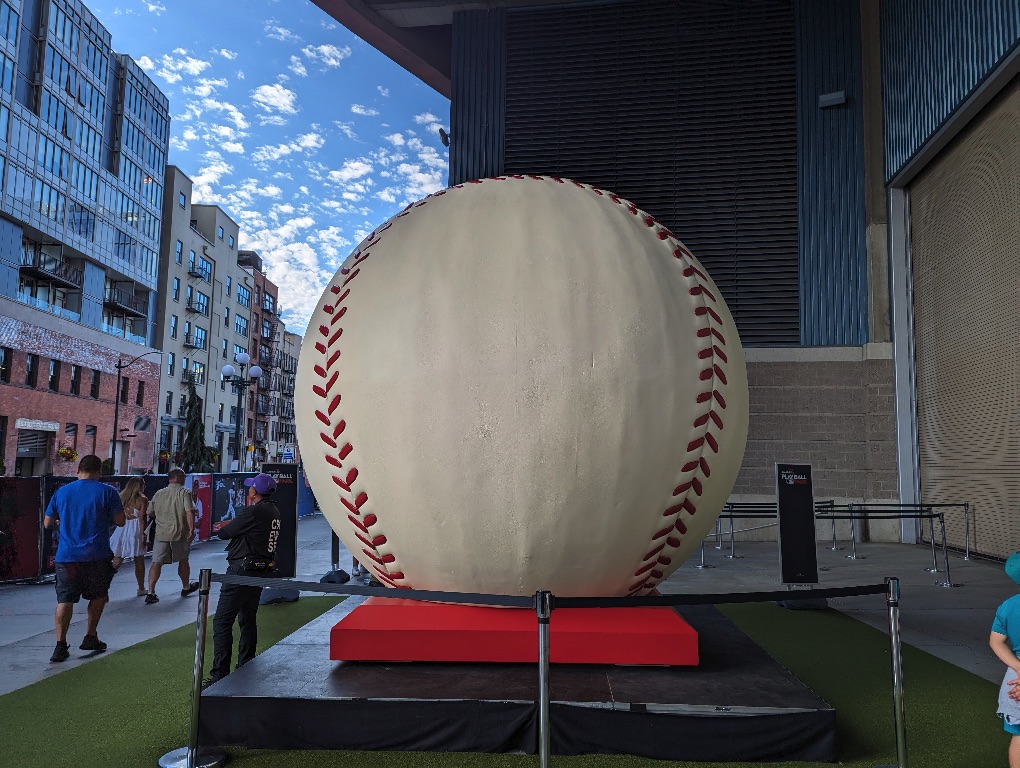
The "back" of the "World's Largest Baseball" at the MLB All-Star Play Ball Park in Seattle.

For those of you who read my last post, I have an update: I saw the World’s Largest Baseball!

In addition to sharing my impressions about this artifact, I will also shout into space my opinions about Play Ball Park, where the World’s Largest Baseball currently resides. (Important context: Because this giant ball was in the free portion of Play Ball Park, that is the only part of the park I visited.)

Access. I will, no doubt, go on for way too long about access to Play Ball Park. (This is an excellent example of attentional bias. Because of the work I do, I am often thinking who can and cannot access care. I regret to inform you that I am now going to carry on about access to the World’s Largest Baseball.)

In order to enter Play Ball Park, you must download an app so you can show a QR code on your phone to the gatekeepers.

  • What if you don’t have a smartphone?
  • What if you don’t have a robust data plan with your cell phone carrier? (MLB does not provide clear orientation about how you must have this app. A lot of people who wanted to enter the park ended up loitering outside the gate to download the app and complete the questionnaire—more on that in a moment. If MLB made it crystal clear on its website that you need this app to access any part of the park, even the free portion, people could have gotten this app somewhere with WiFi.)

The app asks for your name, date of birth, home address, and contact information. Sure, you can lie, but I’m just speaking to the principle here. Why does MLB need to know this information? (You and I both know why, but just indulge me.) Must I share this data when I just want to see a giant baseball? (I’m turning into that Old Person who is paranoid about sharing personal information… even though I maintain a blog that allows me to shout into space.)

To be fair, most, if not all, people who go to Play Ball Park have a smartphone. And most people in this area have home internet access (per the US Census, over 93% of King County households have a subscription to broadband internet), so most are familiar with apps and their data-gathering ways.

The World’s Largest Baseball is not a true baseball. It has a diameter of 12 feet and there are numerous autographs from baseball luminaries on one side. (The photo accompanying this post shows the “back” of the baseball.) Guests are not permitted to touch the baseball or sit on the base. It looks like it is made of metal or other hard material. The red stitching appears to be plastic bumps that are attached to the surface. The panel on the “side” of the ball is secured with bolts and nuts that are painted baseball white. The ball does not appear to be a complete sphere; it looks like the bottom of the ball is flat so it sits flush inside the red base.

Even though the World’s Largest Baseball is a fraud, I still took a photo with it. Who knows when I will see an enormous fake baseball again?

Two Clydesdale horses in separate cages adorned with red Budweiser trim.

The Budweiser Clydesdales were in cages. They are large horses. I don’t know if they ever come out during park hours. Few people were looking at them. This entire situation made me sad.

The author standing behind a life-sized cutout of Mariner Julio Rodriguez; both are smiling.

Fake ball, real smiles? (Julio was the only cutout who was smiling.)

There was a significant police presence in and around Play Ball Park. David Gutman with the Seattle Times wrote a thoughtful piece about the “two Seattles on display as thousands attend MLB All-Star festivities” that has relevance here. Seattle Police was out on foot, on bikes, and in vehicles. It’s been a long time since I’ve seen so many law enforcement officers; it’s not often that we’re surrounded by so many people carrying lethal weapons. It’s not that I felt more or less safe; it was just unsettling to see the amount of firepower amidst a sea of baseball jerseys.

The trains were packed this afternoon for the Home Run Derby. For a few moments, I was transported back to the New York City subways: Standing room only, holding onto poles and straps in awkward angles, and taking shallow breaths to cope with body and breath odors. However, people here were only passive-aggressive (“it would be nice if people moved down more”) versus just plain aggressive (“MOVE, PEOPLE”). I did not need to throw my elbows to escape the train when I got to my stop.

Categories
Lessons Medicine Nonfiction

Treatment Options.

Reading this essay, A Major Problem With Compulsory Mental Health Care Is the Medication, made me think of the following anecdote. I’ll say more about compulsory mental health care (also called involuntary psychiatric treatment) and involuntary medications in a separate post.


Long time readers (from 2004—close to 20 years ago! thanks for spending decades with me!) will recall a physician I dubbed the Special Attending. (In this post from 2019 I identify him by his first name, Matthew.) I am certain that I wrote about the following anecdote at the time it happened; I was upset and distressed. The Special Attending was not a desirable flavor of “special” at this point. Frankly, I believed he was unnecessarily cruel and unfeeling.

I was an intern on the general medicine service. The patient was an elderly, frail woman with multiple medical conditions. She looked and sounded ill; the numbers from her blood and imaging studies confirmed her health was deteriorating.

The senior resident, the other intern, and the medical students all expressed concern about her viability. She looked miserable; she told us with her weak voice that she felt exhausted and uncomfortable. Why are we still poking and prodding her? we wondered. What are we doing?

“We should put her on comfort care,” someone offered. This quickly became the team consensus. We all knew the adage: Cure sometimes, relieve often, comfort always. With confidence that bloomed from the shallow earth of inexperience, we believed that none of our interventions would cure her. The pathway to relief, from our distressed perspective, was only through comfort care.

We—probably me, since this was my patient—proposed this plan with certainty to the Special Attending.

“No,” he replied. It wasn’t that he uttered only one syllable and nothing more. He was frowning. Though I had only worked with him for a few days, it was clear that he was radiating disappointment and disapproval.

Maybe it was me; maybe it was someone else with more courage who finally sliced into the uneasy silence by asking, “Why?”

Because we haven’t tried everything yet, he tersely answered, making no eye contact with any of us. There are still things we could do.

After rounds, we grumbled as a team. “Why is he making us do this?” we whined. “We’re the ones who have to tell her about next steps and do all the things. She’s not going to want this. She’s already suffering so much.”

See, the thing is, we couldn’t tolerate her suffering. We couldn’t bear to witness the deterioration of her body. We didn’t want to try another thing that would fail and prolong our mutual suffering. And what better way to help us escape than by limiting options and withdrawing?


So what does this anecdote have to do with involuntary psychiatric treatment?

My own view is that involuntary psychiatric treatment (inclusive of detention and medications) is a bad outcome. It means that multiple systems failed. The Big We either did not intervene earlier or care to intervene sooner. The Big We didn’t create or maintain enough options to avert this undesired result.

(To be clear: I have provided involuntary psychiatric treatment. It’s not an option I ever want to choose. I never feel great about it.)

We must create as many options as possible for people to receive care and treatment. We must tell people about these options and eliminate barriers so people can access them with ease. When you’re already feeling terrible, the last thing you want to do is climb uphill to knock on doors that won’t open.

It’s hard to witness suffering, but dealing with our discomfort is a problem for us to solve. For those who are suffering, they should not have to solve our discomfort, too.


In retrospect, I wish the Special Attending had explicitly talked with the team about our distress from witnessing the woman’s suffering. It doesn’t have to be a “processing” conversation or “touchy feely”. It could have been something like, “It’s hard to witness someone who is really sick. Our job, though, is to think of and share all treatment ideas with patients. They trust us to help them, so we must try. We can’t give up and look away, though, just because it’s hard for us. We are talking about this woman’s life.”

In the end, we talked with the woman about another treatment plan. She agreed to it. It didn’t help. And that’s when the Special Attending said, “Now we can talk with her about comfort care.”

Categories
Blogosphere Lessons Nonfiction Reading Reflection

Time Millionaires, etc.

A cartoon illustration of a father and son aging together, from birth to the grave.
Artwork by Pascal Campion

Since my last post, I have recovered from illness, though spasms of coughing still occasionally overtake me. Other circumstances have changed, too, that have highlighted to me the importance of spending time with people we love. American culture often focuses on becoming financial millionaires when becoming time millionaires is vastly more important.

Here are some things I read while recuperating that may be of interest to you:

What My Father’s Martial Arts Classes Taught Me about Fighting Racism. “Self-defence means to protect yourself, to protect others around you, and to protect your opponent from committing a crime.”

The Politics of Paying Real Rent Duwamish. This is of greatest interest to people who live in the Seattle-King County area. After reading this article I stopped paying Real Rent. The tagline is accurate: “Why a simple act belies a complicated history.”

“A 1996 Super Mario 64 manga suggests that 1-Up Mushrooms grow from the bodies of dead Marios, perpetuating the cycle of life and death.” The image is what drew me in.

What It Felt Like to Almost Die. “My near-death experience taught me not to fear those final moments.” I hope that this is true for us all.

Generation Connie. I am a bit older than the cohort of Asian American women who were named Connie (and my father said that my parents never considered the name Connie for me), though I definitely remember seeing Connie Chung with Dan Rather when I was growing up. Fun photos in the article.

A Killing on the F Train. Of all the writing I’ve read about Jordan Neely, the man experiencing homelessness and psychiatric symptoms in NYC who died when another subway passenger restrained him (via chokehold), this piece by John McWhorter resonates the most with me. His perspective is kind, nuanced, and empathic. Highly recommended.