A tent in the woods is a symbol of defiance. Whether among towering trees, on a rocky beach, or next to an icy lake, it is a marker of someone intruding upon the natural world. Even if the tent and its occupants leave no trace, the tent itself is a trace, a brightly colored sign of someone who is passing through and does not naturally belong there.
A tent on a cracked sidewalk, underneath a concrete bridge, or tucked into the corner of a parking lot is a symbol of resignation. The tent and its occupants often have no other place to go. They do not belong there and everyone—including them—wishes that they were only passing through. Alas, the tent is their home.
A tent on a college campus is a symbol of defiance. It is not their home. The tent is a vivid icon of someone who is expressing their displeasure with the status quo. The occupants want progress, they want change. Through occupying their tent in a place where it does not belong, they hope that change will come to pass.
A tent in a besieged city, its buildings in ruins and its surviving residents terrified, is a symbol of resignation. They, too, have nowhere to go. Alas, the tent is their home.
I worry how people in power, people who lie, and people who have agendas kept in shadows will manipulate the symbol of the tent. It is much easier to target tents than to recognize the humans within.
I like this model. (Do note, though, that the map is not the territory.) It reminds us of the interdependencies between and within ourselves. If our community isn’t doing well, that will affect our individual mental health. To intentionally use a trivial example (because there are WAY too many heavy things happening these days), consider a city’s baseball team. A not-so-fictional team called the Tridents has had some embarrassing games; hits are uncommon, fielding errors abound, and pitchers are giving up a lot of runs. Grumpy viewers write corrosive comments about the Tridents in the city’s newspaper. Suckers like me read the comments and feel a disjointed sense of “us”. Maybe some of these grumpy viewers are in foul moods for other reasons and they direct their ire at the Tridents because that’s easier to talk about than their alcohol or gambling problems. They would go to Cell Phone Carrier Stadium to grumble at the Tridents directly, but they are dealing with illnesses that limit their abilities to navigate social spaces. Most of us don’t feel psychologically fine when we are physically unwell.
The authors define “lifestyle psychiatry” as seeking
to cultivate well-being and support individuals in preventing and managing psychiatric disorders and optimizing their brain health.
(Editorial comment: I feel some vexation about “lifestyle psychiatry” because I don’t think “lifestyle psychiatry” should be a specialty with its own textbook. Every psychiatrist should practice “lifestyle psychiatry”.) While the authors concede that “patients may have cost or access barriers to traditional care” and conclude the article with a proclamation that lifestyle psychiatry is “a vital component in improving the health and well-being of people around the world”, the final sentence gives away the underlying sentiment of bootstrapping: supporting “individuals in taking ownership of their mental health and well-being” (emphasis mine).
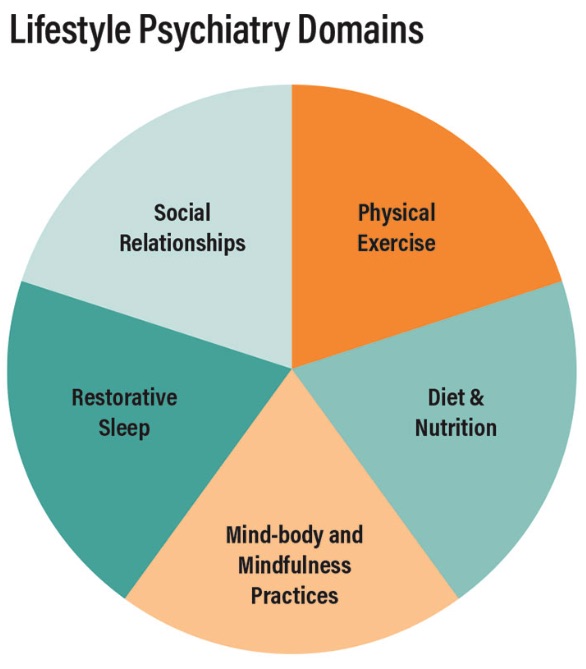
The “social health” component from the Transdomain Model of Health is missing from “lifestyle psychiatry”, even though addressing social health will make it much easier for people to succeed in the “lifestyle psychiatry domains”:
It’s much easier to get physical exercise when there are generous green spaces, plenty of intact sidewalks, and public safety isn’t a concern. Healthy diets and nutrition are easier to achieve when fresh food is available and affordable. It’s easier to be mindful and take yoga classes when you don’t have to work two jobs to make rent. People sleep better when there’s no noise pollution; what if the affordable housing wasn’t only close to airports, trains, and freeways? Neighborhoods with “third spaces” make social relationships more likely to bloom.
To be fair, the lifestyle psychiatry authors do write of “consultation and leadership to governments, corporations, and health care systems” and informing “public education programs and community planners to support the creation of healthy communities [and] employers in creating healthy workplaces”. Their definitions, though, ultimately focus on individuals and do-it-yourself interventions with some consultation with your local lifestyle psychiatrist. (And, to be clear, I’m not saying that systems are the only issue. People do still need to make their own choices, but we can shift systems so it’s not as hard for people to make healthier choices. Life is already hard enough.)
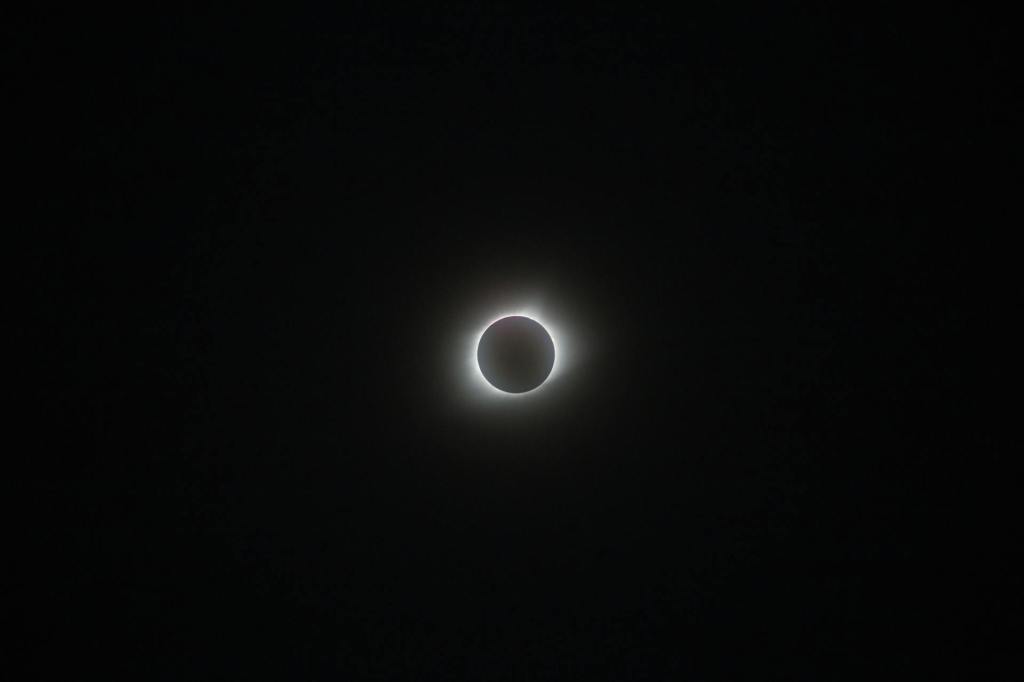
Seattle was not anywhere near the path of totality for the total solar eclipse today. Over lunch I watched part of NASA’s live broadcast. And what a mush ball I am: I cried into my meal as I watched the skies turn to black, heard the crowds cheer and gasp, and saw the dancing corona of the Sun.
I’m not so naive to believe that being in community solves everything. However, I do believe that being in community–contributing to social health–can powerfully change the way we view and feel about ourselves, others, and the world around us. Millions of people witnessed a total solar eclipse in person or in two-dimensions today. I’m pretty sure I wasn’t the only one who cried while watching the broadcast. Three things had to be in place for this celestial event to occur: The Sun, the Moon, and the Earth. To witness this stellar occasion, we all had to be on the same planet. Maybe this is naive: I’d like to think that the shared experience of a total solar eclipse boosted our planetary social health. And, as a result, we individually experienced higher mental health today.
Most people in ten countries lost an hour of time between yesterday and today in the name of Daylight Saving. (Nearly 30 nations in the Northern Hemisphere will lose an hour by the end of March.)
Among the many who woke up at a later clock time today are the seven million or so Americans who have dementia. They opened their eyes and their gazes passed over the clocks in their worlds. The faces of those with dementia may have matched the faces of analog clocks: Flat, blank, lacking emotion.
There were fewer sparks of electricity this morning in these brains speckled with scar tissue. Amyloid plaques and tau tangles are the remnants of neurons that once vibrated with vitality. The hues of their hair have faded to gray; the gray matter of their brains continues to disappear.
When they looked at their cell phones, they may have forgotten that their phones automatically adjusted the time at 2:00am. The steps of logic are missing from these brains; the staircases of reasoning have crumbled. When someone mentioned “Daylight Saving”, they sprang forward with their praxis memory, similar to “muscle memory”: They can no longer explain the steps to search the internet on their phone, but their fingers reflexively swipe and type.
Their aged fingers tapped out the word “time”, trusting that Google would orient them to this moment.
Except their query was unsuccessful. With the decay of the gray matter in their brains, their abilities to give and hold attention, to notice details, have also deteriorated. Their single word question didn’t go to Google; it went into a text message:
Time
And then again, since Google did not respond:
Time
Daylight Saving Time may have stolen one hour of our time, but dementia has stolen hours and ours from us.
The Person’s error wasn’t about my sexual preferences; it was that they thought I go to nightclubs!†
What impression do you have of The Person?
Would your impression change if The Person is:
a man?
a woman?
the teenage child of a friend?
a stranger over the age of 70?
a white person? a non-white person?
a straight person? a queer person?
my boss?
As much as we try, we can never really get away from ourselves. We all think we view the world through relatively impartial lenses. Then we encounter people and situations that trigger our mental habits.
Like viewing the world and the people in it through the lens of sexual preferences.
Or believing that blog posts are only worthwhile if they resemble articles.
† Long-time readers know my opinions about dancing.
For those of you who read my last post, I have an update: I saw the World’s Largest Baseball!
In addition to sharing my impressions about this artifact, I will also shout into space my opinions about Play Ball Park, where the World’s Largest Baseball currently resides. (Important context: Because this giant ball was in the free portion of Play Ball Park, that is the only part of the park I visited.)
Access. I will, no doubt, go on for way too long about access to Play Ball Park. (This is an excellent example of attentional bias. Because of the work I do, I am often thinking who can and cannot access care. I regret to inform you that I am now going to carry on about access to the World’s Largest Baseball.)
In order to enter Play Ball Park, you must download an app so you can show a QR code on your phone to the gatekeepers.
What if you don’t have a smartphone?
What if you don’t have a robust data plan with your cell phone carrier? (MLB does not provide clear orientation about how you must have this app. A lot of people who wanted to enter the park ended up loitering outside the gate to download the app and complete the questionnaire—more on that in a moment. If MLB made it crystal clear on its website that you need this app to access any part of the park, even the free portion, people could have gotten this app somewhere with WiFi.)
The app asks for your name, date of birth, home address, and contact information. Sure, you can lie, but I’m just speaking to the principle here. Why does MLB need to know this information? (You and I both know why, but just indulge me.) Must I share this data when I just want to see a giant baseball? (I’m turning into that Old Person who is paranoid about sharing personal information… even though I maintain a blog that allows me to shout into space.)
To be fair, most, if not all, people who go to Play Ball Park have a smartphone. And most people in this area have home internet access (per the US Census, over 93% of King County households have a subscription to broadband internet), so most are familiar with apps and their data-gathering ways.
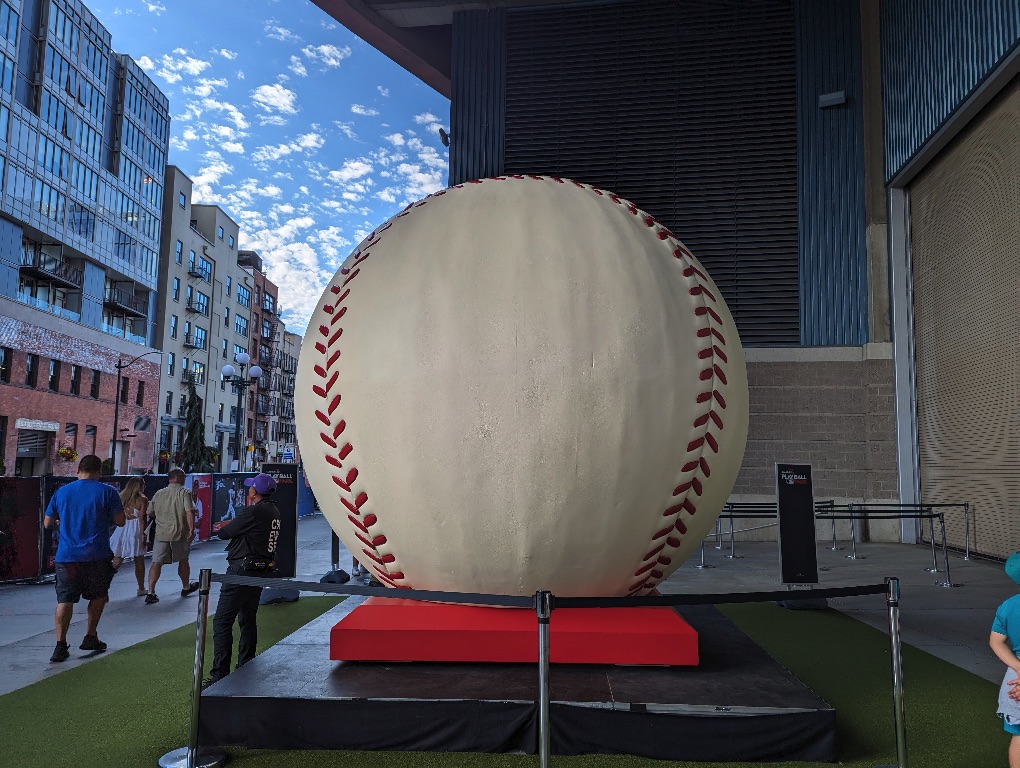
The World’s Largest Baseball is not a true baseball. It has a diameter of 12 feet and there are numerous autographs from baseball luminaries on one side. (The photo accompanying this post shows the “back” of the baseball.) Guests are not permitted to touch the baseball or sit on the base. It looks like it is made of metal or other hard material. The red stitching appears to be plastic bumps that are attached to the surface. The panel on the “side” of the ball is secured with bolts and nuts that are painted baseball white. The ball does not appear to be a complete sphere; it looks like the bottom of the ball is flat so it sits flush inside the red base.
Even though the World’s Largest Baseball is a fraud, I still took a photo with it. Who knows when I will see an enormous fake baseball again?
The Budweiser Clydesdales were in cages. They are large horses. I don’t know if they ever come out during park hours. Few people were looking at them. This entire situation made me sad.
Fake ball, real smiles? (Julio was the only cutout who was smiling.)
There was a significant police presence in and around Play Ball Park. David Gutman with the Seattle Times wrote a thoughtful piece about the “two Seattles on display as thousands attend MLB All-Star festivities” that has relevance here. Seattle Police was out on foot, on bikes, and in vehicles. It’s been a long time since I’ve seen so many law enforcement officers; it’s not often that we’re surrounded by so many people carrying lethal weapons. It’s not that I felt more or less safe; it was just unsettling to see the amount of firepower amidst a sea of baseball jerseys.
The trains were packed this afternoon for the Home Run Derby. For a few moments, I was transported back to the New York City subways: Standing room only, holding onto poles and straps in awkward angles, and taking shallow breaths to cope with body and breath odors. However, people here were only passive-aggressive (“it would be nice if people moved down more”) versus just plain aggressive (“MOVE, PEOPLE”). I did not need to throw my elbows to escape the train when I got to my stop.





 Maria Yang, MD