Categories
Blogosphere Lessons Nonfiction Reading Reflection

Time Millionaires, etc.

A cartoon illustration of a father and son aging together, from birth to the grave.
Artwork by Pascal Campion

Since my last post, I have recovered from illness, though spasms of coughing still occasionally overtake me. Other circumstances have changed, too, that have highlighted to me the importance of spending time with people we love. American culture often focuses on becoming financial millionaires when becoming time millionaires is vastly more important.

Here are some things I read while recuperating that may be of interest to you:

What My Father’s Martial Arts Classes Taught Me about Fighting Racism. “Self-defence means to protect yourself, to protect others around you, and to protect your opponent from committing a crime.”

The Politics of Paying Real Rent Duwamish. This is of greatest interest to people who live in the Seattle-King County area. After reading this article I stopped paying Real Rent. The tagline is accurate: “Why a simple act belies a complicated history.”

“A 1996 Super Mario 64 manga suggests that 1-Up Mushrooms grow from the bodies of dead Marios, perpetuating the cycle of life and death.” The image is what drew me in.

What It Felt Like to Almost Die. “My near-death experience taught me not to fear those final moments.” I hope that this is true for us all.

Generation Connie. I am a bit older than the cohort of Asian American women who were named Connie (and my father said that my parents never considered the name Connie for me), though I definitely remember seeing Connie Chung with Dan Rather when I was growing up. Fun photos in the article.

A Killing on the F Train. Of all the writing I’ve read about Jordan Neely, the man experiencing homelessness and psychiatric symptoms in NYC who died when another subway passenger restrained him (via chokehold), this piece by John McWhorter resonates the most with me. His perspective is kind, nuanced, and empathic. Highly recommended.

Categories
Consult-Liaison Observations Reading Reflection

Therapy and the Use of Words.

Photo by Pixabay

A flurry of mental health-related articles have piqued my attention recently, many of which are worth writing about. We’ll start with one article from the New York Times’s new series, It’s Not Just You: A Times Opinion project on mental health and society in America today.

Huw Green, a clinical psychologist, writes in We Have Reached Peak ‘Mental Health’:

The contemporary cultural landscape’s recent zeal for mental health as an important good has been accompanied by a faith in therapy as the best way to obtain it. …

Therapy is important as a valuable health intervention for many, rather than a universal prerequisite to a good life. Most people simply cannot afford to have lengthy therapy, or it doesn’t fit with their cultural or religious worldview. Do we really want to suggest that this compromises their mental health or their ability to do things like parent well?

Recently, a man at work asked me if he should “get therapy”. A horrifying event happened in his life about six months ago. Someone who cares about him has been haranguing him to go to therapy. He wondered if he should heed that suggestion.

I have provided therapy. I’ve also received therapy myself, which I found both helpful at the time and since it ended. How did I respond to this man?

“The only person who can answer [if you should get therapy] is you.” (Which I realize is a shrinky thing to say that is also not helpful. I elaborated further, which is what follows.)

I don’t think there was ever a time that I thought that “everyone should go to therapy”. Can it be helpful? Yes. Can it improve your life in multiple dimensions? Yes.

Can it take a lot of time? Yes. Can it cost a lot of money? Yes. (Do you think about things you’d rather avoid? Often. Do you sometimes dread going to therapy? Absolutely.)

Could you do something else just as valuable and healthful with your time? Yes.

The thing about conventional therapy is that it has a heavy reliance on words. You have to be able and willing to use words to describe your internal experiences, whether they be thoughts, emotions, or behaviors. You have to be able and willing to sit in a room with another person for dozens of minutes, week after week, often for months, and sometimes for years while using words. (… though I personally believe that no one should be in therapy for many years: If you’ve been routinely seeing a therapist for five or ten years and your presenting concerns or symptoms have not improved, is therapy actually helping you?)

And you know what? Not everyone likes using words. Or using words is not one of their strengths. It is true that part of the task of therapy is learning how to use words as a skill and for therapeutic purposes. While some people will, in the course of therapy, learn to use words instead of drinking three bottles of wine a night or making superficial cuts on their limbs, some people will find using words difficult, uncomfortable, or artificial.

Therapy is often the most successful when people have clear goals (that they can express in words). It’s hard to say you’ve achieved a goal when you are unable to describe it through the specific medium of language.

Furthermore, much of the task of therapy is learning about yourself: How do you react to events in life? Do your reactions cause problems or difficulties for you? For others? Does your reaction serve other purposes in your life? (e.g., Are you always apologizing because you always believe that you’re doing something wrong, and this is how you absolve yourself?) What would happen if you viewed life events, whether internal or external, differently? What if you believed you could make different choices? What if the stories you tell yourself aren’t accurate or true?

Do you need to receive therapy to learn about yourself in this way? I don’t believe so.

People can achieve psychological wellness (note: wellness, not perfection, which is what the term “mental health” seems to suggest these days) through many non-verbal activities:

  • playing a musical instrument
  • listening to music
  • dancing or other inspired movement
  • walking alone
  • walking with trees, mountains, and skies
  • drawing, whether the process is seen or unseen
  • running
  • sitting, with or without spiritual practices like prayer

… and other things that don’t involve words.

People want to live healthy, meaningful lives. Huw Green is right: Therapy isn’t required for this.

Categories
COVID-19 Nonfiction Reading Reflection

Pictures in Time.

The rocks of the mountain beneath your feet broke apart before you were born. Glaciers carved the valley before your eyes before your grandparents were alive. Trees towering overhead on this west coast sprouted before the ships from far away landed on the east coast. All of this was here long before you arrived and will persist long after you are gone.

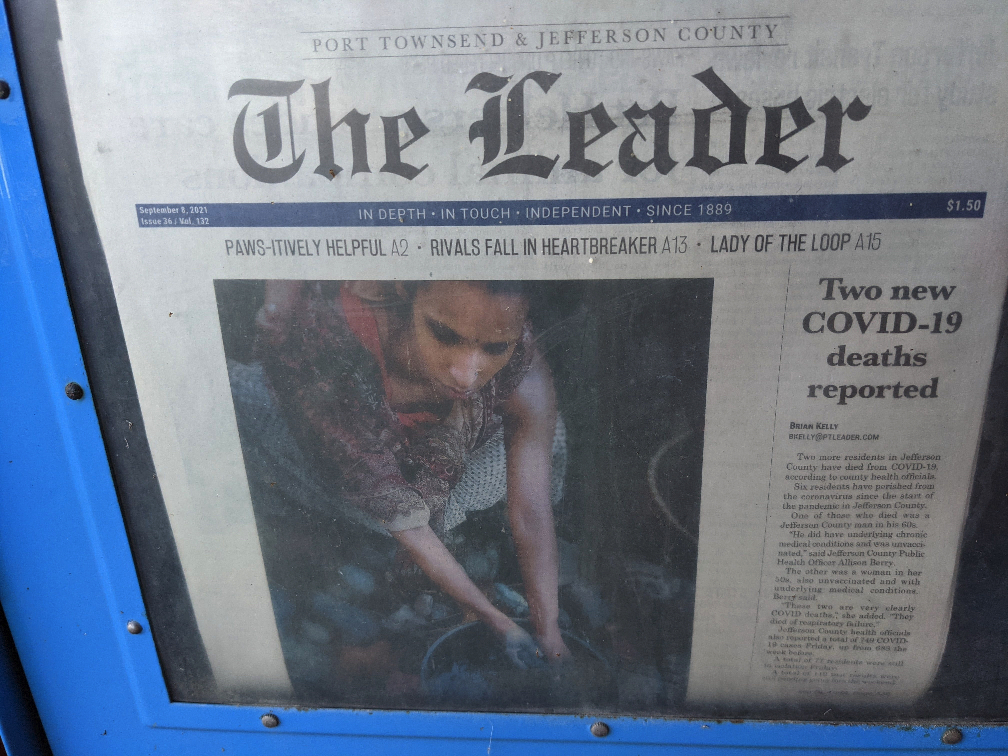
History precedes you and the future remains unknown while you live in the present, where a pandemic persists. This tiny county that holds giant mountains reported two new deaths from Covid-19 this past week, leading to a total of 13 deaths over the course of this cursed pandemic. This number seems paltry compared to the 1,812 deaths in the county you live in, but for each death, many mourn.

Someone offered this idea to me a few years ago: You know those days when you feel sad, though there are no obvious, logical reasons as to why you feel sad? Maybe someone, somewhere, has died and there is no one left to grieve that death. Your sadness is a mourning of that death.

Maybe that, in part, is what we’re all experiencing now.

(I also did not realize that newspaper boxes are mirrors. Exhausted health care workers don’t expect to see exhausted health care workers on the front page of the local paper.)

Though we are exhausted—in varying degrees—and may wonder why we “spend” “our” time doing this work, perhaps this is how time is choosing to use us. Oliver Burkeman’s book Four Thousand Weeks is a gentle yet firm reminder that our time is finite, that only planning for the future logically means that we should only plan for death. That is what awaits all of us in our futures, right?

I highly recommend this book. (Bonus reason, beyond the content of the book: Mr. Burkeman sent a personal reply when I sent him a thank you note!) This choice did not diminish me; it enlarged me.

Sometimes reading about the past brings clarity to the present. The model Wilkerson puts forth in Caste about the relative status of Americans resonates with me (i.e., the actual issue is a caste system, where “race” is often the indicator). Her model better explains the interpersonal and inter-group dynamics of the US compared to solely race-based models. I also highly recommend this book.

Categories
COVID-19 Education Reflection Seattle

On Pushing Vaccines.

This summer is like last summer: We (a homelessness and housing agency) have had very few Covid cases in the past month or so. If this year is like last year, our reprieve will end in mid-autumn.

With this lull, I received recommendations to send out information about the current state of the pandemic as it relates to our agency. I hemmed and hawed before writing the crappy first draft: Everyone is tired and no one wants to read another e-mail. In this draft I waffled about commentary about vaccinations.

While vaccination rates in the Seattle-King County area are around 70% (and thus higher than other parts of the country), this doesn’t mean that everyone has been eager to receive a vaccine. There are people who have made a firm decision to forever decline it. There are also people who remain unsure.

I have felt disappointed and weary upon hearing the disdain of leaders and experts towards people who have not gotten vaccinated. I understand their frustration: No one wants to see people get sick and die. There are many ways to die and dying from Covid-19 is an undesirable way to leave this world.

That being said, scolding or berating people to make a specific choice is rarely (if ever) effective. If someone tells you that you are selfish because you won’t eat vegetables, that probably won’t increase the chances that you will eat vegetables. You might instead avoid this specific someone: Who wants to hear that they are a selfish person? (You can replace eating vegetables with any other behavior, identity, or choice: You are a selfish person because you choose to believe in liberal political ideas. You are a selfish person because you think abortion is wrong. You are a selfish person because you want to defund the police. You are a selfish person because you believe that Jesus was crucified for your sins. Calling someone selfish rarely promotes inquiry or conversation.)

People have shared with me a wide variety of reasons as to why they don’t want to get vaccinated. Some of those same people end up getting vaccinated… maybe because of our conversation, maybe not. I suspect that most didn’t even share all of their reasons with me because they might have felt embarrassment if they did.

If someone is willing to talk with you about a choice they want to make, that also means that they are talking with themselves about that very choice. Any conversation you have with them may carry on in your absence.

I don’t know if this is actually an adage in psychiatry, though I recall several people sharing this while I was in training: As long as someone is alive, there is still hope. Things can still change. People want to make their own choices, though; no one likes coercion. People aren’t stupid, either: They often know when someone is using force to try to change their minds or behaviors. (This use of force doesn’t have to be dramatic either: It can be a simple statement like, “I need loyalty.“)

As long as someone is still alive, there is still hope, and we can use that hope to keep the conversation going. People will share their worries with you if they are willing to give you the chance to change their minds. They will only give you that chance if they have some trust in you. They will have some trust in you if you have genuine interest in their worries and beliefs. People want to be understood. People want dignity.

You may fear that there isn’t enough time: What if they get infected with Covid-19 tomorrow and die next week? Maybe if we put more pressure on people, they will move faster.

Alternatively, if we put undue pressure on people, they may choose to never speak to us again. Any time that we did have is now completely gone. You can play the long game or you can prematurely end the game.

To be clear, I’m not saying any of this is easy or that a select few of us have magical abilities and endless patience to help people change their minds. I do, however, have experience working with people who were not making choices that I wish they would make: People who were living outside and refused to move into housing due to beliefs that were not rooted in reality. People who were using drugs and alcohol for many years. People who declined to take medication even though literally everyone else witnessed their improved health, wellbeing, and function when they did so.

Sighing and making exasperated comments at people who are living outside rarely makes them move into housing faster. Yelling at people who are using drugs and alcohol almost never makes them stop using. Forcing people to take medications does not make medications suddenly more appealing to people who usually refuse them.

Am I fully vaccinated? Yes. Do I wish more people would accept the Covid vaccines? Yes. Do I think threats or domination, even in slight forms, will succeed? No. At this point, efficiency no longer seems effective.


Categories
COVID-19 Nonfiction Reflection Seattle

Desperation.

It is the summer solstice and, at this latitude, there are 16 hours of daylight today. With the trees bursting with green leaves and the blue sky without clouds, we quickly forget that the dark, wet winter days are what put the shimmering snow we now see on the distant mountains.

As we pour outside in our shorts, tee shirts, and sunglasses, we don’t speak of desperation: The desperation during the winter solstice, when thousands of people in the US died each day from Covid-19, when mothers quivered from feelings of unfair guilt due to the impossible burdens of raising children and working, when poor people wondered if they could get work that day to buy enough food to feed their families. When there were only eight and a half hours of daylight, desperate tent cities popped up like mushrooms following a storm. Desperate women smoked stimulant drugs like methamphetamine to stay awake through the night to decrease the chance that someone would rape them. Desperate young people took their own lives, unable to foresee how their circumstances could ever improve.

The cool breeze from the Salish Sea on this glorious summer day doesn’t sweep away the desperation: Emergency departments, hospitals, and clinics don’t have enough staff[1. Who and where are the people taking care of the health care workers?] to care for the desperate people seeking help. Institutions struggle with race and racism: Why did the white supervisor enter the Black person’s office and remove the “Black Lives Matter” sign that was adorned with the institution’s logo? Sirens[2. Who and where are the people taking care of first responders?] continue to wail through the streets at all hours, past the tent cities that persist outside of boarded up storefronts, under freeways, and in patches of public land overrun with dandelions.

Though we don’t speak of desperation, we feel it and then grasp with greed: Let me witness the shaking of the leaves as the breeze moves through the trees. Let me listen to the arboreal applause. Let me squint at the sunlight and find the moon during the day. Let me watch the clouds, let me witness how they change, let me remember that clouds always change, that they are always with us even when they disappear from view. Let me recognize what the clouds are trying to teach me.

I survived. The pandemic has been with us for over a year and I was lucky enough to live. I never got infected, I never got sick. I was not one of the 601,000+ people in this country who died. Don’t I have some obligation to make the most of my time here because I lived?

The antidote to desperation is gratitude, though even my gratitude feels desperate. There are so many people to thank and prayers of gratitude to utter. I want to hold this summer day in my hands, to feel the texture of the evening breeze, to see how the sky changes colors as the earth rotates away from the sun tonight.