Categories
Nonfiction Observations Seattle

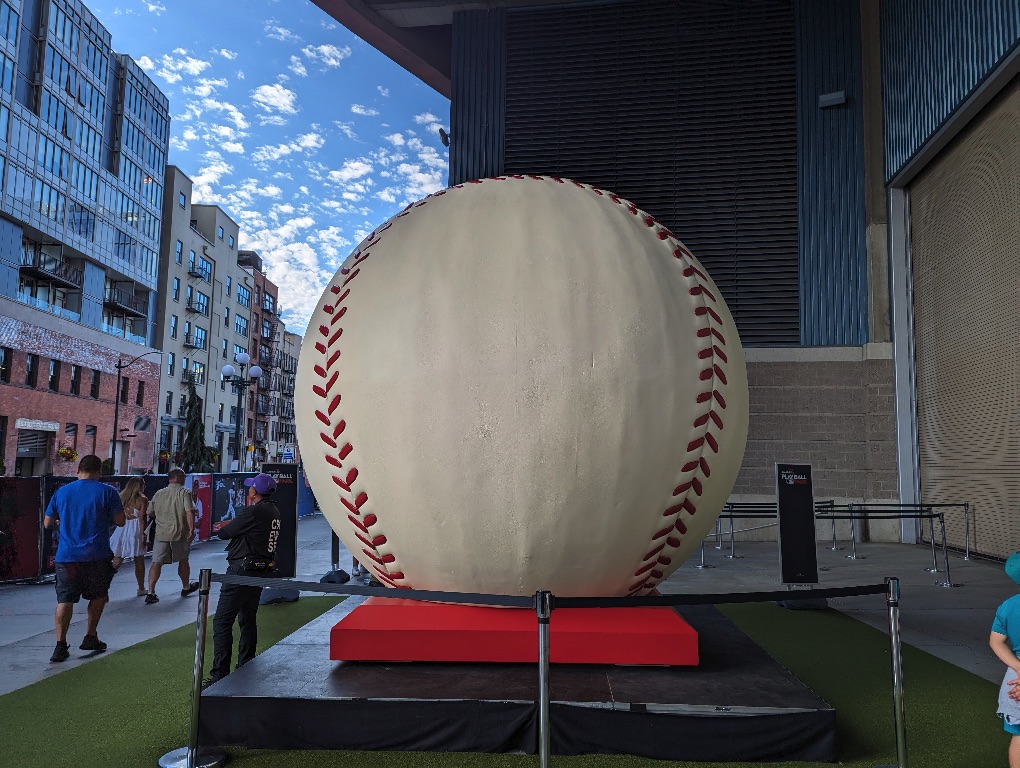
The World’s Largest Baseball.

The "back" of the "World's Largest Baseball" at the MLB All-Star Play Ball Park in Seattle.

For those of you who read my last post, I have an update: I saw the World’s Largest Baseball!

In addition to sharing my impressions about this artifact, I will also shout into space my opinions about Play Ball Park, where the World’s Largest Baseball currently resides. (Important context: Because this giant ball was in the free portion of Play Ball Park, that is the only part of the park I visited.)

Access. I will, no doubt, go on for way too long about access to Play Ball Park. (This is an excellent example of attentional bias. Because of the work I do, I am often thinking who can and cannot access care. I regret to inform you that I am now going to carry on about access to the World’s Largest Baseball.)

In order to enter Play Ball Park, you must download an app so you can show a QR code on your phone to the gatekeepers.

  • What if you don’t have a smartphone?
  • What if you don’t have a robust data plan with your cell phone carrier? (MLB does not provide clear orientation about how you must have this app. A lot of people who wanted to enter the park ended up loitering outside the gate to download the app and complete the questionnaire—more on that in a moment. If MLB made it crystal clear on its website that you need this app to access any part of the park, even the free portion, people could have gotten this app somewhere with WiFi.)

The app asks for your name, date of birth, home address, and contact information. Sure, you can lie, but I’m just speaking to the principle here. Why does MLB need to know this information? (You and I both know why, but just indulge me.) Must I share this data when I just want to see a giant baseball? (I’m turning into that Old Person who is paranoid about sharing personal information… even though I maintain a blog that allows me to shout into space.)

To be fair, most, if not all, people who go to Play Ball Park have a smartphone. And most people in this area have home internet access (per the US Census, over 93% of King County households have a subscription to broadband internet), so most are familiar with apps and their data-gathering ways.

The World’s Largest Baseball is not a true baseball. It has a diameter of 12 feet and there are numerous autographs from baseball luminaries on one side. (The photo accompanying this post shows the “back” of the baseball.) Guests are not permitted to touch the baseball or sit on the base. It looks like it is made of metal or other hard material. The red stitching appears to be plastic bumps that are attached to the surface. The panel on the “side” of the ball is secured with bolts and nuts that are painted baseball white. The ball does not appear to be a complete sphere; it looks like the bottom of the ball is flat so it sits flush inside the red base.

Even though the World’s Largest Baseball is a fraud, I still took a photo with it. Who knows when I will see an enormous fake baseball again?

Two Clydesdale horses in separate cages adorned with red Budweiser trim.

The Budweiser Clydesdales were in cages. They are large horses. I don’t know if they ever come out during park hours. Few people were looking at them. This entire situation made me sad.

The author standing behind a life-sized cutout of Mariner Julio Rodriguez; both are smiling.

Fake ball, real smiles? (Julio was the only cutout who was smiling.)

There was a significant police presence in and around Play Ball Park. David Gutman with the Seattle Times wrote a thoughtful piece about the “two Seattles on display as thousands attend MLB All-Star festivities” that has relevance here. Seattle Police was out on foot, on bikes, and in vehicles. It’s been a long time since I’ve seen so many law enforcement officers; it’s not often that we’re surrounded by so many people carrying lethal weapons. It’s not that I felt more or less safe; it was just unsettling to see the amount of firepower amidst a sea of baseball jerseys.

The trains were packed this afternoon for the Home Run Derby. For a few moments, I was transported back to the New York City subways: Standing room only, holding onto poles and straps in awkward angles, and taking shallow breaths to cope with body and breath odors. However, people here were only passive-aggressive (“it would be nice if people moved down more”) versus just plain aggressive (“MOVE, PEOPLE”). I did not need to throw my elbows to escape the train when I got to my stop.
Categories
Observations Seattle

Impressions of MLB All-Star Week From Someone Who Doesn’t Follow Baseball.

For those of you who follow baseball, you likely know that All-Star Week is happening here in Seattle. For those of you who don’t follow baseball (like me), All-Star Week lasts less than a week and is a celebration of baseball and baseball players. (For example, the World’s Largest Baseball is currently here in Seattle. More on that below. You can already see how I’m focusing on the wrong thing.)

This is the only event I can recall in the 16-ish years I’ve lived in Seattle where the city has put in extraordinary effort to make it shine for its citizens and visitors. (I enjoy living in Seattle, but let’s be honest: the effort is for the visitors.) Because Seattle is tucked in the northwest corner of the country, people just don’t routinely pass through. People seem to equate visiting Seattle with visiting the Galapagos Islands: Neat places with oddities, but so out of the way!

In an effort to be a better spouse, I have been learning about baseball over the past few years, but my fund of knowledge is superficial. For example, when our Mariners made it to the playoffs last year, that’s when I learned what a “rally cap” is, though I had to learn about this via the “rally shoe“. (Again, I’m still missing the point.) It takes me a while to offer a complete definition of a “perfect game“. I know just enough about certain baseball players to ask questions one expects from a child: Do you think Shohei Ohtani the pitcher could strike out Shohei Ohtani the batter? (Can you imagine being married to a psychiatrist who also asks unsophisticated questions about baseball???)

So, for our mutual amusement, here are random, initial impressions from the beginning of Major League Baseball’s All-Star Week from someone who doesn’t follow baseball.

It costs a lot of money. Well, at least the Home Run Derby and the All-Star Game cost a lot of money. The event that most interests me is the inaugural Historically Black Colleges and Universities (HBCU) Swingman Classic, created by former Mariner Ken Griffey, Jr. (There’s a statue of Griffey in front of Seattle’s baseball stadium, which has the phenomenally boring name of T-Mobile Park.) Tickets are all sold out, so I can’t attend, though I’m inspired with Griffey’s efforts to do what he can where he can.

The World’s Largest Baseball is here. I’m suspicious, though: Is it an actual baseball composed of cork and rubber and yarn and leather? (Here’s a promotional video of Play Ball Park that features this giant baseball stationed outside T-Mobile Park; it appears around 0:14. There’s what appears to be a panel near the base of the ball. That doesn’t seem right.) I’ve been wondering about the World’s Largest Baseball all week. If I actually go to Play Ball Park, I’ll provide an update.

The young people are excited. A couple of shockingly pink tour buses featuring Mariner’s star Julio Rodriguez’s smiling face parked in front of a hotel within walking distance of the stadium earlier today. Children and adolescents in baseball uniforms spilled out. Adults corralled their wandering, jumping, and chatty bodies through the revolving doors. Other young people and their accompanying adults are roaming around, proudly wearing jerseys and ball caps that declare their allegiances. (I am particularly impressed with the Milwaukee Brewers logo: The glove contains the letters M and B! So clever! Designed by an art history student!)

This may be the most excited people have been about baseball in recent memory. The Mariners is the only team that has never been to the World Series. People are perennially disappointed with them. (The Seattle Times recently published this piece: Why fans dislike this Mariners team so much. YIKES.) Whenever I see a televised Mariners game, the seats are never full. The only Mariner who made it onto the All Star roster by public vote was pitcher Luis Castillo. Now, none of us can get away from baseball: Posters emblazoned with ball players are plastered all over utility boxes downtown! The local paper has published numerous articles about baseball (not all of them supportive, as noted above)! The city made an assertive push to remove/house all the people living outside near the stadium in the weeks leading up to All-Star Week! The beautification of downtown and Pioneer Square (flowers! new trees! pocket beaches!) has all been in the service of sports! (It seems that the All-Star game was also the catalyst to fix the escalators in the downtown light rail stations that haven’t worked in over two years.)

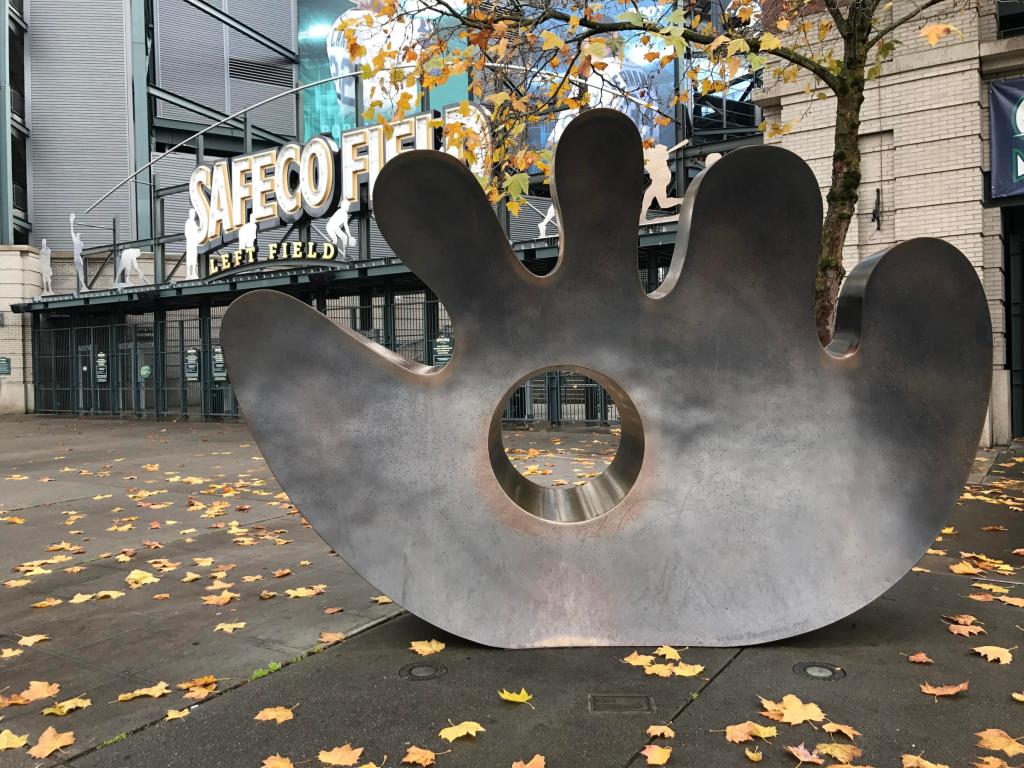
If any of you fine readers are in town for All-Star Week, enjoy the next few days! If you’re going to any of the games, one of my favorite things about the stadium is the sculpture of the baseball glove at the left field gate. It’s called “The Mitt” (it’s in the photograph accompanying this post). You can learn more about the artist and this sculpture here.

Categories
Reading Seattle

Recommendations.

Here’s a small selection of things I humbly recommend for your consideration:

The Disadvantages of an Elite Education. “Our best universities have forgotten that the reason they exist is to make minds, not careers.” (Incisive writing from William Deresiewicz, who is also the author of one of my favorite essays, Solitude and Leadership.)

Ice Merchants: A Father and Son’s Daring Cliff Dive. This is a beautiful, wordless animation that left me speechless.

Why Are These Italians Massacring Each Other With Oranges? Every winter, Ivrea erupts into a ferocious three-day festival where its citizens pelt one another with 900 tons of oranges. (Yes, oranges.) (Thoughtful, descriptive, and hilarious writing from Jon Mooallem.)

The Complete Maus: A Survivor’s Tale. I bought this book on a whim. I don’t understand why some schools have banned it—more people who read it.

E-Jae Pak Mor: These TikTok-Famous Dumplings Deserve the Hype. If you live in or around Seattle and if you like Thai food, give this place a try. (The owner and I met years ago when she was working as a cook at Turkish restaurant. E-Jae Pak Mor is her first restaurant—how thrilling it is to make your dream come true! This is Thai street food and it is delicious.)

Emmett Shear: “I’ll be 40 years old soon. I thought I’d take a look back and see how I’ve spent it….” (Includes a link to a spreadsheet so you can make your own.)

Categories
Funding Policy Public health psychiatry Seattle Systems

Crisis Care Centers Aren’t Enough.

The Tacoma News Tribune graciously agreed to publish an opinion piece an esteemed fellow psychiatrist and I wrote. I invite you to read the 500-word essay, Crisis care centers are important. But WA needs more to fill behavioral health gaps, directly through the newspaper (and show a local newspaper some appreciation through page views!). The piece has particular relevance to residents in King County in Washington State.

If you have more time and would like to read the original version, you can find it below. Thanks for your interest.


King County voters will decide whether to fund a network of crisis care centers in April. There are many reasons to support this: We all know people who have experienced behavioral health crises, including kids in school; colleagues at work; family members; and people we encounter in the community.

Because King County currently has only one crisis center, additional centers will help. However, the entire behavioral health system in Washington is in crisis. A narrow focus on these centers only may lead to even more people tumbling into crisis.

King County has explained that these five crisis centers will “provide a safe place… specifically designed, equipped and staffed for behavioral health urgent care. These Centers will provide immediate mental health and substance use treatment and promote long-term recovery.”

If crisis centers have the most resources, they will be the most robust and responsive element of the system. Outpatient clinics providing earlier intervention and prevention services are often understaffed and have waitlists. People already enrolled in these clinics may wait weeks to months for follow-up appointments. Those leaving hospitals also compete for clinic appointments. This excessive waiting can precipitate crises. People should not have to be in crisis to access care.

Crisis care centers are designed to accept anyone, with or without insurance. Many behavioral health clinics have insurance restrictions. Some clinics don’t accept public insurances like Medicaid or Medicare. Others do, though have limited funds to provide services for uninsured people or for those ineligible to obtain insurance. Such restrictions will funnel uninsured people to the crisis centers. Yet, where will they go for ongoing care?

Due to limited resources, crisis care centers must screen and triage referrals. If people experiencing symptoms related to mental illness or substance use don’t meet criteria for admission to a crisis center or a hospital, what then? If under-resourced outpatient clinics remain understaffed or close, these individuals will be forced to wait for treatment. Their symptoms may worsen, precipitating preventable crises, which no one wants.

The option for people to stay up to 14 days in a crisis care center can help people connect to ongoing services. However, many agencies are unable to see people and establish care within 14 days, in part due to what King County described as: “The behavioral health workforce is strained under the magnitude of the need, all while being underpaid, overworked, and stretched too thin.”

The levy touts the use of peer counselors in crisis centers. Peers with lived experience are valuable, though should not be the primary providers of care. Peer counselors often have the lowest wages and, in some for-profit models, make up the bulk of personnel, presumably to maximize revenue. Some people in crisis are among the most vulnerable, ill, and complex patients in the region. Both patients and staff across the entire continuum of care deserve sufficient support and resources to get, and stay, out of crisis. If people experiencing mental health crises receive insufficient services, they are more likely to fall back into crisis and return to these centers. If these crisis centers are operated by for-profit organizations, readmissions will increase their revenue. We have already witnessed this pattern in several for-profit psychiatric hospitals where patients experienced harm. Patients and their families deserve better.

King County needs crisis centers, but personnel in other parts of the system also need support. The levy notes that funding for residential treatment facilities will focus on capital and maintenance. Building conditions are important, though the staff who work in these buildings are just as valuable. Many individuals receive ongoing care in residential treatment facilities following acute hospital treatment. Supporting and retaining staff in these residential programs are vital in reducing behavioral health crises.

Outpatient clinics with robust funding for personnel, technology, and other resources, along with appropriate reimbursement of services—things that never happened after the original deinstitutionalization movement of the 1960s—will help people access care. This, along with preventative efforts and early intervention at the first signs of behavioral health challenges, decreases crises.

Ultimately, supporting peoples’ basic needs will reduce the need for crisis centers. Living wages, affordable housing, access to food, universal health care coverage, employment opportunities, education and training, and building social connections, will reduce psychological burdens and promote wellness. 

This levy should be viewed as an initial investment in improving our battered behavioral health care system. More needs to be done to improve the mental health of our friends, family, and neighbors. 

Categories
COVID-19 Homelessness Nonfiction Observations Policy Public health psychiatry Seattle

Gifts of Our Lives.

Photo by Leeloo Thefirst

(I know it’s the holiday season and I promise I’m not actually a grinch, but here’s your warning: This is going to be kind of a bummer of a post.)

Some recent scenes for your consideration:

  • The sliding wooden gate did nothing to dampen the sounds of traffic on the boulevard. Inside the wooden gate was a parking lot that was now occupied by around 40 small sheds, each painted a different color. At one end was an open-air shared kitchen and a set of small bathrooms. It was snowing, the kind of wet, clumpy snow that doesn’t stick, but instead seeps immediately into clothes, hats, and sleeping bags. Though people in this “village” are still technically homeless, they were at least protected from this unusual Seattle weather. Within a few minutes of my arrival, a skinny kid, maybe eight or nine years old, wearing a sweater, shorts, and sandals, ambled outside alone to look up at the sky. Later, another skinny kid, maybe thirteen or fourteen, came out, his hands shoved into the pockets of his sweatpants and his eyes fixed on the ground. I wondered what their ACEs scores were and hoped that, as adults, they would escape and remain out of homelessness.
  • As I threaded my way through the city and the morning chill, I kept a mental tally: One man wearing a tank top and making grand gestures at the sky; another shirtless man pacing in tight circles; one woman wearing a soiled hoodie, with either black ink or a black substance smeared across the bottom half of her face, picking up trash from water pooled in the gutter; a man hobbling with a cane and screaming a melody; a man emerging from a collapsed tent to fold up a crinkled black tarp; a woman with bare legs and swaths of bright green caked on her eyelids who, in slurred speech, offered me a wristwatch dangling from her fingers.
  • “We have burned down the house of mental health in this city, and the people you see on the street are the survivors who staggered from the ashes,” writes Anthony Almojera, an N.Y.C. Paramedic [who has] Never Witnessed a Mental Health Crisis Like This One, who also comments that “there’s a serious post-pandemic mental health crisis.”

Maybe my expectations about the pandemic response were too high. A pandemic is an act of God; what could mankind possibly do that can deter the power of God?

And yet.

There were things we could have done to protect mental health during a pandemic. I am not the only one who was (and remains) worried about the psychological consequences of this pandemic in the years to come. There remains insufficient mental health policy or policy implementation, insufficient resources, and insufficient political will, among other implementation failures of public mental health.

I do believe that hope is a discipline. It’s hard to practice every day. But this is why I still question whether my expectations were too high. God spared us—you, dear reader, and me—during this pandemic. For what reason? What can and should we do with the gifts of our lives?