Categories
COVID-19 Nonfiction Reflection Seattle

Desperation.

It is the summer solstice and, at this latitude, there are 16 hours of daylight today. With the trees bursting with green leaves and the blue sky without clouds, we quickly forget that the dark, wet winter days are what put the shimmering snow we now see on the distant mountains.

As we pour outside in our shorts, tee shirts, and sunglasses, we don’t speak of desperation: The desperation during the winter solstice, when thousands of people in the US died each day from Covid-19, when mothers quivered from feelings of unfair guilt due to the impossible burdens of raising children and working, when poor people wondered if they could get work that day to buy enough food to feed their families. When there were only eight and a half hours of daylight, desperate tent cities popped up like mushrooms following a storm. Desperate women smoked stimulant drugs like methamphetamine to stay awake through the night to decrease the chance that someone would rape them. Desperate young people took their own lives, unable to foresee how their circumstances could ever improve.

The cool breeze from the Salish Sea on this glorious summer day doesn’t sweep away the desperation: Emergency departments, hospitals, and clinics don’t have enough staff[1. Who and where are the people taking care of the health care workers?] to care for the desperate people seeking help. Institutions struggle with race and racism: Why did the white supervisor enter the Black person’s office and remove the “Black Lives Matter” sign that was adorned with the institution’s logo? Sirens[2. Who and where are the people taking care of first responders?] continue to wail through the streets at all hours, past the tent cities that persist outside of boarded up storefronts, under freeways, and in patches of public land overrun with dandelions.

Though we don’t speak of desperation, we feel it and then grasp with greed: Let me witness the shaking of the leaves as the breeze moves through the trees. Let me listen to the arboreal applause. Let me squint at the sunlight and find the moon during the day. Let me watch the clouds, let me witness how they change, let me remember that clouds always change, that they are always with us even when they disappear from view. Let me recognize what the clouds are trying to teach me.

I survived. The pandemic has been with us for over a year and I was lucky enough to live. I never got infected, I never got sick. I was not one of the 601,000+ people in this country who died. Don’t I have some obligation to make the most of my time here because I lived?

The antidote to desperation is gratitude, though even my gratitude feels desperate. There are so many people to thank and prayers of gratitude to utter. I want to hold this summer day in my hands, to feel the texture of the evening breeze, to see how the sky changes colors as the earth rotates away from the sun tonight.


Categories
COVID-19 Nonfiction Reflection Seattle

Freedom and Worry.

Over a year had passed since my father, a Chinese American in his 70s, had eaten a meal with another person.

Prior to the pandemic, he set out from his apartment every weekday morning to walk through downtown Seattle. He enjoyed disappearing into the crowds that provided him with anonymity and safety. The concrete hills provided a physical challenge and the fresh air rejuvenated his spirits.

When the Covid-19 pandemic arrived, my father, a reluctant senior citizen, cloistered himself in his apartment. He left his home only to buy groceries, as he wanted to choose his own bunches of baby bok choy, sacks of rice, and cloves of garlic. Though he and I met every Sunday to walk together, he declined to meet: His fears of getting sick were greater than his desire to walk outside. He learned how to make video calls and paced in his apartment.

With the summer weather and declining Covid-19 case counts, along with coaxing from his daughter about the mental health benefits of walking, my father resumed his routine strolls. The commuter crowds had vanished. A face mask provided him with anonymity and safety, though only boarded windows and people with nowhere else to sleep other than the sidewalk witnessed him walking up and down the concrete hills.

Neither the cooler weather nor autumnal rains discouraged him from walking outside. However, when he learned that a few people had shoved elderly Asian Americans to the ground, he paused. “I am a senior citizen,” he murmured, “and I can’t move fast. That could be me.”

When someone knocked a young Asian American woman unconscious in Chinatown, he gave up his morning walks. With a chuckle, he explained, “It’s okay! Walking in my apartment is just as good as walking outside.” He and I both knew that this is untrue. He then tried an alternative explanation: “It’s because I haven’t gotten the Covid vaccine yet.” Then, after he got his vaccination? “There’s still anti-Asian sentiment. Walking in my apartment is just as good as walking outside.”

My father immigrated to the US before Congress proclaimed the first ten days of May as Asian/Pacific American Heritage Week. He knew that some Americans would view him with condescension: Though fluent in English, he speaks with a Chinese accent. He grew up in a different culture marked by poverty, military rule, and limited opportunities. He recognized that he did not look, think, or act like “real” Americans who were corn-fed with blue eyes and blonde hair. However, he never thought that America would stray so far from its expressed ideals, that white supremacy would declare itself without shame, that everyday people might assault him because of these differences.

This is the paralyzing toxicity of racism. Most people will not push an elderly Chinese American man to the ground. However, when a few individuals scream racial slurs at people who sound like you and slash faces that look like yours, you wonder how much anonymity and safety you actually have. It doesn’t matter that my father worked in computer programming before it was cool at companies like McDonnell Douglas and Boeing. It doesn’t matter that he protested against the government of China after the Tiananmen Square massacre. It doesn’t matter that he loves America because of the ideals of democracy, freedom, and justice.

When you don’t know when you should be worried, you always worry.

Recently, my father and I were finally able to share a meal in his apartment. In those quiet moments, we enjoyed freedom from worry: We had health, safety, and peace. The US now dedicates the entire month of May as Asian American and Pacific Islander Heritage Month. Asian Americans continue to wonder if others will ever accept the “American” part of that label. When we can stop worrying?

Categories
COVID-19 Nonfiction Observations Reflection Seattle

The Things We See and Don’t See.

It was my father who alerted me about the “white lives matter” protest scheduled today in Huntington Beach, California.

“I’m so glad you don’t live there anymore,” I sighed. We both knew that this protest would likely occur around Pacific Coast Highway and Main Street, an intersection we had crossed hundreds of times in our lives. When I was a child, each parent grasped one of my hands and ushered me across PCH to access the famous Huntington Beach pier. As a youth, I rode my Schwinn 10-speed bicycle underneath the pier, usually my father ahead of me and my mother behind me. As a younger adult, the three of us walked to the end of the pier, where my parents had scattered the ashes of my paternal grandparents. Six months after my mother died, my father and I, along with a few other distant relatives, scattered her ashes into the rolling waves.

In high school, I learned to avoid the pier after dusk because skinheads were often around Main Street. At the time, I did not fully understand their beliefs nor the danger they represented. Now, as I read about the recent KKK propaganda and white supremacy violence from the years I lived there, I wonder how much racism we experienced during my youth that neither my parents nor I recognized. There was (and is) great pressure to assimilate. For many years, I attributed my discomfort to personal defects. Perhaps ignorance is bliss: Had I recognized and acknowledged the atmosphere of white supremacy, would I have done anything different? Could I have done anything differently?


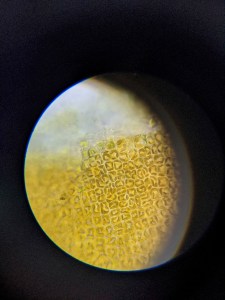
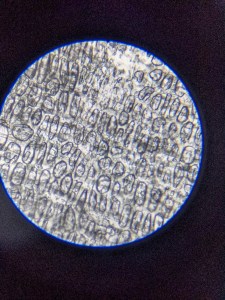
The pandemic has forced us all to view everything through a different perspective. We recently got a microscope in an effort to offset the crushing psychological weight of illness, isolation, suffering, and death. The microscope also forces a different perspective.

Here’s an image of fresh seaweed from Puget Sound (400x):

Here’s an image of garlic skin (100x):

Plant cells continue to build organized structures; chlorophyll continues to convert sunlight into sugars; carbon continues to cycle in and out of life forms. The seasons will continue to change; this season of grief, loss, and sadness will also pass.

Categories
Homelessness Nonfiction Observations Seattle

Leaves of Remembrance.

Throughout Seattle there are small metal plates in the shape of maple leaves that are embedded into the sidewalk. These are “Leaves of Remembrance” that “bear names of homeless women and men who’ve died, so that every person will have a place to be remembered”. People walk on and around them all the time, unaware of the purpose or significance of the leaves.

Only a few people were on the block that morning. It was not yet 8am, so the offices were still closed. The door to the corner store was open, though no customers were inside. A man was leaning against the building on the far end of the block, smoking a cigarette. The light of the sun was just starting to break through the grey clouds.

A man was squatting on the ground, inspecting the Leaves of Remembrance surrounding him. Near him was a styrofoam container of Cup Noodles, the lid removed. He dipped a white napkin into the ramen cup and rubbed it on a metal leaf. He leaned forward to inspect his work, leaned back to change his perspective, then wiped the entire leaf clean. After rotating his body, he began washing and wiping the neighboring leaves.

I’m not sure if he ever lived outside, though he has had his own apartment for years now. Does he recognize the names on the leaves? Was this his way of commemorating someone he once knew? Was this his way of helping to beautify the neighborhood? Is this part of his routine and I simply had not noticed until that morning?

He looked up when I walked past, though he did not recognize that I work as his psychiatrist. I did not greet him, though thanked him silently for his act of kindness during this time of calamity.

Categories
COVID-19 Homelessness Nonfiction Seattle

Dear Maria in March 2020.

Dear Maria in March 2020,

Hi. This is Maria in March 2021. I just want to let you know that you will be alive and well a year into the Covid-19 pandemic. Said nicely: You aren’t prepared for the next 12 months. To be fair, no one is prepared. You and your colleagues who serve people living outside, in shelters, and in permanent supportive housing are going to have a rough year.

First of all, remember that relentless fatigue you felt while you were in training, particularly as an intern? The constant realization that there was so much you didn’t know, the chronic anxiety of what harm you might cause because of your inexperience, and the physical exhaustion that came from working long hours and trying to keep yourself together? There will be many days in 2020 when you will feel something like that. The quality, though, will be different for two main reasons: One, because you do have more experience now, you will have more confidence in what you do and do not know. Two, you unfortunately will not be able to escape this fatigue. It will only worsen as the year goes on. There will be no resolution in March 2021. You won’t be able go off service; there will be no “golden weekends”. You will think about the pandemic and consider what you could or should do about it every single day.

People who receive services in the agency you work in will die from Covid-19. The number will be small—not even double digits—which will surprise everyone, especially you. Initially, you will think the low numbers must be due to luck. Once a Covid outbreak happens in the White House, however, you will recognize the value of the policies and procedures you and the team enacted. You will feel bountiful gratitude to staff for their willingness to follow these protocols, as annoying and inconvenient as they will be. It is because of staff efforts that so few people will get sick.

An uplifting event—one of only a few, I’m sorry to say—will happen in early 2021. You and your teams will establish an in-house Covid-19 vaccination clinic! During those vaccination clinics, staff from all over the agency—older people with various medical conditions, young people who just got out of school, people who left other careers to work in social services, people who do not speak English as their primary language—will come to receive vaccinations. They will express the hearty thanks to you and your staff. You will recognize the depths of their thanks because you will have felt the same way when you get your vaccinations from the beloved county hospital. By March 2021, you and your teams will be eager to vaccinate people receiving care from the agency, but the agency won’t have either the supply or permission to do so just yet.

It will be a terrible year. For many weeks, you will worry you will burst into tears at work. Instead, you will weep at home. It’s the kind of crying where you need to breathe, but all the muscles in your torso contract, so nothing moves. Anger and frustration are your constant companions; what will happen if you let them go? Must you be alone with the grief that you and everyone else feels?

Though few people will die from Covid, people will die. Data will show that the number of people who died in 2020 isn’t greater than the number of people who died in years past, but there will be more deaths on site. People will tumble from windows. The Women in Black will state a stunning number of people—young people, all under the age of 30—died from apparent suicides. The medical examiner will report again and again that someone died from an overdose. Older people won’t exit their apartments; their bodies will be found inside when they don’t respond to door knocks and phone calls.

You will feel anger towards a federal administration that will not demonstrate any concern towards the health and well-being of the nation’s residents. You will witness multiple system failures because there will be no federal coordination or planning. In conversations with state and local public health officials, you will preface your comments with an acknowledgment that they cannot provide optimal support to the community when they are not receiving support or information from the federal government.

Despite your grief and anger, you will often feel gratitude. Is this is a coping mechanism or a genuine reaction? It doesn’t matter. You will be grateful for the generous, non-reactive, and dedicated natures of the colleagues on your teams. You will express thanks that staff don’t quit in droves. You will feel gratitude to people under your care who follow guidance and demonstrate astonishing resilience. You will feel ongoing thanks that no one on staff gets sick and dies. You will be grateful that you still have a a job and are able to buy food and pay your bills when so many others cannot.

I am sorry to say that the pandemic is still ongoing in March 2021. Maria in March 2022 may be able to say more about how much you (and I) have learned and changed. (Perhaps it will be Maria in 2023 or 2025 who will comment on this.)

Do what you can to take care of yourself every day. I might even suggest that you write more, though will understand why if you don’t.

Sincerely,
Maria in March 2021