Categories
Homelessness Nonfiction Observations Seattle

Leaves of Remembrance.

Throughout Seattle there are small metal plates in the shape of maple leaves that are embedded into the sidewalk. These are “Leaves of Remembrance” that “bear names of homeless women and men who’ve died, so that every person will have a place to be remembered”. People walk on and around them all the time, unaware of the purpose or significance of the leaves.

Only a few people were on the block that morning. It was not yet 8am, so the offices were still closed. The door to the corner store was open, though no customers were inside. A man was leaning against the building on the far end of the block, smoking a cigarette. The light of the sun was just starting to break through the grey clouds.

A man was squatting on the ground, inspecting the Leaves of Remembrance surrounding him. Near him was a styrofoam container of Cup Noodles, the lid removed. He dipped a white napkin into the ramen cup and rubbed it on a metal leaf. He leaned forward to inspect his work, leaned back to change his perspective, then wiped the entire leaf clean. After rotating his body, he began washing and wiping the neighboring leaves.

I’m not sure if he ever lived outside, though he has had his own apartment for years now. Does he recognize the names on the leaves? Was this his way of commemorating someone he once knew? Was this his way of helping to beautify the neighborhood? Is this part of his routine and I simply had not noticed until that morning?

He looked up when I walked past, though he did not recognize that I work as his psychiatrist. I did not greet him, though thanked him silently for his act of kindness during this time of calamity.

Categories
COVID-19 Homelessness Nonfiction Seattle

Dear Maria in March 2020.

Dear Maria in March 2020,

Hi. This is Maria in March 2021. I just want to let you know that you will be alive and well a year into the Covid-19 pandemic. Said nicely: You aren’t prepared for the next 12 months. To be fair, no one is prepared. You and your colleagues who serve people living outside, in shelters, and in permanent supportive housing are going to have a rough year.

First of all, remember that relentless fatigue you felt while you were in training, particularly as an intern? The constant realization that there was so much you didn’t know, the chronic anxiety of what harm you might cause because of your inexperience, and the physical exhaustion that came from working long hours and trying to keep yourself together? There will be many days in 2020 when you will feel something like that. The quality, though, will be different for two main reasons: One, because you do have more experience now, you will have more confidence in what you do and do not know. Two, you unfortunately will not be able to escape this fatigue. It will only worsen as the year goes on. There will be no resolution in March 2021. You won’t be able go off service; there will be no “golden weekends”. You will think about the pandemic and consider what you could or should do about it every single day.

People who receive services in the agency you work in will die from Covid-19. The number will be small—not even double digits—which will surprise everyone, especially you. Initially, you will think the low numbers must be due to luck. Once a Covid outbreak happens in the White House, however, you will recognize the value of the policies and procedures you and the team enacted. You will feel bountiful gratitude to staff for their willingness to follow these protocols, as annoying and inconvenient as they will be. It is because of staff efforts that so few people will get sick.

An uplifting event—one of only a few, I’m sorry to say—will happen in early 2021. You and your teams will establish an in-house Covid-19 vaccination clinic! During those vaccination clinics, staff from all over the agency—older people with various medical conditions, young people who just got out of school, people who left other careers to work in social services, people who do not speak English as their primary language—will come to receive vaccinations. They will express the hearty thanks to you and your staff. You will recognize the depths of their thanks because you will have felt the same way when you get your vaccinations from the beloved county hospital. By March 2021, you and your teams will be eager to vaccinate people receiving care from the agency, but the agency won’t have either the supply or permission to do so just yet.

It will be a terrible year. For many weeks, you will worry you will burst into tears at work. Instead, you will weep at home. It’s the kind of crying where you need to breathe, but all the muscles in your torso contract, so nothing moves. Anger and frustration are your constant companions; what will happen if you let them go? Must you be alone with the grief that you and everyone else feels?

Though few people will die from Covid, people will die. Data will show that the number of people who died in 2020 isn’t greater than the number of people who died in years past, but there will be more deaths on site. People will tumble from windows. The Women in Black will state a stunning number of people—young people, all under the age of 30—died from apparent suicides. The medical examiner will report again and again that someone died from an overdose. Older people won’t exit their apartments; their bodies will be found inside when they don’t respond to door knocks and phone calls.

You will feel anger towards a federal administration that will not demonstrate any concern towards the health and well-being of the nation’s residents. You will witness multiple system failures because there will be no federal coordination or planning. In conversations with state and local public health officials, you will preface your comments with an acknowledgment that they cannot provide optimal support to the community when they are not receiving support or information from the federal government.

Despite your grief and anger, you will often feel gratitude. Is this is a coping mechanism or a genuine reaction? It doesn’t matter. You will be grateful for the generous, non-reactive, and dedicated natures of the colleagues on your teams. You will express thanks that staff don’t quit in droves. You will feel gratitude to people under your care who follow guidance and demonstrate astonishing resilience. You will feel ongoing thanks that no one on staff gets sick and dies. You will be grateful that you still have a a job and are able to buy food and pay your bills when so many others cannot.

I am sorry to say that the pandemic is still ongoing in March 2021. Maria in March 2022 may be able to say more about how much you (and I) have learned and changed. (Perhaps it will be Maria in 2023 or 2025 who will comment on this.)

Do what you can to take care of yourself every day. I might even suggest that you write more, though will understand why if you don’t.

Sincerely,
Maria in March 2021

Categories
COVID-19 Education Medicine Seattle

Information about the Covid-19 Vaccines for a Non-Medical Audience.

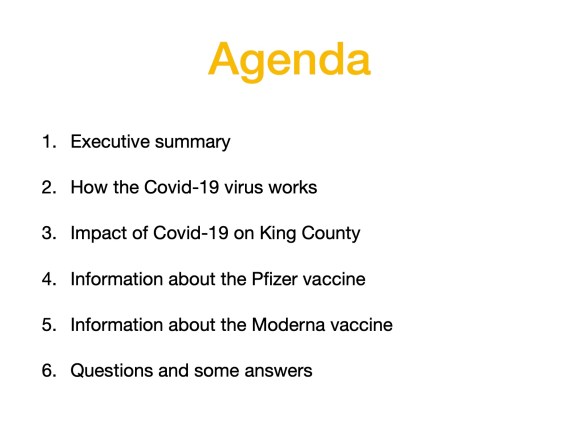
For work, I created a presentation about the current Covid-19 vaccines for a non-medical audience. Maybe you will find it helpful, too. Here’s the agenda:

… where King County refers to the county in Washington State where Seattle is located. The presentation reviews the New England Journal of Medicine paper on the vaccine from Pfizer, as well as the data Moderna shared with the FDA. (Note that I made this slide deck near the end of December, so, if you are reading this in the distant future, data included may be different.)

I usually don’t include so much text in my slides. I made an exception here, as there are nearly a thousand people working at the agency and many may not be able to watch and hear me present this live. Enjoy.

Categories
Consult-Liaison COVID-19 Homelessness Medicine Nonfiction Seattle Systems

“The Impact of Covid-19 on Homeless Services in Seattle.”

On Friday, I presented Grand Rounds to an agency in New York City. The title of my presentation was “The Impact of Covid-19 on Homeless Services in Seattle, Washington”. The audience was comprised mostly of psychiatrists who also work with people who are currently unhoused or have been homeless in the past.

In some ways, this presentation was easy to create: I simply described the agency I work for and walked the audience through the timeline of events:

While the Seattle-King County region was scrambling due to the first death from Covid-19, the first case of Covid-19 was diagnosed in New York City on March 1.

In other ways, this presentation is the only one I’ve made where I had to take breaks while making it because of anger, grief, and sadness.

The month of March was hectic for us and everyone else: We tossed routine policies out the window and scribbled new ones down. We shattered many of our old habits and hastily introduced new practices. Our collective workload increased significantly as we tried to be as flexible and responsive to the changes that were coming at us. We watched systems grind to a halt because systems can’t change that fast: We had to buy hand sanitizer from local distilleries and we donated N95 masks to hospitals. Systems that had long failed us suddenly had the harsh glow of media light on them: In all of Seattle, there were only five bathrooms with hand-washing sinks that were open 24/7. Congregate shelters, where over 200 people had no choice but to share one giant room and one bathroom, suddenly became unacceptable because the beds were not at least six feet apart.

And, yet, eight months later, not much changed. We haven’t had the opportunity to abandon restrictions; many of these new practices are now status quo because the situation hasn’t gotten better. I was honest with the audience: There was no resolution or hopeful conclusion at the end of my talk. Why was that? How could it be that, eight months later, things hadn’t actually changed much?

The audience said nothing. What is there to say? The lack of ownership and coordination at the federal level is the same now as it was in March/April. New York City has significantly more resources than Seattle, though those resources only go so far while SARS-CoV2 can cross state lines and national boundaries when no barriers are erected and no interventions happen. If people in a boat are not rowing in the same direction—or if people aren’t rowing at all—then the boat and everyone in it wastes a lot of time and energy.

I was surprised by the gifts of validation from the audience. Yes, we all work as psychiatrists and the last time most of us saw someone get intubated was when we were residents. However, we all recall doing consults on people in the ICU who were sick. Ostensibly, we were there to take care of the patient and maybe their family members. We also know, though, that an important (and often unspoken) part of psychiatric consults is to support the treating team.

We all have a sense of how terrible it is for the treating teams. These are the reasons why we desperately try to keep people healthy and out of hospitals. We know that our contributions are small—most people don’t live on the streets, in shelters, or in supportive housing; most people don’t have diagnoses of schizophrenia or severe substance use disorders—but we also know that our people are often maligned when they pass through the doors into traditional health care systems. We all have a sense of how terrible it is for our people. We also know that, due to the stress of living marginalized lives, our people often have more severe health conditions. They already have many risk factors that increase the likelihood of complications and death due to Covid-19. We’re trying to mitigate the stress of everyone involved.

It’s heartbreaking, terrible, and unfair.

To end the talk on a positive note, I mentioned several things I am grateful for:

  • The rainy season has arrived in Seattle and I get to sleep in a dry bed indoors.
  • I have confidence in where I am going to sleep tonight.
  • I have a job and can pay my bills.
  • I know I will eat (again!) today.
  • There now exists technology where I can speak to an audience of colleagues on the other side of the continent!

These both mean a lot and nothing at the same time.

In the meantime, we continue to do what we can while we wait.

Categories
Observations Seattle Systems

About the CHAZ….

You’ve heard about Seattle’s Capitol Hill Autonomous Zone (CHAZ), right? With free press from President Trump, people both in the US and abroad now know about the “Seattle takeover” and his imperative to “Take back your city NOW”.

Well, dear reader, if you believe that I am reliable narrator, let me share with you my observations of the CHAZ.

First of all, this is how the CHAZ website describes the Capitol Hill Autonomous Zone:

The Capitol Hill Autonomous Zone née “Free Capitol” is a 6 block section around the East Precinct in Seattle, WA. Abandoned by police and left to burn, this area was instead siezed [sic] by anarchists, BLM supporters and other protestors who have since transformed it into a unverisal [sic] community based on mutual aid. Fundamentally, CHAZ is an occupation of Capitol Hill, not an official declaration of independence.

Here’s some context about the Capitol Hill neighborhood where the CHAZ is located: In addition to being the gay mecca of the Pacific Northwest, Capitol Hill is the hip neighborhood of Seattle.[1. Some would comment that Capitol Hill is the hipster, not hip, neighborhood of Seattle.] Bars old and new cater to the spectrum of genders. There’s wood-fired bagel cafe; a bike shop where, after spending time in the physio lab, one can order a Matcha Chicken Avocado Bowl; and a music venue called whose full name includes “Crystal Ball Reading Room”. Two blocks south from the CHAZ is a dealership shared by Ferrari and Maserati. A local cafe offers apricot jam doughnuts for $3.85 each. Rent for a one-bedroom apartment near the CHAZ is around $2000 a month.

Now, onto my observations:

According to the City of Seattle, about 65% of the city population is white and nearly 7% are Black. The vast majority of people (much more than 65%) I saw in the CHAZ were white. Perhaps this was due to the clumps of white tourists who wanted to witness the CHAZ themselves. Maybe white allies had taken upon themselves to “do the work” and use the CHAZ to advocate for Black Lives Matter (BLM) causes and demands. (Of note, I cannot find any comments from the Seattle-King County chapter of BLM about the CHAZ.) Despite the ongoing pandemic, a notable fraction of these white individuals were not wearing face coverings.

While there is a beautiful mural of “Black Lives Matter” physically on Pine Street and references to Black individuals of Seattle and beyond who have been killed by police, the overall vibe of the CHAZ seems more focused on opposing authority. The graffiti on and around the now abandoned police station, the “conversation cafe” stations, and the new community gardens seemed to chiefly cater to white audiences and suggest an anti-establishment philosophy. Black Lives Matter and “a universal community based on mutual aid” are not the same thing, and this is highlighted in the deliberate demands of the Seattle-King County chapter of Black Lives Matter. To be fair, there is overlap between the demands of CHAZ and BLM, though what people do often reveals actual intentions compared to what people say.

In addition to philosophical contrasts, there were physical contrasts within the CHAZ. A man was hugging his adult poodle like a baby, while a crowd of people were nearly running after a man who was yelling at someone about a stolen phone. A white man with what appeared to be a taxidermy weasel draped around his shoulders got into a profane shouting match with a Black man (one of the very few I saw) seated on a bench, a push cart stuffed with belongings next to him.[2. I promise you, dear reader, that there was indeed a man who had draped what appeared to be a taxidermy weasel around his neck. Maybe it was a plush weasel, but the effect was the same.] A (white) man was shoveling wood chips into a new community garden marked with a hand-written sign that read “This garden is for Black and Indigenous folks and their plant allies”. All the doors to the public bathroom were closed and the phrase “shoplift your future back” was scrawled in spray paint on its foundation.

Meanwhile, Seattle Parks and Recreation collected trash from the CHAZ and hauled it away. An employee, wearing a face covering, emerged from a Seattle Public Utilities truck with a clipboard and headed towards the park.

Here are my questions:

Is the Capitol Hill Autonomous Zone a distraction from Black Lives Matter? If yes, what are the consequences of that distraction at local, state, and federal levels, now that President Trump has condemned this “occupation of Capitol Hill”? What are the consequences to BLM if it is conflated with the CHAZ?

Could an Autonomous Zone exist anywhere else in Seattle? Does it matter that this part of Capitol Hill is young, trendy, and expensive? Could the Autonomous Zone exist in a Seattle neighborhood with more Black lives, such as the Central District or Rainier Valley? Even if the Autonomous Zone could exist in another neighborhood, would it exist? Would protestors want that? Would the neighborhood support that?

Has the local chapter of BLM made a statement about CHAZ? If yes, why is it difficult to find? If no, what worries or hopes does BLM have about doing so? The Seattle-King County BLM chapter has demonstrated great thoughtfulness about its activities in the midst of this pandemic, including specific rules about their protest. Their silent march drew around 60,000 protestors despite the rain. I look forward to learning more about and supporting their perspectives.

Will the CHAZ protestors vote? Some argue that the only way to change the system is to join it. Others insist that change can only come from the outside, as there are too many conflicting interests from within. Voting applies in either scenario.

Will the CHAZ protestors follow the lead of BLM? Sometimes the urge to “do something” is overwhelming, when the most productive and helpful action is to wait and follow. Before people congratulate themselves on the actions they are taking, it is prudent to ensure that these actions are in the service of the goal that will both change and improve the system.

How will the CHAZ end? Will the protestors leave of their own accord? Will they stay until forced to leave? Will there be non-violent negotiations, or will we witness more violence? How much effort will Seattle Police put into returning to their precinct building? What is the Mayor’s strategy about this, now that she is the target of antagonizing messages from both Seattle residents and the President of the United States?

When will the CHAZ end? With unemployment rates high in Seattle, as in the rest of the nation, some people may choose to remain in the CHAZ because the economy continues its slump. There is a Presidential election in November and if the President continues to give his attention to the CHAZ, that may reinforce their desire to remain. If Seattle sees a spike in coronavirus cases, will the city recruit Public Health to help assess the safety of the encampments and gatherings and then ask people to leave?


If you live in the Seattle-King County area and are able, please donate money to the Seattle-King County chapter of Black Lives Matter. Whether you live in Seattle or elsewhere, please also participate in the US Census and make sure you vote in the upcoming elections. Please continue to ask questions, engage your mind, and exercise critical thinking. Change will take all of us.