Categories
COVID-19 Nonfiction Policy Public health psychiatry Systems

Pandemic of Demoralization.

I haven’t posted much recently because I don’t want to be a bummer. There’s enough of that in the world right now: disasters on a global scale and quiet tragedies just down the block.

I worry about the health care workforce. While it is indeed a privilege to go to school to learn about illness and health and then apply those skills to people who somehow trust us, this pandemic has squeezed and stretched us in ways none of us could anticipate. Not only do we see people who get sick with Covid-19, but we also see all the people who get sick from everything else because of the system pressures and failures due to Covid-19.

I see the fatigue on my colleagues’ faces; I see their struggles in trying to provide the best care they can when they themselves are not thinking or feeling their best—now going on for over a year.

We all remain focused on the Covid pandemic, though the demoralization[1. “Demoralization is a feeling state of dejection, hopelessness, and a sense of personal “incompetence” that may be tied to a loss of or threat to one’s own goals or values.”] pandemic has already descended upon us. While the pandemic has fostered more conversations about mental distress and illness, no robust system has emerged to take care of those who take care of others.[2. It is not only health care workers who would benefit from care from people and systems.] (How could we expect a robust system to emerge when the system—if there was one—was fragile prior to this pandemic?) This distress manifests in dreams and dissociation, prickliness and physical pain, withdrawal and wretchedness.

I never formulated my specific work as “public health psychiatry”, though, in the months before the pandemic, this idea crystalized in my mind. Most of my career has focused on the “deep end” of the system: homelessness, crisis, jails, and poverty. While people can and do get better, the challenges are great when one is reacting to, rather than navigating through, these barriers and systems.

So much of what I do is tertiary prevention (“managing disease post diagnosis to slow or stop disease progression“). Fewer people would need “deep end” services if there were more agile and reliable primary and secondary prevention systems. How much healthier would people be if they were never sexually assaulted as children? if parents were able to feed themselves and their children with confidence? if everyone had a stable and safe place to live?

For our health care workforce now, it is too late to prevent demoralization and exhaustion. It seems that the best that we can do is prevent more harm from happening. Tertiary prevention is still prevention, though this is hard to reconcile with the realities of our daily work: Will tertiary prevention buoy us enough so that we can give good enough care to our patients?
Categories
COVID-19 Education Reflection Seattle

On Pushing Vaccines.

This summer is like last summer: We (a homelessness and housing agency) have had very few Covid cases in the past month or so. If this year is like last year, our reprieve will end in mid-autumn.

With this lull, I received recommendations to send out information about the current state of the pandemic as it relates to our agency. I hemmed and hawed before writing the crappy first draft: Everyone is tired and no one wants to read another e-mail. In this draft I waffled about commentary about vaccinations.

While vaccination rates in the Seattle-King County area are around 70% (and thus higher than other parts of the country), this doesn’t mean that everyone has been eager to receive a vaccine. There are people who have made a firm decision to forever decline it. There are also people who remain unsure.

I have felt disappointed and weary upon hearing the disdain of leaders and experts towards people who have not gotten vaccinated. I understand their frustration: No one wants to see people get sick and die. There are many ways to die and dying from Covid-19 is an undesirable way to leave this world.

That being said, scolding or berating people to make a specific choice is rarely (if ever) effective. If someone tells you that you are selfish because you won’t eat vegetables, that probably won’t increase the chances that you will eat vegetables. You might instead avoid this specific someone: Who wants to hear that they are a selfish person? (You can replace eating vegetables with any other behavior, identity, or choice: You are a selfish person because you choose to believe in liberal political ideas. You are a selfish person because you think abortion is wrong. You are a selfish person because you want to defund the police. You are a selfish person because you believe that Jesus was crucified for your sins. Calling someone selfish rarely promotes inquiry or conversation.)

People have shared with me a wide variety of reasons as to why they don’t want to get vaccinated. Some of those same people end up getting vaccinated… maybe because of our conversation, maybe not. I suspect that most didn’t even share all of their reasons with me because they might have felt embarrassment if they did.

If someone is willing to talk with you about a choice they want to make, that also means that they are talking with themselves about that very choice. Any conversation you have with them may carry on in your absence.

I don’t know if this is actually an adage in psychiatry, though I recall several people sharing this while I was in training: As long as someone is alive, there is still hope. Things can still change. People want to make their own choices, though; no one likes coercion. People aren’t stupid, either: They often know when someone is using force to try to change their minds or behaviors. (This use of force doesn’t have to be dramatic either: It can be a simple statement like, “I need loyalty.“)

As long as someone is still alive, there is still hope, and we can use that hope to keep the conversation going. People will share their worries with you if they are willing to give you the chance to change their minds. They will only give you that chance if they have some trust in you. They will have some trust in you if you have genuine interest in their worries and beliefs. People want to be understood. People want dignity.

You may fear that there isn’t enough time: What if they get infected with Covid-19 tomorrow and die next week? Maybe if we put more pressure on people, they will move faster.

Alternatively, if we put undue pressure on people, they may choose to never speak to us again. Any time that we did have is now completely gone. You can play the long game or you can prematurely end the game.

To be clear, I’m not saying any of this is easy or that a select few of us have magical abilities and endless patience to help people change their minds. I do, however, have experience working with people who were not making choices that I wish they would make: People who were living outside and refused to move into housing due to beliefs that were not rooted in reality. People who were using drugs and alcohol for many years. People who declined to take medication even though literally everyone else witnessed their improved health, wellbeing, and function when they did so.

Sighing and making exasperated comments at people who are living outside rarely makes them move into housing faster. Yelling at people who are using drugs and alcohol almost never makes them stop using. Forcing people to take medications does not make medications suddenly more appealing to people who usually refuse them.

Am I fully vaccinated? Yes. Do I wish more people would accept the Covid vaccines? Yes. Do I think threats or domination, even in slight forms, will succeed? No. At this point, efficiency no longer seems effective.

Categories
COVID-19 Nonfiction Reflection Seattle

Desperation.

It is the summer solstice and, at this latitude, there are 16 hours of daylight today. With the trees bursting with green leaves and the blue sky without clouds, we quickly forget that the dark, wet winter days are what put the shimmering snow we now see on the distant mountains.

As we pour outside in our shorts, tee shirts, and sunglasses, we don’t speak of desperation: The desperation during the winter solstice, when thousands of people in the US died each day from Covid-19, when mothers quivered from feelings of unfair guilt due to the impossible burdens of raising children and working, when poor people wondered if they could get work that day to buy enough food to feed their families. When there were only eight and a half hours of daylight, desperate tent cities popped up like mushrooms following a storm. Desperate women smoked stimulant drugs like methamphetamine to stay awake through the night to decrease the chance that someone would rape them. Desperate young people took their own lives, unable to foresee how their circumstances could ever improve.

The cool breeze from the Salish Sea on this glorious summer day doesn’t sweep away the desperation: Emergency departments, hospitals, and clinics don’t have enough staff[1. Who and where are the people taking care of the health care workers?] to care for the desperate people seeking help. Institutions struggle with race and racism: Why did the white supervisor enter the Black person’s office and remove the “Black Lives Matter” sign that was adorned with the institution’s logo? Sirens[2. Who and where are the people taking care of first responders?] continue to wail through the streets at all hours, past the tent cities that persist outside of boarded up storefronts, under freeways, and in patches of public land overrun with dandelions.

Though we don’t speak of desperation, we feel it and then grasp with greed: Let me witness the shaking of the leaves as the breeze moves through the trees. Let me listen to the arboreal applause. Let me squint at the sunlight and find the moon during the day. Let me watch the clouds, let me witness how they change, let me remember that clouds always change, that they are always with us even when they disappear from view. Let me recognize what the clouds are trying to teach me.

I survived. The pandemic has been with us for over a year and I was lucky enough to live. I never got infected, I never got sick. I was not one of the 601,000+ people in this country who died. Don’t I have some obligation to make the most of my time here because I lived?

The antidote to desperation is gratitude, though even my gratitude feels desperate. There are so many people to thank and prayers of gratitude to utter. I want to hold this summer day in my hands, to feel the texture of the evening breeze, to see how the sky changes colors as the earth rotates away from the sun tonight.


Categories
COVID-19 Nonfiction Reflection Seattle

Freedom and Worry.

Over a year had passed since my father, a Chinese American in his 70s, had eaten a meal with another person.

Prior to the pandemic, he set out from his apartment every weekday morning to walk through downtown Seattle. He enjoyed disappearing into the crowds that provided him with anonymity and safety. The concrete hills provided a physical challenge and the fresh air rejuvenated his spirits.

When the Covid-19 pandemic arrived, my father, a reluctant senior citizen, cloistered himself in his apartment. He left his home only to buy groceries, as he wanted to choose his own bunches of baby bok choy, sacks of rice, and cloves of garlic. Though he and I met every Sunday to walk together, he declined to meet: His fears of getting sick were greater than his desire to walk outside. He learned how to make video calls and paced in his apartment.

With the summer weather and declining Covid-19 case counts, along with coaxing from his daughter about the mental health benefits of walking, my father resumed his routine strolls. The commuter crowds had vanished. A face mask provided him with anonymity and safety, though only boarded windows and people with nowhere else to sleep other than the sidewalk witnessed him walking up and down the concrete hills.

Neither the cooler weather nor autumnal rains discouraged him from walking outside. However, when he learned that a few people had shoved elderly Asian Americans to the ground, he paused. “I am a senior citizen,” he murmured, “and I can’t move fast. That could be me.”

When someone knocked a young Asian American woman unconscious in Chinatown, he gave up his morning walks. With a chuckle, he explained, “It’s okay! Walking in my apartment is just as good as walking outside.” He and I both knew that this is untrue. He then tried an alternative explanation: “It’s because I haven’t gotten the Covid vaccine yet.” Then, after he got his vaccination? “There’s still anti-Asian sentiment. Walking in my apartment is just as good as walking outside.”

My father immigrated to the US before Congress proclaimed the first ten days of May as Asian/Pacific American Heritage Week. He knew that some Americans would view him with condescension: Though fluent in English, he speaks with a Chinese accent. He grew up in a different culture marked by poverty, military rule, and limited opportunities. He recognized that he did not look, think, or act like “real” Americans who were corn-fed with blue eyes and blonde hair. However, he never thought that America would stray so far from its expressed ideals, that white supremacy would declare itself without shame, that everyday people might assault him because of these differences.

This is the paralyzing toxicity of racism. Most people will not push an elderly Chinese American man to the ground. However, when a few individuals scream racial slurs at people who sound like you and slash faces that look like yours, you wonder how much anonymity and safety you actually have. It doesn’t matter that my father worked in computer programming before it was cool at companies like McDonnell Douglas and Boeing. It doesn’t matter that he protested against the government of China after the Tiananmen Square massacre. It doesn’t matter that he loves America because of the ideals of democracy, freedom, and justice.

When you don’t know when you should be worried, you always worry.

Recently, my father and I were finally able to share a meal in his apartment. In those quiet moments, we enjoyed freedom from worry: We had health, safety, and peace. The US now dedicates the entire month of May as Asian American and Pacific Islander Heritage Month. Asian Americans continue to wonder if others will ever accept the “American” part of that label. When we can stop worrying?

Categories
COVID-19 Nonfiction Observations Reflection Seattle

The Things We See and Don’t See.

It was my father who alerted me about the “white lives matter” protest scheduled today in Huntington Beach, California.

“I’m so glad you don’t live there anymore,” I sighed. We both knew that this protest would likely occur around Pacific Coast Highway and Main Street, an intersection we had crossed hundreds of times in our lives. When I was a child, each parent grasped one of my hands and ushered me across PCH to access the famous Huntington Beach pier. As a youth, I rode my Schwinn 10-speed bicycle underneath the pier, usually my father ahead of me and my mother behind me. As a younger adult, the three of us walked to the end of the pier, where my parents had scattered the ashes of my paternal grandparents. Six months after my mother died, my father and I, along with a few other distant relatives, scattered her ashes into the rolling waves.

In high school, I learned to avoid the pier after dusk because skinheads were often around Main Street. At the time, I did not fully understand their beliefs nor the danger they represented. Now, as I read about the recent KKK propaganda and white supremacy violence from the years I lived there, I wonder how much racism we experienced during my youth that neither my parents nor I recognized. There was (and is) great pressure to assimilate. For many years, I attributed my discomfort to personal defects. Perhaps ignorance is bliss: Had I recognized and acknowledged the atmosphere of white supremacy, would I have done anything different? Could I have done anything differently?


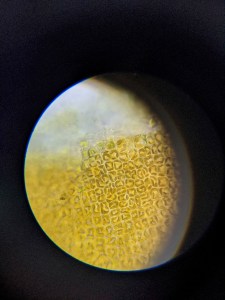
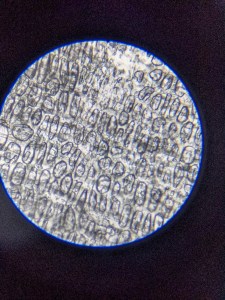
The pandemic has forced us all to view everything through a different perspective. We recently got a microscope in an effort to offset the crushing psychological weight of illness, isolation, suffering, and death. The microscope also forces a different perspective.

Here’s an image of fresh seaweed from Puget Sound (400x):

Here’s an image of garlic skin (100x):

Plant cells continue to build organized structures; chlorophyll continues to convert sunlight into sugars; carbon continues to cycle in and out of life forms. The seasons will continue to change; this season of grief, loss, and sadness will also pass.