Categories
COVID-19 Education Nonfiction

The Pandemic and DBT Skills.

If you look at my archives, you can tell when the burden of the pandemic (whether due to the pandemic itself or the consequences of it) became great: Weeks or months went by without a post. This doesn’t mean I stopped writing; I just stopped posting. Though it is true that some writing (i.e., ranting, rambling) is better kept private, my lack of posting was chiefly due to fatigue. One must think about something to write about something and, you know, I, along with everyone else, am tired and cognitively impaired.

While walking along the still waters of Lake Washington with a friend recently, we reflected on the endless opportunities to practice dialectical behavior therapy (DBT) skills throughout the pandemic. I had the good fortune to learn about and practice DBT for a full year of my psychiatry residency training; I also led the DBT skills training group. As such, I taught the skills to myself over and over again (as that, for me, is the only way I feel comfortable teaching these skills to other people). To the group I often said, “I use these skills all the time.” They may have thought I was telling a white lie, though I was not: I used them all the time and continue to use them now.

Mindfulness. In DBT, this refers to paying attention, without judgment, to what’s happening right now. (See “Right now, it’s like this.”) When we give our attention to what is happening right now, we can witness the events that are (or are not) happening, our reactions to those events, and other “things” we might be adding to the situation. (Our minds are miraculous thought-generating machines, just as our hearts are amazing pumpers of blood. That’s just what they do.) We cannot take next steps if we don’t know what’s happening right now. For example, if a friend is trying to give you directions, but you have no idea where you are, you and your friend will have a hard time finding each other.

The underlying dialectic in DBT is acceptance versus change. If you don’t accept that you don’t know where you are, you cannot change. If I insist that I’m in Los Angeles, even though I’m actually in Seattle, then I am in for a lot of suffering as I try to get to Diddy Riese Cookies by public transport. It is only when I accept that I’m in Seattle that I change and, instead, go to Hello Robin Cookies.

Yes, it’s hard to give our attention to the pandemic and the illness and deaths it has caused, American politics and the ensuing vitriol, and the suffering that both (and other events) have wrought. Acceptance doesn’t mean agreement. Without acceptance, we cannot take next steps.

Distress tolerance. The acceptance described above is a form of distress tolerance (and, in DBT parlance, is called “radical acceptance”). Distress is difficult to tolerate; who among us wants to feel distressed? Wouldn’t you rather feel serene or joyful? Sometimes we worry that the distress will overwhelm us, that the shame or anger will consume us and never go away. Distress tolerance involves mindfulness to attend to what is happening right now, accepting that right now, it’s like this, and then choosing how to cope with the current reality. (See Viktor Frankl’s comment about the space between stimulus and response.) We can’t evade distress. We can choose how we respond to it.

Last winter, one strategy I used to manage my distress was eating a lot of carbohydrates: Pizza, burgers, noodles, dumplings, and my beloved cookies. I understand why I chose that strategy (and it’s one I still fall into on occasion), but it’s not one I want to repeat this year (largely because it didn’t actually reduce my distress much). Oddly enough, the distress feels less acute and piercing this year, perhaps because it is impossible to maintain those physiological and psychological levels of stress for a prolonged period of time. It may also be that I have come to embrace that yes, we all can die at any moment and, thus, we must enjoy all the little things that are lovely while they are happening.

Interpersonal effectiveness. When we don’t feel at our best, our communication and interactions with other people can sour. Not even because we want to come across as aloof or jerky; it just takes energy and mindfulness to assert ourselves and maintain harmonious relationships. Often interpersonal effectiveness skills focus on asking for what you want, managing perceived (and sometimes real) conflict, and boundaries.

If I am alone when I learn of new Covid cases at work, it is not uncommon for me to groan and mumble words that may or may not be profane. Sharing such sentiments with colleagues, though, isn’t helpful and doesn’t increase my effectiveness. Crabbiness generally isn’t charming. Assertiveness scripts or nonviolent communication templates may seem unnatural, though, with practice and personal tailoring, help all of us get along when we’re all feeling tired and cranky.

Emotion regulation. Though internal and external voices may tell you otherwise, your emotions, regardless of what they are, are valid. You feel what you feel. There are, however, things we all can do to increase the likelihood that we will feel certain emotions. In 12-step groups, people often refer to “HALT”: Hungry, Angry, Lonely, and Tired. If we are already experiencing one of those four things, we are more likely to feel worse if another stressor comes our way. (Hence the value of eating and sleeping regularly, as well as building and sustaining community—whatever that may mean to you.) Naming emotions (with the help of mindfulness) is also a skill, as that helps us recognize that we are feeling an emotion, we are not actually the emotion. Emotions give us vital information, though sometimes we realize that there are no logical reasons that underlie how we feel. If I feel anxious because I believe I’m in the way, but I’m not actually in anyone’s way, then the task is to do the thing that will make me feel more anxious… so I eventually stop feeling anxiety due to thoughts about being in the way.

The duration of the pandemic and its consequences makes emotion regulation hard. We can try to reduce our vulnerabilities by eating, sleeping, and connecting with others as well as we can, though ongoing news of illness, death, conflict, and violence reduce our resilience. There are real problems in the systems we live in and under in the US. It is unfair and inaccurate to ask individuals to keep their chins up and “just be happy” when our current context is so abnormal. We, however, can still make choices in that space between stimulus and response.


I often quip (with decreasing levels of energy) that the pandemic is developing my character, though I’m ready to be done with personal growth. Right now, though, it is like this. We also know that everything changes. The pandemic will end (just not when we want it to), things will change (though perhaps not in the way that we anticipate), and many of us enjoy blessings right now that we take for granted (e.g., you are able to read these words! you have access to the internet! most, if not all, of you know where you will sleep tonight! you haven’t died from Covid!).

If you’d like to learn more about dialectical behavior therapy and the four skills above, this website is pretty good and covers the four core skills with plenty of examples.
Categories
COVID-19 Education Reflection Seattle

On Pushing Vaccines.

This summer is like last summer: We (a homelessness and housing agency) have had very few Covid cases in the past month or so. If this year is like last year, our reprieve will end in mid-autumn.

With this lull, I received recommendations to send out information about the current state of the pandemic as it relates to our agency. I hemmed and hawed before writing the crappy first draft: Everyone is tired and no one wants to read another e-mail. In this draft I waffled about commentary about vaccinations.

While vaccination rates in the Seattle-King County area are around 70% (and thus higher than other parts of the country), this doesn’t mean that everyone has been eager to receive a vaccine. There are people who have made a firm decision to forever decline it. There are also people who remain unsure.

I have felt disappointed and weary upon hearing the disdain of leaders and experts towards people who have not gotten vaccinated. I understand their frustration: No one wants to see people get sick and die. There are many ways to die and dying from Covid-19 is an undesirable way to leave this world.

That being said, scolding or berating people to make a specific choice is rarely (if ever) effective. If someone tells you that you are selfish because you won’t eat vegetables, that probably won’t increase the chances that you will eat vegetables. You might instead avoid this specific someone: Who wants to hear that they are a selfish person? (You can replace eating vegetables with any other behavior, identity, or choice: You are a selfish person because you choose to believe in liberal political ideas. You are a selfish person because you think abortion is wrong. You are a selfish person because you want to defund the police. You are a selfish person because you believe that Jesus was crucified for your sins. Calling someone selfish rarely promotes inquiry or conversation.)

People have shared with me a wide variety of reasons as to why they don’t want to get vaccinated. Some of those same people end up getting vaccinated… maybe because of our conversation, maybe not. I suspect that most didn’t even share all of their reasons with me because they might have felt embarrassment if they did.

If someone is willing to talk with you about a choice they want to make, that also means that they are talking with themselves about that very choice. Any conversation you have with them may carry on in your absence.

I don’t know if this is actually an adage in psychiatry, though I recall several people sharing this while I was in training: As long as someone is alive, there is still hope. Things can still change. People want to make their own choices, though; no one likes coercion. People aren’t stupid, either: They often know when someone is using force to try to change their minds or behaviors. (This use of force doesn’t have to be dramatic either: It can be a simple statement like, “I need loyalty.“)

As long as someone is still alive, there is still hope, and we can use that hope to keep the conversation going. People will share their worries with you if they are willing to give you the chance to change their minds. They will only give you that chance if they have some trust in you. They will have some trust in you if you have genuine interest in their worries and beliefs. People want to be understood. People want dignity.

You may fear that there isn’t enough time: What if they get infected with Covid-19 tomorrow and die next week? Maybe if we put more pressure on people, they will move faster.

Alternatively, if we put undue pressure on people, they may choose to never speak to us again. Any time that we did have is now completely gone. You can play the long game or you can prematurely end the game.

To be clear, I’m not saying any of this is easy or that a select few of us have magical abilities and endless patience to help people change their minds. I do, however, have experience working with people who were not making choices that I wish they would make: People who were living outside and refused to move into housing due to beliefs that were not rooted in reality. People who were using drugs and alcohol for many years. People who declined to take medication even though literally everyone else witnessed their improved health, wellbeing, and function when they did so.

Sighing and making exasperated comments at people who are living outside rarely makes them move into housing faster. Yelling at people who are using drugs and alcohol almost never makes them stop using. Forcing people to take medications does not make medications suddenly more appealing to people who usually refuse them.

Am I fully vaccinated? Yes. Do I wish more people would accept the Covid vaccines? Yes. Do I think threats or domination, even in slight forms, will succeed? No. At this point, efficiency no longer seems effective.

Categories
Consult-Liaison Education Medicine Nonfiction Systems

More Annotations on the Britney Spears Transcript.

I have not paid close attention to news about Ms. Britney Spears’s conservatorship over the years, though was interested to learn what she recently had to say about it. I felt both sad and disturbed after I read her remarks. (Here’s an audio recording, too.)

To be clear, I don’t know anything about her, her diagnoses, or the specific details of medical care she has received. Despite spending most of my career working with people with conditions like schizophrenia, bipolar disorder, cognitive impairment, substance use disorders, and often major medical conditions, I have referred very few people for guardianship… and none of them presented like Ms. Spears. I have never provided care to public figures or similar VIPs.

Following are the reactions and questions I had upon reading the annotated transcript of her testimony, for your consideration:

They all said I wasn’t participating in rehearsals and I never agreed to take my medication, which, my medication is only taken in the mornings, never at rehearsal.

I don’t know what medications she takes. If she is referring to any psychiatric medication here, this hopefully suggests that her medications cause only minimal, if any, sedation. Many medications usually prescribed for conditions like schizophrenia and bipolar disorder can make people feel tired, sleepy, or sluggish, particularly when people first start taking them.

I was told by my at-the-time therapist — Dr. Benson, who died — that my manager called him in that moment and told him that I wasn’t cooperating or following the guidelines in rehearsals.

I don’t know the terms of her conservatorship, though it is uncommon for managers to be able to call a patient’s therapist or doctor. Can you imagine if your boss were able to call your doctor to report that you weren’t “cooperating or following guidelines”?

Maybe there are releases on information on file for her manager and doctor to talk to each other, though most people don’t want to mix their personal and professional lives like this. That being said, I have had friends or parents of people under my care call me to share information with me, though they understood that I would say nothing in response. I’ve never had a teacher or boss call me, though.

And he also said I wasn’t taking my medication, which is so dumb because I’ve had the same lady every morning for the past eight years give me my same medication, and I’m nowhere near these stupid people.

So many questions here! Who is this “same lady”? Is this a health care professional, like a nurse? For “every morning”? For the “past eight years”? Does she actually need someone to give her medications every morning? Is she unable to do this herself? (This seems unlikely if she is able to “[rehearse] four days a week”, “[direct] most of the show”, and “[do] most of the choreography”.) Or is the purpose of this “lady” to enforce and report compliance? The usual goal is to help promote people’s autonomy and independence, since no one wants to undergo monitoring like this… especially for eight years!

Presumably this “lady” is also using a medication administration record for Ms. Spears so there is written proof of what she is or is not taking. This might be one way the therapist would know that she “wasn’t taking [her] medication”.

Three days later, after I said no to Vegas, my therapist sat me down in a room and said that he had a million phone calls about how I was not cooperating in rehearsals, and I haven’t been taking my medication. All this was false.

An accurate and truthful medication adherence record would provide proof to both Ms. Spears and her therapist about whether she was taking her medication. This is a document that attorneys, judges, and other people could review.

He immediately, the next day, put me on lithium, out of nowhere. He took me off my normal meds I’ve been on for five years…

If I am reading this right, this means she was under medication administration monitoring for eight years and had been taking the same medications for at least five years (though she said eight years earlier). This suggests a stable medication regimen that she was able to tolerate.

… lithium is a very, very strong and completely different medication compared to what I was used to.

Lithium started at aggressive doses can indeed be “very, very strong”. “Strong” doses of lithium are most often used for people experiencing “mania”, which is a component of bipolar disorder. “Mania” doesn’t mean someone who is “happy” or simply “euphoric”. Mania, in its more extreme forms, looks like increasing amounts of energy in the context of decreased sleep (sometimes for only a few hours, if at all) for many nights, sometimes lasting weeks. People often demonstrate significant changes in behavior during this period of time, such as spending large sums of money they don’t have (e.g., via credit cards) and doing impulsive things that are uncharacteristic of them (e.g., starting businesses with no foundation, having sex with people they don’t know, using drugs or alcohol). Sometimes these combination of behaviors are lethal: People will jump from heights, having full confidence that they can fly.

The thing is, lithium usually doesn’t work that fast. Usually people who are experiencing mania receive lithium to prevent the next episode. They also take something else (ideally for a short period of time) to treat the current episode.

You can go mentally impaired if you take too much, if you stay on it longer than five months.

I don’t know what she means here. Some people take lithium for years (decades!) and they do not “go mentally impaired”. In fact, lithium can be literally lifesaving and keep people well and out of the hospital.

Lithium at high doses, if not properly monitored, can cause sudden changes in mental status and emergency medical problems.

But he put me on that, and I felt drunk.

Yes, this can happen, particularly if the starting dose is high.

I told them I was scared and my doctor had me on — six different nurses with this new medication come to my home, stay with me to monitor me on this new medication, which I never wanted to be on to begin with. There were six different nurses in my home and they wouldn’t let me get in my car to go anywhere for a month.

Six different nurses? Who were staying with her? When people (recall that my experience is limited to non-VIPs, which makes up most of us) are in an intensive care unit (ICU) for a major medical problem, there’s ideally one nurse working with only two patients. Six nurses to one patient is a lot. Maybe she meant she worked with six different nurses, but there was only one nurse in her home at any given time?

People who start taking lithium at conservative doses don’t need this level of monitoring. People who start taking lithium are often still working, taking care of their kids, going to school, etc. When people start taking lithium in a psychiatric hospital, this intensity of monitoring doesn’t happen.

Lithium can be sedating, particularly at high doses, which might be why these nurses prohibited her from driving. But for a month? Does this mean that the dose of lithium was changing/increasing over the course of the month? Or they were overly cautious?

He acted like he didn’t know, but I was told I had to be tested over the Christmas holidays before they sent me away when my kids went home to Louisiana.

It seems that she means psychological testing here, though perhaps this also included getting blood drawn to check the amount of lithium in her blood? This latter bit is called a “lithium level”. As noted above, high levels of lithium can be toxic, so people who take lithium get “lithium levels” drawn on a routine basis to ensure that the levels are not near/at toxic levels. Lithium can also affect the function of kidneys and the thyroid gland, so health care professionals often check these labs, too. If the blood draw doesn’t show any lithium, then that means the person hasn’t been taking it.

Over the two-week holiday, a lady came into my home for four hours a day, sat me down and did a psych test on me. It took forever. But I was told I had to. Then, after I got a phone call from my dad saying, after I did the psych test with this lady, basically saying I’d failed the test or whatever.

I don’t know what this is, either. Did the “psych test” last four hours? (Was it a Structured Clinical Interview for DSM-5? I am skeptical: Why would someone start a medication and then do a “psych test”?)

If you don’t build rapport with people, they will provide incomplete or inaccurate information to you. The onus is on the interviewer to build rapport with the patient. I don’t know what it means to “fail” a “psych test”.

“I’m sorry, Britney, you have to listen to your doctors. They’re planning to send you to a small home in Beverly Hills to do a small rehab program that we’re going to make up for you. You’re going to pay $60,000 a month for this.”

I don’t know what “rehab program” means here. “Rehab” often refers to treatment for substance use disorders, though there are no indications to use lithium for substance use disorders. Psychiatric rehabilitation is also a thing, though this usually refers to providing education and support to people regarding social skills, gaining independence, and other strategies to prevent return to psychiatric hospitals and other intensive models of care. The goal is to keep people in the community and away from institutions.

I worked seven days a week, no days off, which in California the only similar thing to this is called sex trafficking, making anyone work, work against their will, taking all their possessions away — credit card, cash, phone, passport card — and placing them in a home where they work with the people who live with them. They all lived in the house with me — the nurses, the 24-7 security. There was one chef that came there and cooked for me daily, during the weekdays. They watched me change every day — naked — morning, noon, and night. My body — I had no privacy door for my room, I gave eight gals of blood a week.

This sounds like an extreme and unethical version of a “therapeutic community”. (The evidence supporting the application of therapeutic communities isn’t great, though some people who have gone through such programs swear by it.) This sounds more like an upscale jail, which, to be clear, is still a jail.

Humans hold less than two gallons of blood, so I don’t know what she means here. Did she undergo a lot of blood draws? To check her lithium level? To monitor whether she was using any drugs or alcohol? (Checking urine is a less invasive way of doing this.)

And ma’am, I will tell you, sitting in a chair 10 hours a day, seven days a week, it ain’t fun. And especially when you can’t walk out the front door.

If she spent most of her time “sitting in a chair”, then maybe this wasn’t a therapeutic community (and more like jail). People usually have to do chores and attend meetings in therapeutic communities. People in (non-VIP) psychiatric hospitals also don’t spend 10 hours sitting in a chair for seven days a week.

I don’t even drink alcohol — I should drink alcohol considering what they put my heart through. Also the Bridges facility they sent me to…

Today I learned about Bridges to Recovery, “residential mental health treatment in a private, luxury environment”. Is this where she went? Bridges to Recovery is part of Constellation Behavioral Health, which is owned by New MainStream Capital.

New MainStream Capital is a “private investment firm specializing in strategic equity investments in leading middle market companies with an emphasis on sustainable growth trends in both the business services and healthcare services industries.” This tells me that they are more interested in getting as much return on investment for their shareholders than providing quality care to people at Bridges to Recovery.

They have me going to therapy twice a week and a psychiatrist. I’ve never in the past had — wait, they have me going, yeah, twice a week, and Dr. [unclear] — so that’s three times a week. I’ve never in the past had to see a therapist more than once a week.

Yes, that’s a lot of therapy. People who participate in psychoanalysis go to therapy four to five times a week. However, psychoanalysis under normal circumstances is a voluntary process. (Full disclosure: I am biased against psychoanalysis.) If the psychiatrist is providing medication services only, that’s a lot of psychiatrist visits. Maybe they know a lot more than I do: How much meaningful medication tinkering can a psychiatrist do with meds every week, when the mechanism of action for so many psychiatric medications remains unknown? (Exhibit A: The serotonin hypothesis.)

I have a friend that I used to do AA meetings with. I did AA for two years. I did three meetings a week. I’ve met a bunch of women there. And I’m not able to see my friends that live eight minutes away from me, which I find extremely strange.

It sounds like Ms. Spears found AA helpful because of the support she got from her community. Much of what she reported in the transcript sounds like absence of community, which of course will have negative effects on her mental health and wellbeing.

I wanted to take the ID [IUD] out so I could start trying to have another baby. But this so-called team won’t let me go to the doctor to take it out because they don’t want me to have children, any more children.

Many have already commented on her statement that she is not allowed to remove her IUD and how this relates to reproductive justice. This also makes me wonder if she is taking any medications that might result in birth defects.

I am sorry to say that I have had women under my care who underwent involuntary hysterectomies due to their psychiatric conditions. All of these women were in their 70s and 80s, so none of these were recent events, but these women usually were not told that their uteruses were surgically removed until after the fact. By the time I saw them, they were taking minimal (if any) psychiatric medications and were not demonstrating symptoms that would warrant an irreversible intervention without any discussion about it.


There is so much that we don’t know about Ms. Spears and what has happened. I only hope that, if she has experienced injustice at the hands of individuals or systems, she will be vindicated and systems will change for the better.

Categories
COVID-19 Education Medicine Seattle

Information about the Covid-19 Vaccines for a Non-Medical Audience.

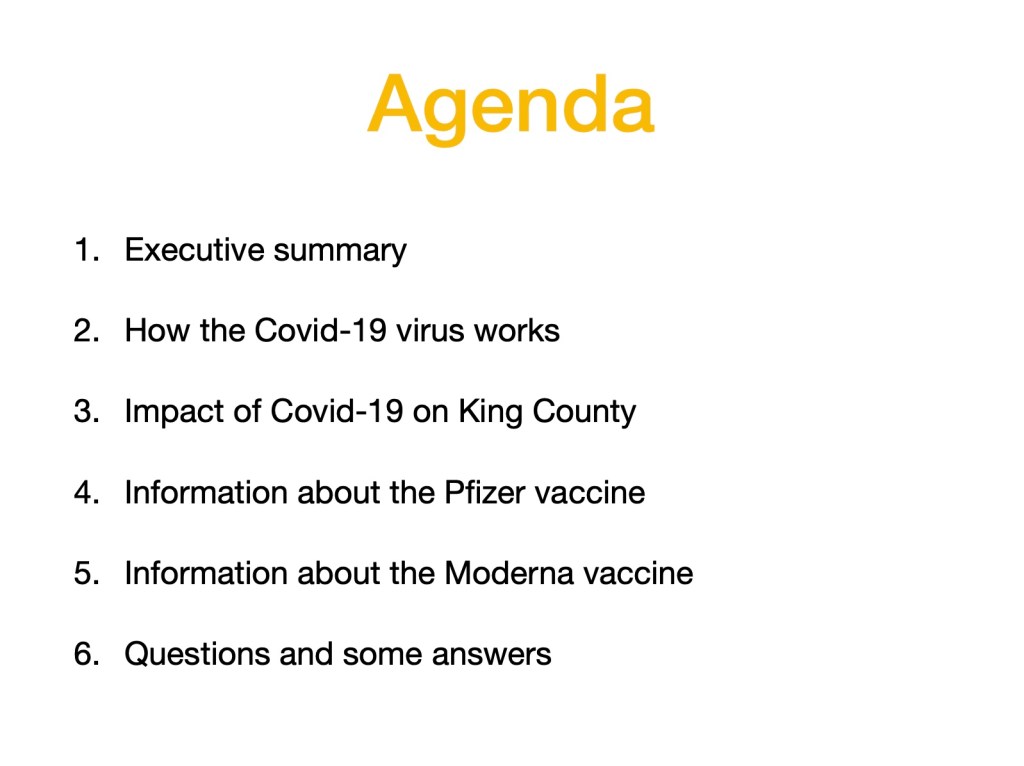
For work, I created a presentation about the current Covid-19 vaccines for a non-medical audience. Maybe you will find it helpful, too. Here’s the agenda:

… where King County refers to the county in Washington State where Seattle is located. The presentation reviews the New England Journal of Medicine paper on the vaccine from Pfizer, as well as the data Moderna shared with the FDA. (Note that I made this slide deck near the end of December, so, if you are reading this in the distant future, data included may be different.)

I usually don’t include so much text in my slides. I made an exception here, as there are nearly a thousand people working at the agency and many may not be able to watch and hear me present this live. Enjoy.

Categories
Consult-Liaison COVID-19 Education

Triangle of Thoughts, Behaviors, and Emotions.

diagram showing that thoughts, behaviors, and emotions are all interlinked

(T) = thought
(E) = emotion
(B) = behavior

All are interrelated and we can intervene at any point of the triangle to change the other factors.

Starting with THOUGHTS:

(T) “The federal government, in providing no support or interventions for the pandemic, has abandoned the people of this nation.”
(E) Anger, sometimes rage.
(B) Eat six servings of cookies.
Result? Fleeting pleasure (E) from the taste and texture of cookies, leading to thoughts of, “I ate too many cookies; I should have done something different” (T), which can lead to disappointment and guilt (E).

(T) “The federal government, in providing no support or interventions for the pandemic, has abandoned the people of this nation.”
(E) Anger, sometimes rage.
(B) Write a blog post about it.
Result? Satisfaction (E) from accomplishing a task that helps me feel more calm (E) and may help other people try something different so they can feel less anger (T).

(T) “The federal government, in providing no support or interventions for the pandemic, has abandoned the people of this nation.”
(E) Anger, sometimes rage.
(B) Go out for a walk.
Result? Sense of calm (E) due to changing my enviroment and recognizing that I am doing something to improve my health (T).

Sometimes we don’t recognize our emotions, which could result in events like this:

(T) “The federal government, in providing no support or interventions for the pandemic, has abandoned the people of this nation.”
(B) Throwing something across the room.

Starting with EMOTIONS:

(E) Grief and anger.
(B) Pull the blankets over your head.
(T) “I don’t want to get out of bed and deal with all the things related to the pandemic.”
Result? Loitering in bed (B) because the world feels overwhelming and I feel helpless (E), which makes me believe that things won’t get better (T).

(E) Grief and anger.
(B) Go out for a walk.
(T) “Look at the leafless trees, how the color of the fog matches the color of the water, how the world seems to reflect our collective mood….”
Result? Recognizing that I at least took a step to take care of my mind and body (T), which helps me feel some measure of serenity and gratitude (E).

(E) Grief and anger.
(T) Think about the how the emotions of grief and anger affect my thoughts and behaviors.
(B) Write a blog post to clarify my thoughts, emotions, and behaviors.
Result? Feeling hope (E) that maybe these words will help other people feel more empowered, less lonely, and less angry (T).

There are some professionals who believe in the “primacy of thought”, meaning that they believe that thoughts precede all emotions and behaviors. I do not hold this view, as (a) our current understanding of thoughts center on the use of language, and sometimes we all struggle to name the emotions we feel and (b) reflexes circumvent thoughts (i.e., we yank our hands away from the flame without thinking about the fire burning our fingers).

Starting with BEHAVIORS:

(B) Clenching my jaw and shoulders.
(E) Anxious. Maybe angry. Maybe sad, particularly since many cultures tolerate and accept anger more than sadness.
(T) “Let’s get up and drink some water. Changing positions will help me relax my jaw and shoulders.”
Result: Momentary release of muscle tension (B) that may help reduce anxiety (E).

(B) Checking e-mail way too many times in an hour to learn updates about people staying in the shelter who may have tested positive for Covid-19.
(T) “Oh, please say that no one tested positive, please don’t let anyone have Covid….”
(E) Anxiety and fear. Probably an attempt to limit prevent guilt, too.
Result: Feeling annoyed (E) with myself for trying to control things that I cannot control (T), then resolving to get up and do something else away from the computer (T) and encouraging myself to adhere to a schedule of checking e-mail (B) so I don’t clench my jaws and shoulders (B) due to anxiety (E)

Thanks for reading this and working through this triangle with me. (This triangle forms the basis of cognitive-behavioral therapy (CBT), in case you wish to learn more.)