Categories
Homelessness Medicine Nonfiction Policy Public health psychiatry Seattle

Who Gets to Be Sad?

For those of you who don’t follow baseball, the Seattle Mariners were in the running to go to the finals in baseball, called the World Series. (So American, of course, to call the finals the “World Series” when it doesn’t involve the entire world!) The Mariners are the only team in all of Major League Baseball that has never been to the World Series.

As such, you can imagine how much of a frenzy the city was in. The Mariners flag was hoisted to the top of the Space Needle twice! The downtown skyscrapers coordinated their night lights to glow in Mariners colors. The mayor raised the Mariners’ flag at City Hall.

Game 7 in the semi-finals, which happened last week, was the “win and go to the World Series, or lose and go home” game. The Seattle Mariners lost.

Over the past week, since that loss, the city has been distraught.

Immediately following game 7, there were brutal postgame interviews. Sports journalists, for obtuse reasons, asked weeping baseball players how they felt.

Here’s Cal Raleigh, our inimitable catcher, showing what his face looked like when he was seven years old and heartbroken:

See how he ran his hand through his hair? That was a desperate act of self-soothing while multiple cameras gave him no place to hide his flushed face and wet eyes.

Meanwhile, here’s Bryan Woo, who turned out to be the team’s ace pitcher this year. He’s not crying, but he is also just trying to get through the interview. A wail of despair interrupts him:

The man whose heartache was heard, but not seen, was our cool center fielder, Julio Rodriguez.

So, are grown men allowed to cry or not? Here were professional athletes caught in the throes of disappointment and sadness. They were crying. Sports journalists pushed microphones into their faces and asked them how they were feeling.

On the one hand, I appreciate this exercise: It’s a chance for these robust young men to model (to other males) how to use words to describe internal experiences. They’re not smashing bats into the walls or punching the journalists. You can talk about unpleasant emotions without resorting to violence or destruction.

On the other hand, asking people about their feelings on camera when they are obviously distressed seems unkind. Sure, baseball players, as public figures, have training about and responsibilities to the media. But such pointed questions do nothing to soothe or support the person. Reporters can also learn the exact same information — how do you feel about losing the biggest game of your professional career to date? — an hour later, when people have had the chance to cry and wail in private. Show some respect, give people some dignity!

But we apparently want to see our heroes cry. We want to know that they feel just as sad as we do.


There are many other people throughout the nation who are crying. They are not professional baseball players; they are not famous. Many of us will never know any of their names.

Some of them were looking forward to leaving the street and moving into an apartment! With winter right around the corner, the anticipation of living somewhere dry and warm was thrilling. Because of the government shutdown, though, the mainstream vouchers that would have paid for those apartments are invalid. So they will have to wait for the government to open before they can move inside.

Many of these same people have Medicaid for health insurance. There are also millions of other people with Medicaid who do know where they will sleep tonight.

The federal government has somehow concluded that it’s not worth it to spend money on health insurance for poor people. But, it is somehow cool to take that money to give tax cuts to people who are wealthy. Yes, it is true that, one day, we will all die. Taking health insurance away from poor people, though, is spiteful. It only makes it more likely that they will needlessly suffer while they are alive.

You know what makes suffering worse? Hunger.

The government shutdown, if not resolved by November 1st, will also shut down the Supplemental Nutrition Assistance Program (SNAP). This program, also called “food stamps”, gives financial aid to poor people to help them buy nutritious food. Food banks are already struggling to provide enough food to visitors. Furthermore, here in Washington State, many grocery stores have closed.

Some people are already hungry. More people will join them.

Yes, you’re reading this right: Soon, the same group of people will have increasing struggles to access food, health care, AND housing. What they all have in common is poverty. Literally no one ever says, “When I grow up, I want to be poor and rely on welfare!” Being poor is not a moral failing. No one, regardless of how much money they have, deserves to have the foundations of wellbeing — food, shelter, and health — taken from them.

But we apparently don’t want to see poor people cry. We don’t want to know their sadness. Some people think poor people deserve to be sad. Others think that poor people are not people.

What would we have to admit to ourselves if we felt their sadness? What would we have to change if we acknowledged that their sadness is real?

Categories
Medicine Policy Systems

The Word “Mental” in Project 2025. (viii)

The eighth instance of the word “mental” in Project 2025 is on page 648 in the section about the Veterans Health Administration:

Examine the surpluses or deficits in mental health professionals throughout the enterprise, recognizing that the department needs a blend of social workers, therapists, psychologists, and psychiatrists with a focus on attracting high-quality talent.

This chapter advocates for “Veteran-centric” care and wants military veterans to have easier access to high quality services. This recommendation is part of a list that calls for bolstering health care personnel to reduce wait times for veterans. This is completely reasonable.

(There are some highly biased comments in this section, such as “the Left’s pernicious trend of abusing the role of government to further its own agenda”, even though the preceding sentence is literally “rescind all departmental clinical policy directives that are contrary to principles of conservative governance”, as if “conservative governance” isn’t an agenda???)

I do wonder how the arbiters will know what numbers of mental health professionals are a “surplus” versus a “deficit”. Most (all?) health systems struggle with a “scarcity” or “substantial shortages” of behavioral health professionals. Perhaps the authors of Project 2025 are aware that mental health professionals, such as psychiatrists, are far more likely to be registered Democrats. The VA directives they want rescinded are ”abortion services and gender reassignment surgery”, so perhaps the “surplus” of mental health professionals are the pernicious Lefties who support those services.

Like most other physicians who trained in the US, I spent time in residency and fellowship working in VA hospitals. (As a medical student I did not train at a VA, but was instead sent to an Air Force base for part of my pediatrics rotation!) We were in the midst of the Iraq War. The VA patients under my care at that time were around my age. (How did fate send us on such different paths, only to intersect in the hospital?) The psychological wounds of these young men from fighting in the war were still gaping. I also saw Vietnam War- and World War II-era patients whose memories were deteriorating, their bodies not yet as infirm as their minds.

Apart from one unfortunate experience, I found my work experiences at the VA meaningful. I know it sounds corny, but it truly is a privilege to provide care to people who have served in the military. (We’ll put aside for now the vexing reality that trainees spend so much time learning their health care profession on patients who don’t have much money in publicly-funded institutions. Never did I nor a colleague treat an Admiral, Commander, or other high-ranking, presumably not poor, officer.) While not routine, I continue to encounter veterans now who are homeless and have significant psychiatric conditions. My primary goal in those instances is to get them connected to the local VA if possible, since the VA, for all of its bureaucratic problems, often offers many more resources than other public programs.

When I consider the provision of mental health services at the VA, I can’t help but think that the best way that we can protect the mental health of veterans is to limit their exposure to war. We can’t prevent all bad things from happening, but war is an especially bad thing. It messes people up. I’m not even talking about formal psychiatric disorders. War induces heartache. I think about the various veterans I’ve worked with as colleagues (some as health care professionals, most not), and what stands out to me is how much loss they carry. They’re “fine”: They are married, they have kids, they have fun hobbies, they do satisfactory to exemplary work at their jobs, some have even achieved high status in their professions.

And then I see artifacts from a comrade who died, sense their guardedness, hear their reluctance to speak about their time in service.

There are things that civilians may never understand. Here I agree that veterans deserve high quality health care. The issue is that the authors of Project 2025 apparently believe that some people do not deserve certain kinds of health care, high quality or not.

Categories
Funding Medicine Policy Reading

The Word “Mental” in Project 2025. (v)

The fifth instance of the word “mental” in Project 2025 is on page 518 in the section about the Health Resources and Services Administration (HRSA):

Withdraw Ryan White guidance allowing funds to pay for cross-sex transition support. HRSA should withdraw all guidance encouraging Ryan White HIV/AIDS Program service providers to provide controversial “gender transition” procedures or “gender-affirming care,” which cause irreversible physical and mental harm to those who receive them.

You can learn more about Ryan White, the person, here. (Learning both about him and how HIV is transmitted while in elementary school was revelatory for me. I learned how a disease can unfairly confer stigma onto people, even kids! More importantly, I learned that I could do something to reduce the stigma, like shake the hand of someone with HIV without fear.)

The Ryan White HIV/AIDS Program (RWHAP):

helps low-income people with HIV. We help them receive: 

  • Medical care  
  • Medications  
  • Essential support services to help them stay in care

More than 50% of people with diagnosed HIV – about a half million people – receive services through the RWHAP each year. 

We also help diagnose, treat, prevent, and respond to end the HIV epidemic in the U.S.

Notice how specific the target population is! The RWHAP provides more details as it relates to the Project 2025 recommendation:

Of the more than 561,000 people served by the RWHAP in 2020, 2.1 percent, approximately 11,600 were transgender. 

Thus, the Project 2025 recommendation is specifically aimed at these 11,600 people.

Are “gender transition” procedures or “gender-affirming care” controversial? Yes. Note that “controversial” does not mean “dangerous”. Pineapple on pizza is controversial. People have opinions.

Do “gender transition” procedures or “gender-affirming care” cause “irreversible… mental harm to those who receive them”?

Let’s see what the research says. The data to answer this question isn’t as robust as what is available for abortion. Because the study designs have weaknesses in them (e.g., not enough people enrolled; did not follow people over time; etc.), much of the research is classified as “low quality”. This is a fair evaluation.

Based on available data, the current consensus is that gender transition surgeries do not cause “irreversible… mental harm”. They rather seem to reduce distress, smoking, and suicidal ideation.

Only 15% of people who had gender transition surgeries about forty years ago responded to a survey. They reported high satisfaction, less negative moods, and reduced mental health issues. (What about the remaining 85%?)

If regret is considered “mental harm”, it also appears that the rate of regret following gender transition surgeries is less than 1%. This is far lower than regret following other surgeries that have nothing to do with gender transition (around 14%). (Again, there are challenges with this data: How does one accurately measure regret? When there is no agreement about which tool to use, or no tool yet exists, it’s hard to know if you’re measuring what you want to measure.)

Hormone treatment, which has been studied more than gender transition surgeries, also does not seem to cause “irreversible… mental harm”. It seems associated with increased quality of life, decreased depression, and decreased anxiety for most transgender people. How does this happen? One pathway seems to be through reducing gender dysphoria, body dissatisfaction, and uneasiness.

It looks like there isn’t enough data to state with confidence that either intervention — surgery or hormones — reduces death by suicide. (Suicide is a relatively rare event. However, transgender people are far more likely to think about suicide compared to cisgender people, gay or straight.)

We return again to an important caveat about scientific research: It looks at populations of people, not individuals. Are there people who underwent “gender transition” procedures or “gender-affirming care” and suffered “irreversible… mental harm”? There is probably at least one person who would say yes.

However, from what data is available, it looks like most people who undergo gender transition surgeries and hormone treatment do not experience mental harm and, in most cases, experience improvements in their mental health.

The phrasing “irreversible physical and mental harm to those who receive them”, troubles me, too. This makes it sound like people who undergo these interventions have no agency, that they have no say in what happens to them. People choose to take hormones or undergo surgery. There are gatekeepers to these interventions.

The strenuous objection that some have to the mere idea of “gender-affirming care” also puzzles me. People have preferences about their identities and they like receiving care that affirms these identities. For example:

  • If someone prefers to communicate in a language other than English, providing health care to them in their preferred language is affirming.
  • If someone prefers to work with a health care professional from a similar cultural background (and I’m not referring only to race or ethnicity — I’m including regional culture, age, communication styles, etc.), accommodating that preference is affirming and helps people feel more seen. (It’s often gratifying for the health care professional, too).
  • Heck, calling someone by their preferred name is affirming care. And while this can include pronouns, I’m actually thinking of all the Williams in the world who would prefer to be called Bill, the John Smiths who, upon greeting them as “Mr. Smith”, shoot back, “Mr. Smith is my dad! Call me John!”, and the people who prefer to be called by a nickname.

Going back to the original text, though:

First, RWHAP only pays for outpatient services. This means RWHAP funds could never be used for gender transition surgeries.

Second, Project 2025 authors may have included more recommendations elsewhere about prohibiting “gender transition” procedures or “gender-affirming care” for any resident of the US. (I can only tolerate reading this enormous document in small doses.) People who are eligible for RWHAP are, by definition, poor. Will the authors also oppose these interventions for rich people? (Does Project 2025 oppose the idea of transgender people only if public dollars are spent for their care? Or do they entirely oppose the idea of transgender people, even if they are millionaires or a billionaire?)

Third, we all, including the authors of Project 2025, must continually check our biases. All of us are prone to believe that “I make correct assessments“, when our assessments can be phenomenally wrong. Until there is more and better data, the assertion that “‘gender transition’ procedures or ‘gender-affirming care’… cause irreversible physical and mental harm to those who receive them” is false.

Categories
Medicine Policy Public health psychiatry

The Word “Mental” in Project 2025. (iv)

(I am skipping over the third instance of the word “mental” in Project 2025 for now. There are two reasons for this: First, the quote is “mental or psychological issues”, which is part of a long list of categories of information. Second, the relevant paragraph describes the Family Educational Rights and Privacy Act (FERPA) and Protection of Pupil Rights Amendment (PPRA). I am not familiar enough with either regulation. To understand what the author is trying to say, I will need to read more. If you know more about this and are willing to explain it to me, feel free to let me know.)

The fourth instance of the word “mental” is on page 461 under the section of National Institutes of Health:

Finally, HHS [Department of Health and Human Services] should create and promote a research agenda that supports prolife [sic] policies and explores the harms, both mental and physical, that abortion has wrought on women and girls.

The construction of this sentence is curious. A generous interpretation is that the author has limited experience with research and is unfamiliar with the order of operations. Another possibility is that the author is intentionally dressing up an opinion in the lab coat and safety goggles of unbiased science.

Scientific research begins with questions. Studies seek to answer these questions. Once there are good enough answers, officials can then craft policies that are informed by these answers. We all understand that more questions will come up, which leads to more studies, which leads to more answers, some of which will challenge what we once knew. We learn and adapt accordingly.

The more logical framing of this short paragraph would be:

  • Does abortion cause mental and physical harms for women and girls? (That question can be answered through research.)
  • If the answer is yes, then develop pro-life, anti-abortion policies.

The thing is, research already exists that answers the question, “Does abortion cause mental and physical harms for women and girls?”

Please meet the Turnaway Study:

The Turnaway Study is [Advancing New Standards in Reproductive Health]’s prospective longitudinal study examining the effects of unwanted pregnancy on women’s lives. The major aim of the study is to describe the mental health, physical health, and socioeconomic consequences of receiving an abortion compared to carrying an unwanted pregnancy to term.

Note that the Turnaway Study actually asks two questions:

  1. Does abortion for an unwanted pregnancy cause mental and physical harms for women and girls?
  2. Does carrying an unwanted pregnancy to term cause mental and physical harms for women and girls?

(Another note: The Turnaway Study included females ages 15 and older, so does not include all girls who could get pregnant.)

The authors of Project 2025 do not include the second question in their call for research. Is it that they do not care? Or that the answers would not change their minds?

The Turnaway Study is clear in its results:

The main finding of The Turnaway Study is that receiving an abortion does not harm the health and wellbeing of women, but in fact, being denied an abortion results in worse financial, health and family outcomes.

When specifically examining mental harms, the Turnaway Study found “women who have an abortion are not more likely than those denied the procedure to have depression, anxiety, or suicidal ideation.” There was also no evidence that women were more likely to use more tobacco, alcohol, or drugs after an abortion.

Now, let’s be clear: The results of the Turnaway Study do NOT show that women who have an abortion never experience symptoms of anxiety, depression, PTSD, or suicidal ideation. (I assume this is what the Project 2025 authors mean when they write “mental harms”.) The study shows that the rates of these conditions are about the same whether women with unwanted pregnancies receive abortions or not.

That’s the thing with research. Scientific studies examine groups of people, not individuals. While most women who have an abortion (or not) won’t experience anxiety or depression, a small percentage will. If you’re one of the women who does, that sucks. But just because one woman has an unwanted psychological outcome doesn’t mean that all women will. Multiple factors, including chance, contribute to the risk.

The Royal We make choices all the time that involve significant risk, though we assume that we will be fine because the odds are in our favor. Let’s use the following question to test our assumptions of safety: Are you more likely to die while being in a moving car, or from accidentally falling down?

The numbers are close, but you’re more likely to die from unintentionally falling (14/100K) than from being in a moving car (13.4/100K)! You’re also far more likely to die while in a car or from falling down than from a homicide (7.5/100K).

However, despite this data, no one has suggested a policy platform on the federal level to prevent falls. (Similarly, no one is advocating the outlawing of cars.)

If the authors of Project 2025 were open to editorial feedback, I would suggest that they omit words to punctuate their point:

Finally, HHS [Department of Health and Human Services] should create and promote an agenda that supports prolife policies.

There’s no point in doing research if the results won’t change what you do. Just say what you mean.

Categories
Education Medicine Policy Public health psychiatry Systems

What is Mental Health? (02)

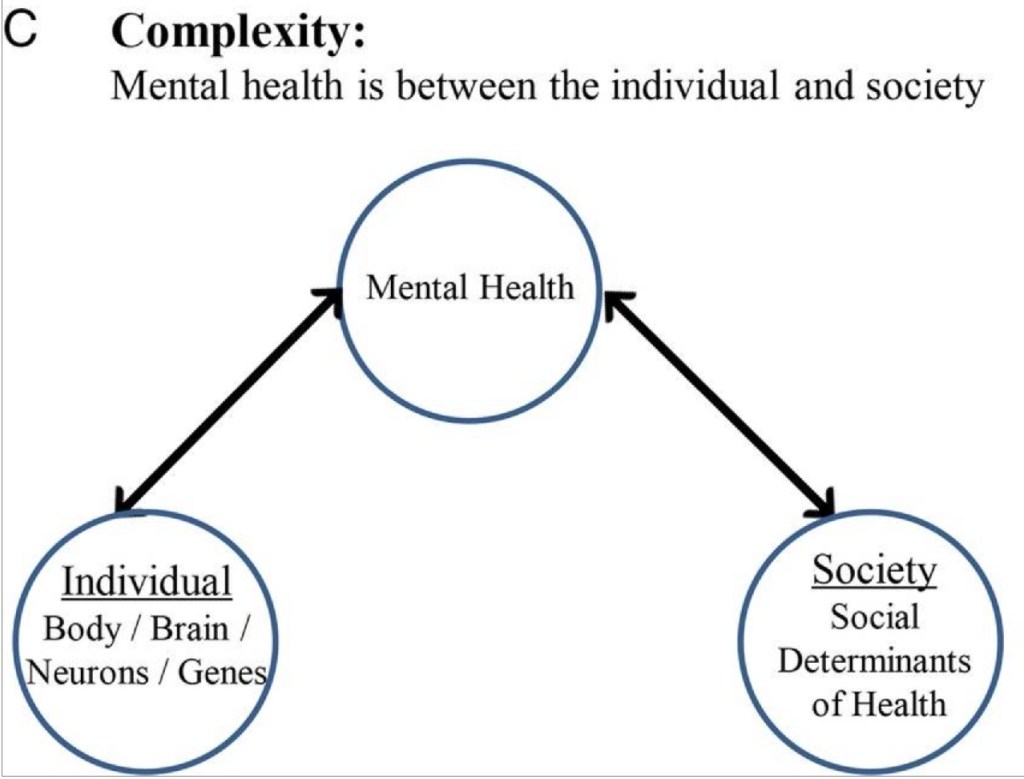
To continue from my last post about “what is mental health?” and “what am I doing?”, let’s look at another figure from the paper What is mental health? Evidence towards a new definition from a mixed methods multidisciplinary international survey:

Figure 2C

This model argues that an individual’s mental health isn’t the sole product of that single person (because, yes, things are complex). “Society” also contributes to and affects a person’s mental health.1

The Covid pandemic provided plenty of empirical evidence that “society” has enormous influence on the mental health of individuals. Over a third of young people reported “poor mental health” and nearly half reported they “persistently felt sad or hopeless” in 2021. There were nearly 30,000 (!) more deaths related to alcohol when comparing 2019 to 2021. Two out of every five adults reported “high levels of psychological distress” at some point during the pandemic.2

The pandemic isn’t the only example of the power of “society” on mental health. Survivors of mass shootings can develop psychiatric symptoms or disorders. Residents of Flint, Michigan, could only access drinking water contaminated with bacteria, disinfectants, and lead. This contributed to elevated rates of psychological conditions like depression and PTSD. Poverty increases the likelihood of depression and anxiety.

“Imagine how many people I wouldn’t need to see if people never experienced homelessness!” I mutter (or exclaim) at least once a month. It’s not just homelessness: It’s working three jobs to make rent; it’s trying to keep the family fed and housed when one parent has major medical problems; it’s trying to leave an abusive partner; it’s trying to keep things together when a family member has an alcohol or gambling problem. Because much of my career has been in the “deep end” of the system, I often witness how misaligned and rigid institutions often bruise and scar the psyches of individuals and populations of people.

Maybe context matters more in psychiatry than in other fields of medicine. When I think, “What am I doing?”, I often wonder if I should work “upstream” in prevention and early intervention to help change these contexts. This includes advocacy for action that is outside the purview of medicine, such as lowering barriers to housing or increasing regulation of firearms.

Some physicians (and others) have argued that doctors should “stay in our lane”, that we should focus on treating conditions that we are trained to treat. Medical school didn’t teach me how to prevent psychotic disorders; it trained me to identify and treat schizophrenia. In residency I didn’t learn how to develop policy and programming to prevent war and rape; I was trained to provide care and support to someone with PTSD. I can help someone choose to put their gun away so they don’t shoot themselves; I don’t know how to organize people to persuade elected officials to change gun regulations.3

Of course, there’s a middle ground. My clinical experience and expertise give me the anecdotes and data to advocate for system changes. These system changes can improve the health of individual people. Furthermore, there are real people who have real psychiatric problems who need real help right now. As Paul Farmer said,

To give priority to prevention is to sentence them to death—almost to urge them to get out of the way so that the serious business of prevention can start.

I once worked for a medical director who often said, “I’d love to work myself out of a job.” It sounds disingenuous, but it’s true: I completely agree. How wonderful would it be if fewer people experienced psychological distress and problems with living! (Given the ongoing shortage of psychiatrists and other mental health professionals, this would be a win for literally everybody.) What if people didn’t believe that suicide was the best option? Or if people didn’t have to grapple with unending worry about where they will sleep tonight or when their next meal would be? I wholeheartedly concede that crafting legislative language and designing policies and programs are not my strengths. However, it also makes little sense to me to keep my head down and simply treat illnesses and suffering that can be prevented. Things don’t have to be this way.


(1) Again, if we’re going to be picky about words, I prefer the word “context” over “society”. “Society” suggests something uniform, when there exist microcultures within one society. For example, I’ve worked as a homeless outreach psychiatrist in New York City and Seattle. In New York I wore bright blouses with large ascots. In Seattle I wear dark hoodies. Same job, same society, different contexts.

(2) We can argue about whether these reports of distress and their associated behaviors reflect “mental illness” versus “mental unwellness”, in reference to part one of this series.

(3) While media reporting often focuses on guns and homicide, firearms cause more suicides than homicides.