Categories
Policy Reading

The Word “Mental” in Project 2025. (i)

The word “mental” appears 16 times in “Mandate for Leadership: The Conservative Promise”, better known as Project 2025.

It first appears in the foreword on page 4, under the first promise to “restore the family as the centerpiece of American life and protect our children”:

Today, the American family is in crisis. Forty percent of all children are born to unmarried mothers, including more than 70 percent of black children. There is no government program that can replace the hole in a child’s soul cut out by the absence of a father. Fatherlessness is one of the principal sources of American poverty, crime, mental illness, teen suicide, substance abuse, rejection of the church, and high school dropouts. So many of the problems government programs are designed to solve—but can’t—are ultimately problems created by the crisis of marriage and the family. The world has never seen a thriving, healthy, free, and prosperous society where most children grow up without their married parents. If current trends continue, we are heading toward social implosion.

Let’s take a closer look at this with a critical eye:

Yes, according to the CDC, in 2022, about 40% of all children in the US were born to unmarried women. Let’s be charitable and assume that the author made a rounding error: Just under 70% of these “nonmarital births” occurred in Black women. For what reason did he highlight the percentage for Black women? The percentage for American Indian and Alaska Native women was about 68%. The second lowest percentage was among White women, which was just over 27%.

It is beyond the scope of my expertise to remark if fatherlessness is “one of the principal sources of American poverty, crime… rejection of the church, and high school dropouts”, but I can comment on “mental illness, teen suicide, [and] substance abuse”.

(A quick skim of data, though, shows that “Christian women in the U.S. are more religious than their male counterparts” and “women are more likely than men to say they attend worship services regularly”. From this data it seems that fathers are more likely to reject the church.)

This paper from 2013, The Causal Effects of Father Absence from the Annual Review of Sociology, tries to correct for flaws of past studies that tried to discern what happens to kids when their fathers are absent. From their work the authors conclude there is:

  • strong evidence that father absence negatively affects children’s social-emotional development, particularly by increasing externalizing behavior (where “externalizing behavior” means aggressive and attention-seeking behavior, in contrast to “internalizing behavior”, which manifests as anxiety and depression)
  • strong evidence that father absence increases adolescents’ risky behavior, such as smoking or early childbearing
  • [some suggestion] that the psychological harms of father absence experienced during childhood persist throughout the life course

Again, let’s be generous towards the author and assume that he equated “externalizing behavior”, “internalizing behavior”, and “risky behavior” to “mental illness[es]”. (Behaviors alone do not always constitute mental illnesses.) Yes, research supports the idea that an absent father results in behavioral problems in children. However, fatherlessness itself may not be a “principal source”. I could not find robust studies that examined any relationship between motherlessness and mental illness. (Single mothers are far more common than single fathers. Motherless children may exhibit these same worrisome behaviors.)

I am not able to find data that directly links absent fathers to teen suicides in the US. (There is a paper that describes “parental absence predicts suicide ideation through emotional disorders” in China, though this doesn’t focus solely on absent fathers. A paper from the US in 1998 concludes that “dramatic increase in youth suicide during the past three decades seems unlikely to be attributable to the increase in divorce rates”.) If there is an indirect linkage, it is likely mediated by other factors that led to the absence of the father.

While it is true that no governmental program can “replace the hole in a child’s soul cut by the absence of a father”, it is not only the absence of a father that cuts holes in children’s souls. No program, whether offered by the government or a church, can replace a missing father, mother, or other parental figure. Programs are not people. So let’s talk about actual people.

Over two-thirds of children live with married parents. The nonmarital birthrate continues to decrease over time. Divorce rates are also decreasing. In light of these facts, that “fatherlessness” is actually decreasing, what “crisis of marriage and the family” and pending “social implosion” is the author talking about?

The authors of Project 2025 do not seem to recognize what the authors of “The Causal Effects of Father Absence” declare: “family disruption is not a random event and because the characteristics that cause father absence are likely to affect child well-being through other pathways.” (emphasis mine)

If they are concerned about “poverty, crime, mental illness, teen suicide, substance abuse, rejection of the church, and high school dropouts”, there are more fruitful ways to address these problems:

Reduce the likelihood that children experience adverse childhood events. People with fewer adverse childhood events are less likely to develop mental illnesses, like depression, and less likely to attempt or die by suicide. (Fathers can be sources of adverse childhood events. There is research that shows that youth with “harsher fathers” engaged in more offending behaviors and used more substances than youth with “absent fathers”. Sometimes, unfortunately, fatherlessness is the better option.)

Promote health equity. Improving physical environments where people live, work, and play improves mental health and well-being, as does access to education. People want to work and learn in healthful spaces. Reducing income equality also improves physical and mental health. People want enough money to live in safety and comfort. Ensure that people have easy access to health care when they need it, but, even better, create a healthy nation where people won’t need to routinely see a doctor.

Promote social connections to reduce loneliness. People who are socially isolated are more likely to develop physical illnesses, such as heart disease and diabetes, as well as mental illnesses, such as anxiety and depression.

Note that these interventions require looking beyond the immediate family, and certainly beyond the presence or absence of a father. We live in communities. Because we all live in an interdependent networks, if the community is experiencing crisis, it will impact families. So why does Project 2025 instead put so much focus on the father?

Categories
Homelessness Policy Public health psychiatry Systems

Homelessness and the Supreme Court.

Tomorrow (April 22) the United States Supreme Court will hear oral arguments in the case City of Grants Pass, Oregon, v. Gloria Johnson. This article, 5 things to know about the Grants Pass homelessness case before the US Supreme Court, summarizes the issue well: “The repercussions could have national implications for how cities can regulate homelessness.” In short, if the Supreme Court sides with the City of Grants Pass, it could essentially be a crime to be homeless. (Note: “Homelessness” here refers strictly to street homelessness. The federal definition includes other populations that are not as visible, such as people living in shelters, people about to be evicted, etc.)

This brings to mind other information:

California Statewide Study of People Experiencing Homelessness. This came out in June of 2023. It’s one of the few recent surveys that examines mental health conditions and substance use among people experiencing homelessness. Over 3,000 people in various parts of California answered surveys and over 300 people participated in detailed interviews. They didn’t administer technical interviews to determine whether people met diagnostic criteria for psychiatric conditions. They instead asked people if they had ever experienced certain symptoms (e.g., hallucinations, anxiety, depression) or engaged in certain behaviors (e.g., used any substance three or more times a week) in the past or at the time of the interview. More than half of the people who responded said that they either had a mental health condition in the past or were experiencing one now. More than half reported that they had used substances in the past; about one-third reported that they were currently using any substance at least three times a week. (Note that “substance” here does not include alcohol or tobacco.)

JAMA Psychiatry: Prevalence of Mental Health Disorders Among Individuals Experiencing Homelessness. I have yet to read this paper. It’s a review and analysis of past research related to this topic (a research study of past research studies, if you will). It looks like they looked at specific diagnoses, with a call out of 44% of people experiencing homelessness experiencing any substance use disorder. Other highlights included in the abstract include prevalence rates for antisocial personality disorder (26%) (one of my most popular posts—from 2013!—is about this condition, for whatever reason… and I’ve been wondering about this one again), major depression (19%), schizophrenia (7%), and bipolar disorder (8%).

Open drug scenes: responses of five European cities. This paper is from 2014, though it holds lessons that we in the US can and should learn from. The information within disappoints everyone, which means it is probably a reasonable map to use.

Open drug scenes are gatherings of drug users who publicly consume and deal drugs.

To be clear, as evidenced by data shared above and from anecdotes from those of us who do this work, not everyone who is homeless uses drugs. Not everyone who uses drugs is homeless, either. Much of the current discourse about homelessness is related to drug use, though, which is why I bring up this paper.

The five cities described in the paper vary in size (Zurich, Switzerland, at around 415,000 people to Lisbon, Portugal, at 2.7 million people), though they each use similar strategies to reduce and eliminate open drug scenes:

  • drug dependence is a health problem
  • drug use behavior is a public nuisance problem
  • need for low threshold health services, outreach social work, and effective policing
  • appropriate combinations of harm reduction and restrictive measures

Law enforcement is needed to address the public nuisance problem. Robust health and social services that include harm reduction are needed to address the health problem. (At least two of the cities legalized heroin so people can use drugs safely in monitored settings, with hopes that they will one day use less and perhaps stop. Recall that this paper came out before the destructive wave of fentanyl overcame us.) Most cities have yet to find the “appropriate combinations” to reduce open drug scenes. (Just to reiterate, these strategies did not eliminate homelessness, only open drug scenes.)

Textbook Talk: Dr. Van Yu on Housing First and the Role of Psychiatry in Supported Housing. One significant way to eliminate homelessness is to ensure that people have places to live. Lemme tell ya: It is hard to effectively treat someone’s mental health or substance use disorder if they don’t have a stable place to live. If the person can’t or won’t come to you, that means you have to go to them. If you can’t find them (because they don’t have a place to live so they move around a lot), it’s hard to make a connection to help them. Even if they want to participate in treatment, it’s challenging to Do All the Things when you don’t know where you are going to sleep. Can you imagine what you’d do or how you’d feel if you didn’t know where you were going to sleep tonight? Seeing a health care professional likely won’t be your priority. Working in a Housing First or other public setting also changes the way you think about health care: Your interventions don’t just affect one person; they affect a whole community. Conversely, the community influences your interventions as a health care professional. We naturally become systems thinkers. (Full disclosure: Dr. Yu was once my boss. I learned and continue to learn a lot from him.)

I will follow the City of Grants Pass, Oregon, v. Gloria Johnson case with interest. The problem of homelessness is complex because people experiencing homelessness each have distinct challenges. They are not a monolith. I believe that there are government officials who are sympathetic to their circumstances. I still wonder, though, what problem are they trying to solve? Is it that they don’t want people to live outside? Or that they don’t want to see people living outside?

Categories
Education Medicine Policy Public health psychiatry Systems

What is Mental Health? (02)

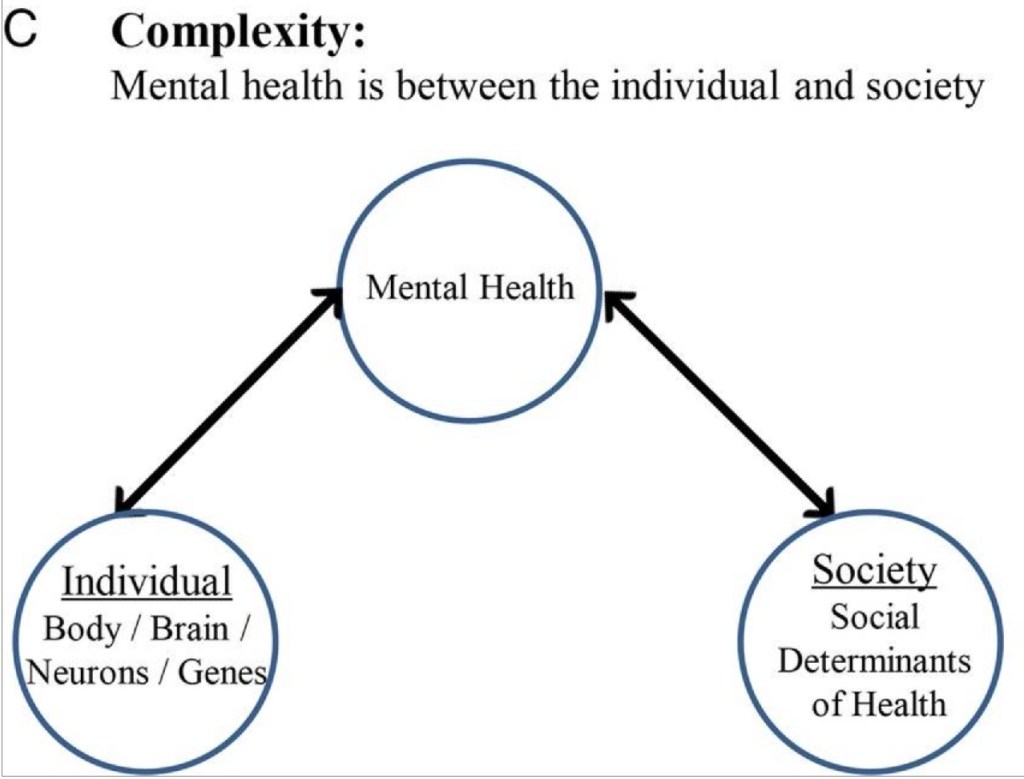
To continue from my last post about “what is mental health?” and “what am I doing?”, let’s look at another figure from the paper What is mental health? Evidence towards a new definition from a mixed methods multidisciplinary international survey:

Figure 2C

This model argues that an individual’s mental health isn’t the sole product of that single person (because, yes, things are complex). “Society” also contributes to and affects a person’s mental health.1

The Covid pandemic provided plenty of empirical evidence that “society” has enormous influence on the mental health of individuals. Over a third of young people reported “poor mental health” and nearly half reported they “persistently felt sad or hopeless” in 2021. There were nearly 30,000 (!) more deaths related to alcohol when comparing 2019 to 2021. Two out of every five adults reported “high levels of psychological distress” at some point during the pandemic.2

The pandemic isn’t the only example of the power of “society” on mental health. Survivors of mass shootings can develop psychiatric symptoms or disorders. Residents of Flint, Michigan, could only access drinking water contaminated with bacteria, disinfectants, and lead. This contributed to elevated rates of psychological conditions like depression and PTSD. Poverty increases the likelihood of depression and anxiety.

“Imagine how many people I wouldn’t need to see if people never experienced homelessness!” I mutter (or exclaim) at least once a month. It’s not just homelessness: It’s working three jobs to make rent; it’s trying to keep the family fed and housed when one parent has major medical problems; it’s trying to leave an abusive partner; it’s trying to keep things together when a family member has an alcohol or gambling problem. Because much of my career has been in the “deep end” of the system, I often witness how misaligned and rigid institutions often bruise and scar the psyches of individuals and populations of people.

Maybe context matters more in psychiatry than in other fields of medicine. When I think, “What am I doing?”, I often wonder if I should work “upstream” in prevention and early intervention to help change these contexts. This includes advocacy for action that is outside the purview of medicine, such as lowering barriers to housing or increasing regulation of firearms.

Some physicians (and others) have argued that doctors should “stay in our lane”, that we should focus on treating conditions that we are trained to treat. Medical school didn’t teach me how to prevent psychotic disorders; it trained me to identify and treat schizophrenia. In residency I didn’t learn how to develop policy and programming to prevent war and rape; I was trained to provide care and support to someone with PTSD. I can help someone choose to put their gun away so they don’t shoot themselves; I don’t know how to organize people to persuade elected officials to change gun regulations.3

Of course, there’s a middle ground. My clinical experience and expertise give me the anecdotes and data to advocate for system changes. These system changes can improve the health of individual people. Furthermore, there are real people who have real psychiatric problems who need real help right now. As Paul Farmer said,

To give priority to prevention is to sentence them to death—almost to urge them to get out of the way so that the serious business of prevention can start.

I once worked for a medical director who often said, “I’d love to work myself out of a job.” It sounds disingenuous, but it’s true: I completely agree. How wonderful would it be if fewer people experienced psychological distress and problems with living! (Given the ongoing shortage of psychiatrists and other mental health professionals, this would be a win for literally everybody.) What if people didn’t believe that suicide was the best option? Or if people didn’t have to grapple with unending worry about where they will sleep tonight or when their next meal would be? I wholeheartedly concede that crafting legislative language and designing policies and programs are not my strengths. However, it also makes little sense to me to keep my head down and simply treat illnesses and suffering that can be prevented. Things don’t have to be this way.


(1) Again, if we’re going to be picky about words, I prefer the word “context” over “society”. “Society” suggests something uniform, when there exist microcultures within one society. For example, I’ve worked as a homeless outreach psychiatrist in New York City and Seattle. In New York I wore bright blouses with large ascots. In Seattle I wear dark hoodies. Same job, same society, different contexts.

(2) We can argue about whether these reports of distress and their associated behaviors reflect “mental illness” versus “mental unwellness”, in reference to part one of this series.

(3) While media reporting often focuses on guns and homicide, firearms cause more suicides than homicides.

Categories
Homelessness Nonfiction Policy Public health psychiatry

Age and Vulnerability.

She was unprepared: One woolen blanket was wrapped around her shoulders. The other one was spread out so she did not have to sit directly on the ivy and weeds crawling across the hillside. A nylon sheet was rumpled by her side. Behind her was a pushcart that held a thin roll of garbage bags and a small empty cardboard box. There was no tent or sleeping bag. Though there were other people higher on the hillside, there was no one within earshot.

Most of the pages in her notebook were blank. The pen ink was bright turquoise; her penmanship was small and neat.

Small metal studs adorned her ears and a chunky chain was around her slender neck. Her hair was dyed an unnatural color and showed no signs of fading. The only hints that revealed that was not brand new to the hillside were the dust on her fashionable sneakers and the dirt that was collecting underneath her short fingernails. She also said that her phone had run out of charge.

She is not yet 20 years old.


I don’t expect that they are still alive, though I still think of them even when I’m not visiting New York City.

I met her when she was in her mid-60s. She never told us where she slept, though we reliably found her at the ferry terminal. Her fingers moved the needle and thread with ease to close the hole in her sock. She kept spools of thread in a plastic container that sat on the bundle of clothes she packed into her pushcart. Despite our best efforts for over two years, she never accepted housing: “The aliens will exterminate me if I go inside.”

I met him when he was in his 70s, or so we thought. No one knew his birthdate; he never shared this information. He buried himself between mounds of full trashbags or folded himself into cardboard boxes lining the curb. On the few occasions he spoke, the thinness of his voice—sometimes so faint that it seemed that only wisps of his speech reached my ears—betrayed his age.

Back here in Seattle, as elsewhere, there are people in their 70s and 80s who live outside or in shelters.


People under the age of 25 who are on their own and homeless are called “unaccompanied youth”. They are “considered vulnerable due to their age”. These unaccompanied youth make up about 5% of the homeless population in the US.

As the US population ages, people who are homeless are also aging. A study of homeless people in California found that 47% of all homeless adults are 50 years of age or older. Even more alarming, nearly half of all homeless people over 50 years of age first became homeless after they turned 50 years old!

Why do we consider “extremes” of age (though being in your late teens or your 70s is not actually “extreme”) as a factor that contributes to vulnerability when homeless? If you’re a 51 year-old man and you don’t know where you’re going to sleep tonight, doesn’t the variable of not knowing where you’re going to sleep tonight automatically make you vulnerable? Sure, you may have the size and mass to successfully defend yourself if someone attacks you or the ability to endure nighttime temperatures, but is that really where we’ve set the bar for vulnerability?

Categories
Funding Policy Public health psychiatry Seattle Systems

Crisis Care Centers Aren’t Enough.

The Tacoma News Tribune graciously agreed to publish an opinion piece an esteemed fellow psychiatrist and I wrote. I invite you to read the 500-word essay, Crisis care centers are important. But WA needs more to fill behavioral health gaps, directly through the newspaper (and show a local newspaper some appreciation through page views!). The piece has particular relevance to residents in King County in Washington State.

If you have more time and would like to read the original version, you can find it below. Thanks for your interest.


King County voters will decide whether to fund a network of crisis care centers in April. There are many reasons to support this: We all know people who have experienced behavioral health crises, including kids in school; colleagues at work; family members; and people we encounter in the community.

Because King County currently has only one crisis center, additional centers will help. However, the entire behavioral health system in Washington is in crisis. A narrow focus on these centers only may lead to even more people tumbling into crisis.

King County has explained that these five crisis centers will “provide a safe place… specifically designed, equipped and staffed for behavioral health urgent care. These Centers will provide immediate mental health and substance use treatment and promote long-term recovery.”

If crisis centers have the most resources, they will be the most robust and responsive element of the system. Outpatient clinics providing earlier intervention and prevention services are often understaffed and have waitlists. People already enrolled in these clinics may wait weeks to months for follow-up appointments. Those leaving hospitals also compete for clinic appointments. This excessive waiting can precipitate crises. People should not have to be in crisis to access care.

Crisis care centers are designed to accept anyone, with or without insurance. Many behavioral health clinics have insurance restrictions. Some clinics don’t accept public insurances like Medicaid or Medicare. Others do, though have limited funds to provide services for uninsured people or for those ineligible to obtain insurance. Such restrictions will funnel uninsured people to the crisis centers. Yet, where will they go for ongoing care?

Due to limited resources, crisis care centers must screen and triage referrals. If people experiencing symptoms related to mental illness or substance use don’t meet criteria for admission to a crisis center or a hospital, what then? If under-resourced outpatient clinics remain understaffed or close, these individuals will be forced to wait for treatment. Their symptoms may worsen, precipitating preventable crises, which no one wants.

The option for people to stay up to 14 days in a crisis care center can help people connect to ongoing services. However, many agencies are unable to see people and establish care within 14 days, in part due to what King County described as: “The behavioral health workforce is strained under the magnitude of the need, all while being underpaid, overworked, and stretched too thin.”

The levy touts the use of peer counselors in crisis centers. Peers with lived experience are valuable, though should not be the primary providers of care. Peer counselors often have the lowest wages and, in some for-profit models, make up the bulk of personnel, presumably to maximize revenue. Some people in crisis are among the most vulnerable, ill, and complex patients in the region. Both patients and staff across the entire continuum of care deserve sufficient support and resources to get, and stay, out of crisis. If people experiencing mental health crises receive insufficient services, they are more likely to fall back into crisis and return to these centers. If these crisis centers are operated by for-profit organizations, readmissions will increase their revenue. We have already witnessed this pattern in several for-profit psychiatric hospitals where patients experienced harm. Patients and their families deserve better.

King County needs crisis centers, but personnel in other parts of the system also need support. The levy notes that funding for residential treatment facilities will focus on capital and maintenance. Building conditions are important, though the staff who work in these buildings are just as valuable. Many individuals receive ongoing care in residential treatment facilities following acute hospital treatment. Supporting and retaining staff in these residential programs are vital in reducing behavioral health crises.

Outpatient clinics with robust funding for personnel, technology, and other resources, along with appropriate reimbursement of services—things that never happened after the original deinstitutionalization movement of the 1960s—will help people access care. This, along with preventative efforts and early intervention at the first signs of behavioral health challenges, decreases crises.

Ultimately, supporting peoples’ basic needs will reduce the need for crisis centers. Living wages, affordable housing, access to food, universal health care coverage, employment opportunities, education and training, and building social connections, will reduce psychological burdens and promote wellness. 

This levy should be viewed as an initial investment in improving our battered behavioral health care system. More needs to be done to improve the mental health of our friends, family, and neighbors.