Categories
COVID-19 Education Medicine Seattle

Information about the Covid-19 Vaccines for a Non-Medical Audience.

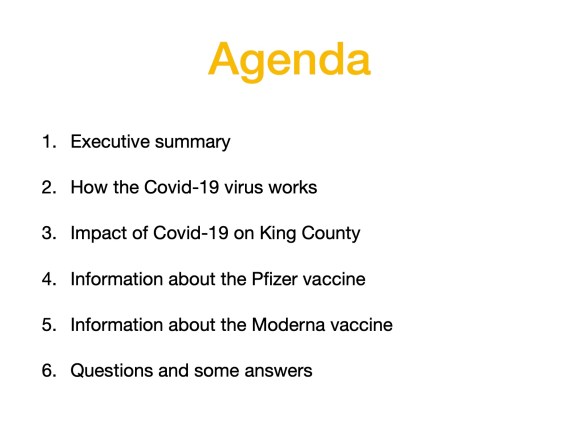
For work, I created a presentation about the current Covid-19 vaccines for a non-medical audience. Maybe you will find it helpful, too. Here’s the agenda:

… where King County refers to the county in Washington State where Seattle is located. The presentation reviews the New England Journal of Medicine paper on the vaccine from Pfizer, as well as the data Moderna shared with the FDA. (Note that I made this slide deck near the end of December, so, if you are reading this in the distant future, data included may be different.)

I usually don’t include so much text in my slides. I made an exception here, as there are nearly a thousand people working at the agency and many may not be able to watch and hear me present this live. Enjoy.

Categories
Consult-Liaison COVID-19 Homelessness Medicine Nonfiction Seattle Systems

“The Impact of Covid-19 on Homeless Services in Seattle.”

On Friday, I presented Grand Rounds to an agency in New York City. The title of my presentation was “The Impact of Covid-19 on Homeless Services in Seattle, Washington”. The audience was comprised mostly of psychiatrists who also work with people who are currently unhoused or have been homeless in the past.

In some ways, this presentation was easy to create: I simply described the agency I work for and walked the audience through the timeline of events:

While the Seattle-King County region was scrambling due to the first death from Covid-19, the first case of Covid-19 was diagnosed in New York City on March 1.

In other ways, this presentation is the only one I’ve made where I had to take breaks while making it because of anger, grief, and sadness.

The month of March was hectic for us and everyone else: We tossed routine policies out the window and scribbled new ones down. We shattered many of our old habits and hastily introduced new practices. Our collective workload increased significantly as we tried to be as flexible and responsive to the changes that were coming at us. We watched systems grind to a halt because systems can’t change that fast: We had to buy hand sanitizer from local distilleries and we donated N95 masks to hospitals. Systems that had long failed us suddenly had the harsh glow of media light on them: In all of Seattle, there were only five bathrooms with hand-washing sinks that were open 24/7. Congregate shelters, where over 200 people had no choice but to share one giant room and one bathroom, suddenly became unacceptable because the beds were not at least six feet apart.

And, yet, eight months later, not much changed. We haven’t had the opportunity to abandon restrictions; many of these new practices are now status quo because the situation hasn’t gotten better. I was honest with the audience: There was no resolution or hopeful conclusion at the end of my talk. Why was that? How could it be that, eight months later, things hadn’t actually changed much?

The audience said nothing. What is there to say? The lack of ownership and coordination at the federal level is the same now as it was in March/April. New York City has significantly more resources than Seattle, though those resources only go so far while SARS-CoV2 can cross state lines and national boundaries when no barriers are erected and no interventions happen. If people in a boat are not rowing in the same direction—or if people aren’t rowing at all—then the boat and everyone in it wastes a lot of time and energy.

I was surprised by the gifts of validation from the audience. Yes, we all work as psychiatrists and the last time most of us saw someone get intubated was when we were residents. However, we all recall doing consults on people in the ICU who were sick. Ostensibly, we were there to take care of the patient and maybe their family members. We also know, though, that an important (and often unspoken) part of psychiatric consults is to support the treating team.

We all have a sense of how terrible it is for the treating teams. These are the reasons why we desperately try to keep people healthy and out of hospitals. We know that our contributions are small—most people don’t live on the streets, in shelters, or in supportive housing; most people don’t have diagnoses of schizophrenia or severe substance use disorders—but we also know that our people are often maligned when they pass through the doors into traditional health care systems. We all have a sense of how terrible it is for our people. We also know that, due to the stress of living marginalized lives, our people often have more severe health conditions. They already have many risk factors that increase the likelihood of complications and death due to Covid-19. We’re trying to mitigate the stress of everyone involved.

It’s heartbreaking, terrible, and unfair.

To end the talk on a positive note, I mentioned several things I am grateful for:

  • The rainy season has arrived in Seattle and I get to sleep in a dry bed indoors.
  • I have confidence in where I am going to sleep tonight.
  • I have a job and can pay my bills.
  • I know I will eat (again!) today.
  • There now exists technology where I can speak to an audience of colleagues on the other side of the continent!

These both mean a lot and nothing at the same time.

In the meantime, we continue to do what we can while we wait.

Categories
Observations Seattle Systems

About the CHAZ….

You’ve heard about Seattle’s Capitol Hill Autonomous Zone (CHAZ), right? With free press from President Trump, people both in the US and abroad now know about the “Seattle takeover” and his imperative to “Take back your city NOW”.

Well, dear reader, if you believe that I am reliable narrator, let me share with you my observations of the CHAZ.

First of all, this is how the CHAZ website describes the Capitol Hill Autonomous Zone:

The Capitol Hill Autonomous Zone née “Free Capitol” is a 6 block section around the East Precinct in Seattle, WA. Abandoned by police and left to burn, this area was instead siezed [sic] by anarchists, BLM supporters and other protestors who have since transformed it into a unverisal [sic] community based on mutual aid. Fundamentally, CHAZ is an occupation of Capitol Hill, not an official declaration of independence.

Here’s some context about the Capitol Hill neighborhood where the CHAZ is located: In addition to being the gay mecca of the Pacific Northwest, Capitol Hill is the hip neighborhood of Seattle.[1. Some would comment that Capitol Hill is the hipster, not hip, neighborhood of Seattle.] Bars old and new cater to the spectrum of genders. There’s wood-fired bagel cafe; a bike shop where, after spending time in the physio lab, one can order a Matcha Chicken Avocado Bowl; and a music venue called whose full name includes “Crystal Ball Reading Room”. Two blocks south from the CHAZ is a dealership shared by Ferrari and Maserati. A local cafe offers apricot jam doughnuts for $3.85 each. Rent for a one-bedroom apartment near the CHAZ is around $2000 a month.

Now, onto my observations:

According to the City of Seattle, about 65% of the city population is white and nearly 7% are Black. The vast majority of people (much more than 65%) I saw in the CHAZ were white. Perhaps this was due to the clumps of white tourists who wanted to witness the CHAZ themselves. Maybe white allies had taken upon themselves to “do the work” and use the CHAZ to advocate for Black Lives Matter (BLM) causes and demands. (Of note, I cannot find any comments from the Seattle-King County chapter of BLM about the CHAZ.) Despite the ongoing pandemic, a notable fraction of these white individuals were not wearing face coverings.

While there is a beautiful mural of “Black Lives Matter” physically on Pine Street and references to Black individuals of Seattle and beyond who have been killed by police, the overall vibe of the CHAZ seems more focused on opposing authority. The graffiti on and around the now abandoned police station, the “conversation cafe” stations, and the new community gardens seemed to chiefly cater to white audiences and suggest an anti-establishment philosophy. Black Lives Matter and “a universal community based on mutual aid” are not the same thing, and this is highlighted in the deliberate demands of the Seattle-King County chapter of Black Lives Matter. To be fair, there is overlap between the demands of CHAZ and BLM, though what people do often reveals actual intentions compared to what people say.

In addition to philosophical contrasts, there were physical contrasts within the CHAZ. A man was hugging his adult poodle like a baby, while a crowd of people were nearly running after a man who was yelling at someone about a stolen phone. A white man with what appeared to be a taxidermy weasel draped around his shoulders got into a profane shouting match with a Black man (one of the very few I saw) seated on a bench, a push cart stuffed with belongings next to him.[2. I promise you, dear reader, that there was indeed a man who had draped what appeared to be a taxidermy weasel around his neck. Maybe it was a plush weasel, but the effect was the same.] A (white) man was shoveling wood chips into a new community garden marked with a hand-written sign that read “This garden is for Black and Indigenous folks and their plant allies”. All the doors to the public bathroom were closed and the phrase “shoplift your future back” was scrawled in spray paint on its foundation.

Meanwhile, Seattle Parks and Recreation collected trash from the CHAZ and hauled it away. An employee, wearing a face covering, emerged from a Seattle Public Utilities truck with a clipboard and headed towards the park.

Here are my questions:

Is the Capitol Hill Autonomous Zone a distraction from Black Lives Matter? If yes, what are the consequences of that distraction at local, state, and federal levels, now that President Trump has condemned this “occupation of Capitol Hill”? What are the consequences to BLM if it is conflated with the CHAZ?

Could an Autonomous Zone exist anywhere else in Seattle? Does it matter that this part of Capitol Hill is young, trendy, and expensive? Could the Autonomous Zone exist in a Seattle neighborhood with more Black lives, such as the Central District or Rainier Valley? Even if the Autonomous Zone could exist in another neighborhood, would it exist? Would protestors want that? Would the neighborhood support that?

Has the local chapter of BLM made a statement about CHAZ? If yes, why is it difficult to find? If no, what worries or hopes does BLM have about doing so? The Seattle-King County BLM chapter has demonstrated great thoughtfulness about its activities in the midst of this pandemic, including specific rules about their protest. Their silent march drew around 60,000 protestors despite the rain. I look forward to learning more about and supporting their perspectives.

Will the CHAZ protestors vote? Some argue that the only way to change the system is to join it. Others insist that change can only come from the outside, as there are too many conflicting interests from within. Voting applies in either scenario.

Will the CHAZ protestors follow the lead of BLM? Sometimes the urge to “do something” is overwhelming, when the most productive and helpful action is to wait and follow. Before people congratulate themselves on the actions they are taking, it is prudent to ensure that these actions are in the service of the goal that will both change and improve the system.

How will the CHAZ end? Will the protestors leave of their own accord? Will they stay until forced to leave? Will there be non-violent negotiations, or will we witness more violence? How much effort will Seattle Police put into returning to their precinct building? What is the Mayor’s strategy about this, now that she is the target of antagonizing messages from both Seattle residents and the President of the United States?

When will the CHAZ end? With unemployment rates high in Seattle, as in the rest of the nation, some people may choose to remain in the CHAZ because the economy continues its slump. There is a Presidential election in November and if the President continues to give his attention to the CHAZ, that may reinforce their desire to remain. If Seattle sees a spike in coronavirus cases, will the city recruit Public Health to help assess the safety of the encampments and gatherings and then ask people to leave?


If you live in the Seattle-King County area and are able, please donate money to the Seattle-King County chapter of Black Lives Matter. Whether you live in Seattle or elsewhere, please also participate in the US Census and make sure you vote in the upcoming elections. Please continue to ask questions, engage your mind, and exercise critical thinking. Change will take all of us.


Categories
COVID-19 Homelessness Medicine Nonfiction Observations Policy Seattle

The Space Between Us.

I am one of the few people walking through downtown Seattle these days. Most of the people outside are people who slept outside the night before. Sometimes they are still sleeping in sleeping bags or tattered boxes when I walk past. They’ve always been there, but now that there are much fewer people outside, they seem to be everywhere.

The other people walking through downtown in the morning fall into two groups: People going to work, like me, and people walking their dogs. The people out and about in the morning are much more likely to wear face masks. The evening crowd seems to be younger and they are much less likely to wear face masks.

I see the magnolia trees bloom. Their pastel petals are already falling off to make room for new leaves. The soft pink cherry blossoms are already gone; the tree limbs are already full of fresh green leaves.

The offices now have bottles of liquid hand sanitizer from local distilleries. The hand sanitizer coming out of the wall dispensers have floral and chemical notes.

Every staff person should have their own set of cloth face masks. There are two in a bag. Volunteers sewed and packaged them. One of mine is dark blue with intersecting white lines. The other is light blue with a large pattern that is reminiscent of paisley.

Several people staying in our shelters have tested positive for coronavirus. There haven’t been “clusters” of cases yet, just one here, another one there. Staff show up to work, don their cloth face masks, put on gloves, and wipe down surfaces with disinfectant when they can. Some people staying in shelters cough and sneeze. Most put on the surgical face masks that staff give to them and try to stay away from other people, but where are they to go? A few are unable or unwilling to wear face masks. Staff continue to don their cloth face masks, put on gloves, and wipe down surfaces.

People are moving from congregate shelter settings into motel and hotel rooms. What will happen when people have their own private spaces? Their own bathrooms, their own beds, their own doors that they can lock? This reduces the likelihood of disease transmission. What else does this reduce? Hypervigilance? Paranoia? Pain? Substance use? (Or maybe it increases all of those things?)

The nurses are amazing. They try to assess for respiratory symptoms from six feet away, a subtle dance that we’ve all had to learn how to do quickly. Maybe it’s a chronic cough. Maybe it’s flu-like symptoms. Maybe it’s coronavirus.

The internal coronavirus team is amazing. They organize the waterfall of data and quickly refer people to the county isolation and quarantine sites. The system has started to move faster, but it’s not fast enough. And what are we to do when the isolation and quarantine sites won’t accept our referrals? Who holds the balance between liability and public health? What will the emergency departments say when it is the fear of acute withdrawal, not the actual withdrawal itself, that results in a visit from someone with coronavirus?

When I start feeling angry, I pause and realize that my colleagues in hospitals have even more reasons to feel anger. I’m not misreading the guidance: Following a high risk exposure to someone with confirmed coronavirus, staff should continue to work even if asymptomatic. Of course, I know why: The system needs health care workers to work during this pandemic. But what is the message this sends to individual workers? You might get sick, you might contribute to asymptomatic spread at work. The people who live with you might get sick. Despite this worry for yourself and those around you, please continue to work. And because we don’t have enough tests right now, we won’t test you until you start to demonstrate symptoms.

(What about the grocery store workers and farm workers? Do their employers provide face masks? Are they part of unions? Do they have health insurance?)

You are essential, you are a critical worker, you are immune to worry and anxiety. Right? This is no time to worry about yourself because we also don’t have time to worry about you.

I see the pairs of police officers leaning against their cars on Pike and Pine, their arms crossed. The sun stretches its warm rays across the sound and the new leaves rustle in the spring breeze. My cloth mask is mildly damp from the humidified air moving in and out of my lungs. I make brief eye contact with the person approaching me. We make time to worry about each other and the physical space between us grows.

Categories
COVID-19 Homelessness Medicine Seattle

Some Notes Related to COVID-19.

Some notes:[1. Personal notes that reflect my own opinions, not those of my employer!]

To my knowledge, as of this writing, no individual staying in our shelter or housing programs has tested positive for COVID-19. (Note: Only a fraction of them have been tested.) This continues to boggle my mind. There may come a time very soon when I will look back on this post and think, “Well, that was quaint.”

I received a phone call from a medical epidemiologist this afternoon. Among other things, he said that his job is “to get swabs into people’s noses”. I won’t lie: I had to stifle a laugh.

The medical epidemiologist also shared that there is apparently a shortage of “viral media”, though he didn’t want to “get into the sordid details” about that. My secret source commented that the cause of the shortage of viral media is a shortage of bovine serum albumin. Holy cow.

I haven’t talked so much about nasal anatomy and swabs in my life, even as a medical student learning anatomy. The FDA has apparently approved self-swabs for COVID-19 testing, which include sampling from the anterior nares (nose picking) and mid-turbinates, both of which are easier to access than the nasopharyngeal region (the experience of which has been described as “brain tickling” or a “brain biopsy”). Supplies are limited, though, and we don’t know how to access them.

Homeless shelters and other congregate settings are the lowest priority to receive personal protective equipment (PPE). The only way these settings rise in priority is if there is a confirmed case. Thus, volunteers have made cloth face masks for PPE. It’s wonderful and terrible at the same time.

With Washington State’s “stay home, stay healthy” order, most of the people now on the streets are pushing overflowing carts, wearing soiled blankets, carrying stuffed trash bags, and carrying broken backpacks because they have no homes in which to stay. It is hard to witness this.

I appreciated Ed Yong’s article about How the Pandemic Will End. You may, too.