Categories
Medicine Policy Systems

The Word “Mental” in Project 2025. (viii)

The eighth instance of the word “mental” in Project 2025 is on page 648 in the section about the Veterans Health Administration:

Examine the surpluses or deficits in mental health professionals throughout the enterprise, recognizing that the department needs a blend of social workers, therapists, psychologists, and psychiatrists with a focus on attracting high-quality talent.

This chapter advocates for “Veteran-centric” care and wants military veterans to have easier access to high quality services. This recommendation is part of a list that calls for bolstering health care personnel to reduce wait times for veterans. This is completely reasonable.

(There are some highly biased comments in this section, such as “the Left’s pernicious trend of abusing the role of government to further its own agenda”, even though the preceding sentence is literally “rescind all departmental clinical policy directives that are contrary to principles of conservative governance”, as if “conservative governance” isn’t an agenda???)

I do wonder how the arbiters will know what numbers of mental health professionals are a “surplus” versus a “deficit”. Most (all?) health systems struggle with a “scarcity” or “substantial shortages” of behavioral health professionals. Perhaps the authors of Project 2025 are aware that mental health professionals, such as psychiatrists, are far more likely to be registered Democrats. The VA directives they want rescinded are ”abortion services and gender reassignment surgery”, so perhaps the “surplus” of mental health professionals are the pernicious Lefties who support those services.

Like most other physicians who trained in the US, I spent time in residency and fellowship working in VA hospitals. (As a medical student I did not train at a VA, but was instead sent to an Air Force base for part of my pediatrics rotation!) We were in the midst of the Iraq War. The VA patients under my care at that time were around my age. (How did fate send us on such different paths, only to intersect in the hospital?) The psychological wounds of these young men from fighting in the war were still gaping. I also saw Vietnam War- and World War II-era patients whose memories were deteriorating, their bodies not yet as infirm as their minds.

Apart from one unfortunate experience, I found my work experiences at the VA meaningful. I know it sounds corny, but it truly is a privilege to provide care to people who have served in the military. (We’ll put aside for now the vexing reality that trainees spend so much time learning their health care profession on patients who don’t have much money in publicly-funded institutions. Never did I nor a colleague treat an Admiral, Commander, or other high-ranking, presumably not poor, officer.) While not routine, I continue to encounter veterans now who are homeless and have significant psychiatric conditions. My primary goal in those instances is to get them connected to the local VA if possible, since the VA, for all of its bureaucratic problems, often offers many more resources than other public programs.

When I consider the provision of mental health services at the VA, I can’t help but think that the best way that we can protect the mental health of veterans is to limit their exposure to war. We can’t prevent all bad things from happening, but war is an especially bad thing. It messes people up. I’m not even talking about formal psychiatric disorders. War induces heartache. I think about the various veterans I’ve worked with as colleagues (some as health care professionals, most not), and what stands out to me is how much loss they carry. They’re “fine”: They are married, they have kids, they have fun hobbies, they do satisfactory to exemplary work at their jobs, some have even achieved high status in their professions.

And then I see artifacts from a comrade who died, sense their guardedness, hear their reluctance to speak about their time in service.

There are things that civilians may never understand. Here I agree that veterans deserve high quality health care. The issue is that the authors of Project 2025 apparently believe that some people do not deserve certain kinds of health care, high quality or not.

Categories
Homelessness Policy Public health psychiatry Systems

Homelessness and the Supreme Court.

Tomorrow (April 22) the United States Supreme Court will hear oral arguments in the case City of Grants Pass, Oregon, v. Gloria Johnson. This article, 5 things to know about the Grants Pass homelessness case before the US Supreme Court, summarizes the issue well: “The repercussions could have national implications for how cities can regulate homelessness.” In short, if the Supreme Court sides with the City of Grants Pass, it could essentially be a crime to be homeless. (Note: “Homelessness” here refers strictly to street homelessness. The federal definition includes other populations that are not as visible, such as people living in shelters, people about to be evicted, etc.)

This brings to mind other information:

California Statewide Study of People Experiencing Homelessness. This came out in June of 2023. It’s one of the few recent surveys that examines mental health conditions and substance use among people experiencing homelessness. Over 3,000 people in various parts of California answered surveys and over 300 people participated in detailed interviews. They didn’t administer technical interviews to determine whether people met diagnostic criteria for psychiatric conditions. They instead asked people if they had ever experienced certain symptoms (e.g., hallucinations, anxiety, depression) or engaged in certain behaviors (e.g., used any substance three or more times a week) in the past or at the time of the interview. More than half of the people who responded said that they either had a mental health condition in the past or were experiencing one now. More than half reported that they had used substances in the past; about one-third reported that they were currently using any substance at least three times a week. (Note that “substance” here does not include alcohol or tobacco.)

JAMA Psychiatry: Prevalence of Mental Health Disorders Among Individuals Experiencing Homelessness. I have yet to read this paper. It’s a review and analysis of past research related to this topic (a research study of past research studies, if you will). It looks like they looked at specific diagnoses, with a call out of 44% of people experiencing homelessness experiencing any substance use disorder. Other highlights included in the abstract include prevalence rates for antisocial personality disorder (26%) (one of my most popular posts—from 2013!—is about this condition, for whatever reason… and I’ve been wondering about this one again), major depression (19%), schizophrenia (7%), and bipolar disorder (8%).

Open drug scenes: responses of five European cities. This paper is from 2014, though it holds lessons that we in the US can and should learn from. The information within disappoints everyone, which means it is probably a reasonable map to use.

Open drug scenes are gatherings of drug users who publicly consume and deal drugs.

To be clear, as evidenced by data shared above and from anecdotes from those of us who do this work, not everyone who is homeless uses drugs. Not everyone who uses drugs is homeless, either. Much of the current discourse about homelessness is related to drug use, though, which is why I bring up this paper.

The five cities described in the paper vary in size (Zurich, Switzerland, at around 415,000 people to Lisbon, Portugal, at 2.7 million people), though they each use similar strategies to reduce and eliminate open drug scenes:

  • drug dependence is a health problem
  • drug use behavior is a public nuisance problem
  • need for low threshold health services, outreach social work, and effective policing
  • appropriate combinations of harm reduction and restrictive measures

Law enforcement is needed to address the public nuisance problem. Robust health and social services that include harm reduction are needed to address the health problem. (At least two of the cities legalized heroin so people can use drugs safely in monitored settings, with hopes that they will one day use less and perhaps stop. Recall that this paper came out before the destructive wave of fentanyl overcame us.) Most cities have yet to find the “appropriate combinations” to reduce open drug scenes. (Just to reiterate, these strategies did not eliminate homelessness, only open drug scenes.)

Textbook Talk: Dr. Van Yu on Housing First and the Role of Psychiatry in Supported Housing. One significant way to eliminate homelessness is to ensure that people have places to live. Lemme tell ya: It is hard to effectively treat someone’s mental health or substance use disorder if they don’t have a stable place to live. If the person can’t or won’t come to you, that means you have to go to them. If you can’t find them (because they don’t have a place to live so they move around a lot), it’s hard to make a connection to help them. Even if they want to participate in treatment, it’s challenging to Do All the Things when you don’t know where you are going to sleep. Can you imagine what you’d do or how you’d feel if you didn’t know where you were going to sleep tonight? Seeing a health care professional likely won’t be your priority. Working in a Housing First or other public setting also changes the way you think about health care: Your interventions don’t just affect one person; they affect a whole community. Conversely, the community influences your interventions as a health care professional. We naturally become systems thinkers. (Full disclosure: Dr. Yu was once my boss. I learned and continue to learn a lot from him.)

I will follow the City of Grants Pass, Oregon, v. Gloria Johnson case with interest. The problem of homelessness is complex because people experiencing homelessness each have distinct challenges. They are not a monolith. I believe that there are government officials who are sympathetic to their circumstances. I still wonder, though, what problem are they trying to solve? Is it that they don’t want people to live outside? Or that they don’t want to see people living outside?

Categories
Education Medicine Policy Public health psychiatry Systems

What is Mental Health? (02)

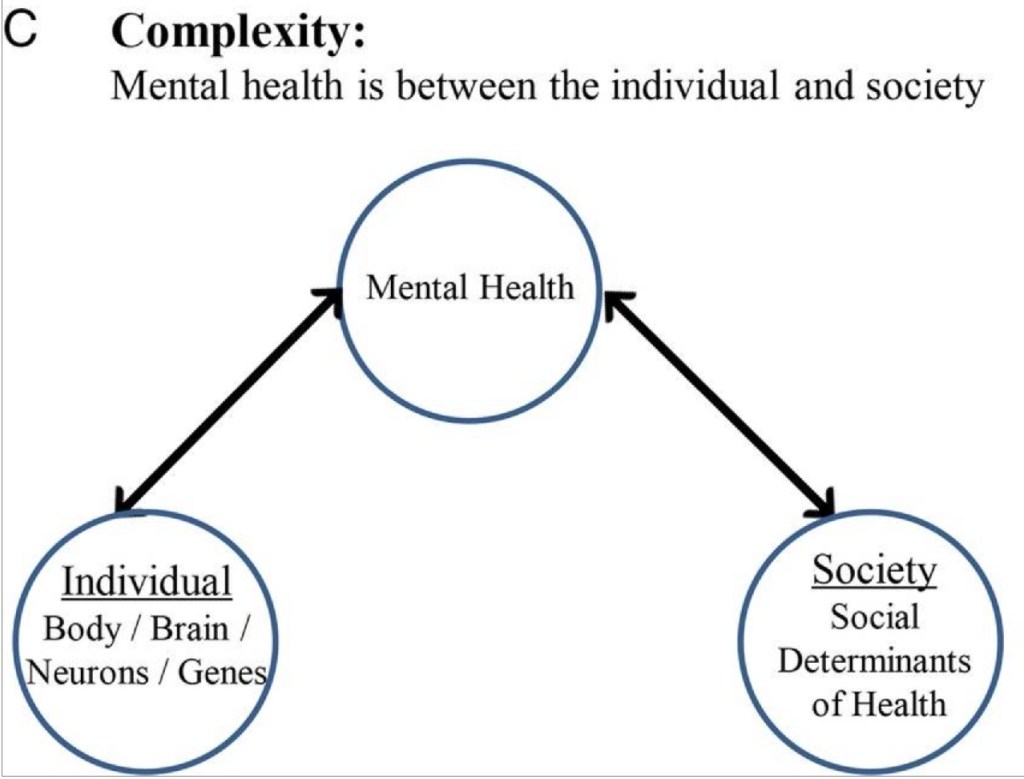
To continue from my last post about “what is mental health?” and “what am I doing?”, let’s look at another figure from the paper What is mental health? Evidence towards a new definition from a mixed methods multidisciplinary international survey:

Figure 2C

This model argues that an individual’s mental health isn’t the sole product of that single person (because, yes, things are complex). “Society” also contributes to and affects a person’s mental health.1

The Covid pandemic provided plenty of empirical evidence that “society” has enormous influence on the mental health of individuals. Over a third of young people reported “poor mental health” and nearly half reported they “persistently felt sad or hopeless” in 2021. There were nearly 30,000 (!) more deaths related to alcohol when comparing 2019 to 2021. Two out of every five adults reported “high levels of psychological distress” at some point during the pandemic.2

The pandemic isn’t the only example of the power of “society” on mental health. Survivors of mass shootings can develop psychiatric symptoms or disorders. Residents of Flint, Michigan, could only access drinking water contaminated with bacteria, disinfectants, and lead. This contributed to elevated rates of psychological conditions like depression and PTSD. Poverty increases the likelihood of depression and anxiety.

“Imagine how many people I wouldn’t need to see if people never experienced homelessness!” I mutter (or exclaim) at least once a month. It’s not just homelessness: It’s working three jobs to make rent; it’s trying to keep the family fed and housed when one parent has major medical problems; it’s trying to leave an abusive partner; it’s trying to keep things together when a family member has an alcohol or gambling problem. Because much of my career has been in the “deep end” of the system, I often witness how misaligned and rigid institutions often bruise and scar the psyches of individuals and populations of people.

Maybe context matters more in psychiatry than in other fields of medicine. When I think, “What am I doing?”, I often wonder if I should work “upstream” in prevention and early intervention to help change these contexts. This includes advocacy for action that is outside the purview of medicine, such as lowering barriers to housing or increasing regulation of firearms.

Some physicians (and others) have argued that doctors should “stay in our lane”, that we should focus on treating conditions that we are trained to treat. Medical school didn’t teach me how to prevent psychotic disorders; it trained me to identify and treat schizophrenia. In residency I didn’t learn how to develop policy and programming to prevent war and rape; I was trained to provide care and support to someone with PTSD. I can help someone choose to put their gun away so they don’t shoot themselves; I don’t know how to organize people to persuade elected officials to change gun regulations.3

Of course, there’s a middle ground. My clinical experience and expertise give me the anecdotes and data to advocate for system changes. These system changes can improve the health of individual people. Furthermore, there are real people who have real psychiatric problems who need real help right now. As Paul Farmer said,

To give priority to prevention is to sentence them to death—almost to urge them to get out of the way so that the serious business of prevention can start.

I once worked for a medical director who often said, “I’d love to work myself out of a job.” It sounds disingenuous, but it’s true: I completely agree. How wonderful would it be if fewer people experienced psychological distress and problems with living! (Given the ongoing shortage of psychiatrists and other mental health professionals, this would be a win for literally everybody.) What if people didn’t believe that suicide was the best option? Or if people didn’t have to grapple with unending worry about where they will sleep tonight or when their next meal would be? I wholeheartedly concede that crafting legislative language and designing policies and programs are not my strengths. However, it also makes little sense to me to keep my head down and simply treat illnesses and suffering that can be prevented. Things don’t have to be this way.


(1) Again, if we’re going to be picky about words, I prefer the word “context” over “society”. “Society” suggests something uniform, when there exist microcultures within one society. For example, I’ve worked as a homeless outreach psychiatrist in New York City and Seattle. In New York I wore bright blouses with large ascots. In Seattle I wear dark hoodies. Same job, same society, different contexts.

(2) We can argue about whether these reports of distress and their associated behaviors reflect “mental illness” versus “mental unwellness”, in reference to part one of this series.

(3) While media reporting often focuses on guns and homicide, firearms cause more suicides than homicides.

Categories
Blogosphere Medicine Systems

Brain Snacks.

It’s a short post this week, though the links will take you to nutritious brain snacks (or hors d’oeuvres, if you identify as classy):

24 Hours in an Invisible Pandemic. This is an excellent example of data visualization about the experience of loneliness in the US.

26.2 to Life. This documentary is about the San Quentin Marathon. The athletes are inmates at the San Quentin prison. The course is 105 laps around the prison yard. (The virtual premiere is this weekend.)

30 Days of Healthcare. Dr. Glaucomflecken’s series of short videos about the US health care system is accurate, devastating, and, when it can be, amusing.

We Are Not Just Polarized. We Are Traumatized. This long essay is provocative, thoughtful, and worth the time to read. (Side commentary: The term “trauma response” is a relatively new phrase and, as far as I know, isn’t rooted in robust psychological or biological principles. I worry that the usage of “trauma response” may also dilute the experiences of people who meet formal criteria for the diagnosis of PTSD.)

Categories
Medicine Observations Systems

On Who People Think You Are.

The author wearing a black face mask while holding a soft serve cone. The wall behind her features a cone that looks like a fish that has green soft serve in it.
A photo of yours truly wearing a mask. Photo credit to Amy L.

There were two patients in the hospital room. Both were elderly East Asian males, each reclining in his bed. The curtain that divided the room in half was pulled forward, offering the illusion of privacy. Sound still travels through cloth.

Outside the hospital room I rubbed sanitizer onto my hands. The only size of blue plastic gowns offered was extra-large. My arms swam through the enormous sleeves as I pulled the gown over my yellow sweatshirt. The only gloves available were size large, which I slid onto my hands before putting goggles on my face. I was already wearing an N95 mask. Only my black track pants and black sneakers emerged from my blue contact precautions.

My dad had alerted me that, overnight, he was moved from a private isolation room into a shared room. His roommate, though ethnically Chinese, spent much of his life in a different country in Asia. He spoke limited English. They quickly discerned that they both speak Chinese.

Within a few minutes, I pushed the curtain back so the divided room became whole. Chinese conversation flowed among the three of us, punctuated by occasional wet coughs rattling through the torsos of the two men.

If I looked right, I could see through the window in the door. Sometimes staff walked by, paused, and waved. One was a man in his fifties who, at one point, opened the door and said to me, “We’re thinking we might discharge him today.” He gave me a thumbs up sign and shut the door before I could respond. He wasn’t my father’s doctor.

Later, my father’s nurse walked in and asked who I was. “Oh,” she commented, “I thought you were the interpreter.”

The other man’s nurse walked in minutes after that and asked who I was. “Oh,” she said, “I thought you were a physical therapist.”

Later, in the hallway, the man who appeared to be in his fifties waved me down. He was wearing a long white coat and there was a red label on his ID badge that said “Doctor”. His eyes smiled at me as he asked, “How is your dad doing?”

I paused before asking, “May I ask who you think my dad is?”

“Mr. Other Guy,” he said effortlessly.

“That’s not my dad.”

“Oh?”

“The other Asian man is my dad.”

“Oh.” He was anchored in awkwardness.

“Thanks for taking care of Mr. Other Guy,” I said before walking away, releasing the anchor. He waited a beat before veering off in the other direction.