Categories
Consult-Liaison Observations Reading Reflection

Therapy and the Use of Words.

Photo by Pixabay

A flurry of mental health-related articles have piqued my attention recently, many of which are worth writing about. We’ll start with one article from the New York Times’s new series, It’s Not Just You: A Times Opinion project on mental health and society in America today.

Huw Green, a clinical psychologist, writes in We Have Reached Peak ‘Mental Health’:

The contemporary cultural landscape’s recent zeal for mental health as an important good has been accompanied by a faith in therapy as the best way to obtain it. …

Therapy is important as a valuable health intervention for many, rather than a universal prerequisite to a good life. Most people simply cannot afford to have lengthy therapy, or it doesn’t fit with their cultural or religious worldview. Do we really want to suggest that this compromises their mental health or their ability to do things like parent well?

Recently, a man at work asked me if he should “get therapy”. A horrifying event happened in his life about six months ago. Someone who cares about him has been haranguing him to go to therapy. He wondered if he should heed that suggestion.

I have provided therapy. I’ve also received therapy myself, which I found both helpful at the time and since it ended. How did I respond to this man?

“The only person who can answer [if you should get therapy] is you.” (Which I realize is a shrinky thing to say that is also not helpful. I elaborated further, which is what follows.)

I don’t think there was ever a time that I thought that “everyone should go to therapy”. Can it be helpful? Yes. Can it improve your life in multiple dimensions? Yes.

Can it take a lot of time? Yes. Can it cost a lot of money? Yes. (Do you think about things you’d rather avoid? Often. Do you sometimes dread going to therapy? Absolutely.)

Could you do something else just as valuable and healthful with your time? Yes.

The thing about conventional therapy is that it has a heavy reliance on words. You have to be able and willing to use words to describe your internal experiences, whether they be thoughts, emotions, or behaviors. You have to be able and willing to sit in a room with another person for dozens of minutes, week after week, often for months, and sometimes for years while using words. (… though I personally believe that no one should be in therapy for many years: If you’ve been routinely seeing a therapist for five or ten years and your presenting concerns or symptoms have not improved, is therapy actually helping you?)

And you know what? Not everyone likes using words. Or using words is not one of their strengths. It is true that part of the task of therapy is learning how to use words as a skill and for therapeutic purposes. While some people will, in the course of therapy, learn to use words instead of drinking three bottles of wine a night or making superficial cuts on their limbs, some people will find using words difficult, uncomfortable, or artificial.

Therapy is often the most successful when people have clear goals (that they can express in words). It’s hard to say you’ve achieved a goal when you are unable to describe it through the specific medium of language.

Furthermore, much of the task of therapy is learning about yourself: How do you react to events in life? Do your reactions cause problems or difficulties for you? For others? Does your reaction serve other purposes in your life? (e.g., Are you always apologizing because you always believe that you’re doing something wrong, and this is how you absolve yourself?) What would happen if you viewed life events, whether internal or external, differently? What if you believed you could make different choices? What if the stories you tell yourself aren’t accurate or true?

Do you need to receive therapy to learn about yourself in this way? I don’t believe so.

People can achieve psychological wellness (note: wellness, not perfection, which is what the term “mental health” seems to suggest these days) through many non-verbal activities:

  • playing a musical instrument
  • listening to music
  • dancing or other inspired movement
  • walking alone
  • walking with trees, mountains, and skies
  • drawing, whether the process is seen or unseen
  • running
  • sitting, with or without spiritual practices like prayer

… and other things that don’t involve words.

People want to live healthy, meaningful lives. Huw Green is right: Therapy isn’t required for this.

Categories
COVID-19 Education Medicine Nonfiction Observations

Three Observations.

I. He was standing outside of the homeless shelter. The bouquet of bright tulips in his hand were splashes of color against the tired cement walls and grey skies.

A man staying in the shelter ambled towards him. “Hi,” he greeted, his eyes gazing at the buds of the young tulips. “Is today a good day or a bad day?”

The shelter manager laughed and warmly responded, “Why are you asking me that?”

“Because you got flowers….” the man said.

After a pause, the shelter manager reassured, “These are ‘congratulations’ flowers.”

“Oh, okay, good,” the man said. The wrinkles around his eyes revealed the smile that his mask obscured. “Congratulations.”


II. Earlier this year, I wrote:

We know from history that pandemics do not last forever. The 1918 flu pandemic lasted just over two years. The 2002 SARS outbreak was declared over in less than two years. The 2013 Ebola epidemic persisted for less than three years. All things change, all things end.

By the end of 2020, I had already read some literature about protecting mental health during epidemics. This information gave me confidence to share with others that, yes, pandemics do end in two to three years’ time.

Last month, I finally embraced “that the Covid pandemic will likely end for the majority of people in the US before it ends for those of us who work in and use safety net programs“. And only in the past week did I finally recognize that these past epidemics and pandemics of course did not end in two to three years. That just seems to be the duration of time that societies can tolerate abrupt social restrictions and consequences.

I interpreted the published timelines as start and end dates of biological phenomena.

I feel foolish for having done so. Time is an artificial construct, so of course the expiration dates of pandemics are artificial constructs, too.

Someone somewhere can explain why two to three years is the maximum amount of time that people and societies can tolerate drastic changes before reverting “back to normal”. Of course, there is no way any of us can ever go “back”, pandemic or not.


III. The author of this tweet has since deleted it for reasons that will be apparent (profile photo modified by yours truly):

The tweet is dehumanizing, but that’s not actually the chief reason why this struck me.

The author of this tweet is a Big Name in the field of psychiatry. He is the chair of a Fancy Pants psychiatry department at a Hoity-Toity institution. He’s published seminal papers in the field related to psychotic disorders.

Over ten years ago I completed a fellowship at this institution (this is not meant to be a humblebrag, I promise) and I have a distinct memory from when Dr. Big Name when he spoke at the graduation ceremony. He grasped both sides of the lectern, leaned forward in his dark suit, and glowered at the audience.

“As a graduate of This Place, you now have a responsibility to This Place. Whatever you say, whatever you do, is a reflection on us. Make sure you don’t ever do anything that will reflect poorly on This Place.”

It was strange and uncomfortable. His warning about reputation management during a rite of passage was, in of itself, something that didn’t reflect well on That Place. Which is exactly why this memory resurfaced when I saw his tweet.

May God spare all of us and may we all avoid these errors, in public and in private.

Categories
COVID-19 Nonfiction Observations Reflection Seattle

The Things We See and Don’t See.

It was my father who alerted me about the “white lives matter” protest scheduled today in Huntington Beach, California.

“I’m so glad you don’t live there anymore,” I sighed. We both knew that this protest would likely occur around Pacific Coast Highway and Main Street, an intersection we had crossed hundreds of times in our lives. When I was a child, each parent grasped one of my hands and ushered me across PCH to access the famous Huntington Beach pier. As a youth, I rode my Schwinn 10-speed bicycle underneath the pier, usually my father ahead of me and my mother behind me. As a younger adult, the three of us walked to the end of the pier, where my parents had scattered the ashes of my paternal grandparents. Six months after my mother died, my father and I, along with a few other distant relatives, scattered her ashes into the rolling waves.

In high school, I learned to avoid the pier after dusk because skinheads were often around Main Street. At the time, I did not fully understand their beliefs nor the danger they represented. Now, as I read about the recent KKK propaganda and white supremacy violence from the years I lived there, I wonder how much racism we experienced during my youth that neither my parents nor I recognized. There was (and is) great pressure to assimilate. For many years, I attributed my discomfort to personal defects. Perhaps ignorance is bliss: Had I recognized and acknowledged the atmosphere of white supremacy, would I have done anything different? Could I have done anything differently?


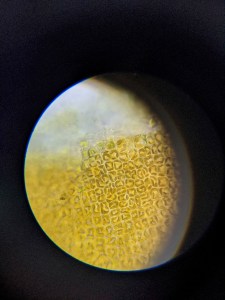
The pandemic has forced us all to view everything through a different perspective. We recently got a microscope in an effort to offset the crushing psychological weight of illness, isolation, suffering, and death. The microscope also forces a different perspective.

Here’s an image of fresh seaweed from Puget Sound (400x):

Here’s an image of garlic skin (100x):

Plant cells continue to build organized structures; chlorophyll continues to convert sunlight into sugars; carbon continues to cycle in and out of life forms. The seasons will continue to change; this season of grief, loss, and sadness will also pass.

Categories
Homelessness Nonfiction Observations Seattle

Leaves of Remembrance.

Throughout Seattle there are small metal plates in the shape of maple leaves that are embedded into the sidewalk. These are “Leaves of Remembrance” that “bear names of homeless women and men who’ve died, so that every person will have a place to be remembered”. People walk on and around them all the time, unaware of the purpose or significance of the leaves.

Only a few people were on the block that morning. It was not yet 8am, so the offices were still closed. The door to the corner store was open, though no customers were inside. A man was leaning against the building on the far end of the block, smoking a cigarette. The light of the sun was just starting to break through the grey clouds.

A man was squatting on the ground, inspecting the Leaves of Remembrance surrounding him. Near him was a styrofoam container of Cup Noodles, the lid removed. He dipped a white napkin into the ramen cup and rubbed it on a metal leaf. He leaned forward to inspect his work, leaned back to change his perspective, then wiped the entire leaf clean. After rotating his body, he began washing and wiping the neighboring leaves.

I’m not sure if he ever lived outside, though he has had his own apartment for years now. Does he recognize the names on the leaves? Was this his way of commemorating someone he once knew? Was this his way of helping to beautify the neighborhood? Is this part of his routine and I simply had not noticed until that morning?

He looked up when I walked past, though he did not recognize that I work as his psychiatrist. I did not greet him, though thanked him silently for his act of kindness during this time of calamity.

Categories
Observations Seattle Systems

About the CHAZ….

You’ve heard about Seattle’s Capitol Hill Autonomous Zone (CHAZ), right? With free press from President Trump, people both in the US and abroad now know about the “Seattle takeover” and his imperative to “Take back your city NOW”.

Well, dear reader, if you believe that I am reliable narrator, let me share with you my observations of the CHAZ.

First of all, this is how the CHAZ website describes the Capitol Hill Autonomous Zone:

The Capitol Hill Autonomous Zone née “Free Capitol” is a 6 block section around the East Precinct in Seattle, WA. Abandoned by police and left to burn, this area was instead siezed [sic] by anarchists, BLM supporters and other protestors who have since transformed it into a unverisal [sic] community based on mutual aid. Fundamentally, CHAZ is an occupation of Capitol Hill, not an official declaration of independence.

Here’s some context about the Capitol Hill neighborhood where the CHAZ is located: In addition to being the gay mecca of the Pacific Northwest, Capitol Hill is the hip neighborhood of Seattle.[1. Some would comment that Capitol Hill is the hipster, not hip, neighborhood of Seattle.] Bars old and new cater to the spectrum of genders. There’s wood-fired bagel cafe; a bike shop where, after spending time in the physio lab, one can order a Matcha Chicken Avocado Bowl; and a music venue called whose full name includes “Crystal Ball Reading Room”. Two blocks south from the CHAZ is a dealership shared by Ferrari and Maserati. A local cafe offers apricot jam doughnuts for $3.85 each. Rent for a one-bedroom apartment near the CHAZ is around $2000 a month.

Now, onto my observations:

According to the City of Seattle, about 65% of the city population is white and nearly 7% are Black. The vast majority of people (much more than 65%) I saw in the CHAZ were white. Perhaps this was due to the clumps of white tourists who wanted to witness the CHAZ themselves. Maybe white allies had taken upon themselves to “do the work” and use the CHAZ to advocate for Black Lives Matter (BLM) causes and demands. (Of note, I cannot find any comments from the Seattle-King County chapter of BLM about the CHAZ.) Despite the ongoing pandemic, a notable fraction of these white individuals were not wearing face coverings.

While there is a beautiful mural of “Black Lives Matter” physically on Pine Street and references to Black individuals of Seattle and beyond who have been killed by police, the overall vibe of the CHAZ seems more focused on opposing authority. The graffiti on and around the now abandoned police station, the “conversation cafe” stations, and the new community gardens seemed to chiefly cater to white audiences and suggest an anti-establishment philosophy. Black Lives Matter and “a universal community based on mutual aid” are not the same thing, and this is highlighted in the deliberate demands of the Seattle-King County chapter of Black Lives Matter. To be fair, there is overlap between the demands of CHAZ and BLM, though what people do often reveals actual intentions compared to what people say.

In addition to philosophical contrasts, there were physical contrasts within the CHAZ. A man was hugging his adult poodle like a baby, while a crowd of people were nearly running after a man who was yelling at someone about a stolen phone. A white man with what appeared to be a taxidermy weasel draped around his shoulders got into a profane shouting match with a Black man (one of the very few I saw) seated on a bench, a push cart stuffed with belongings next to him.[2. I promise you, dear reader, that there was indeed a man who had draped what appeared to be a taxidermy weasel around his neck. Maybe it was a plush weasel, but the effect was the same.] A (white) man was shoveling wood chips into a new community garden marked with a hand-written sign that read “This garden is for Black and Indigenous folks and their plant allies”. All the doors to the public bathroom were closed and the phrase “shoplift your future back” was scrawled in spray paint on its foundation.

Meanwhile, Seattle Parks and Recreation collected trash from the CHAZ and hauled it away. An employee, wearing a face covering, emerged from a Seattle Public Utilities truck with a clipboard and headed towards the park.

Here are my questions:

Is the Capitol Hill Autonomous Zone a distraction from Black Lives Matter? If yes, what are the consequences of that distraction at local, state, and federal levels, now that President Trump has condemned this “occupation of Capitol Hill”? What are the consequences to BLM if it is conflated with the CHAZ?

Could an Autonomous Zone exist anywhere else in Seattle? Does it matter that this part of Capitol Hill is young, trendy, and expensive? Could the Autonomous Zone exist in a Seattle neighborhood with more Black lives, such as the Central District or Rainier Valley? Even if the Autonomous Zone could exist in another neighborhood, would it exist? Would protestors want that? Would the neighborhood support that?

Has the local chapter of BLM made a statement about CHAZ? If yes, why is it difficult to find? If no, what worries or hopes does BLM have about doing so? The Seattle-King County BLM chapter has demonstrated great thoughtfulness about its activities in the midst of this pandemic, including specific rules about their protest. Their silent march drew around 60,000 protestors despite the rain. I look forward to learning more about and supporting their perspectives.

Will the CHAZ protestors vote? Some argue that the only way to change the system is to join it. Others insist that change can only come from the outside, as there are too many conflicting interests from within. Voting applies in either scenario.

Will the CHAZ protestors follow the lead of BLM? Sometimes the urge to “do something” is overwhelming, when the most productive and helpful action is to wait and follow. Before people congratulate themselves on the actions they are taking, it is prudent to ensure that these actions are in the service of the goal that will both change and improve the system.

How will the CHAZ end? Will the protestors leave of their own accord? Will they stay until forced to leave? Will there be non-violent negotiations, or will we witness more violence? How much effort will Seattle Police put into returning to their precinct building? What is the Mayor’s strategy about this, now that she is the target of antagonizing messages from both Seattle residents and the President of the United States?

When will the CHAZ end? With unemployment rates high in Seattle, as in the rest of the nation, some people may choose to remain in the CHAZ because the economy continues its slump. There is a Presidential election in November and if the President continues to give his attention to the CHAZ, that may reinforce their desire to remain. If Seattle sees a spike in coronavirus cases, will the city recruit Public Health to help assess the safety of the encampments and gatherings and then ask people to leave?


If you live in the Seattle-King County area and are able, please donate money to the Seattle-King County chapter of Black Lives Matter. Whether you live in Seattle or elsewhere, please also participate in the US Census and make sure you vote in the upcoming elections. Please continue to ask questions, engage your mind, and exercise critical thinking. Change will take all of us.