(I know it’s the holiday season and I promise I’m not actually a grinch, but here’s your warning: This is going to be kind of a bummer of a post.)
Some recent scenes for your consideration:
The sliding wooden gate did nothing to dampen the sounds of traffic on the boulevard. Inside the wooden gate was a parking lot that was now occupied by around 40 small sheds, each painted a different color. At one end was an open-air shared kitchen and a set of small bathrooms. It was snowing, the kind of wet, clumpy snow that doesn’t stick, but instead seeps immediately into clothes, hats, and sleeping bags. Though people in this “village” are still technically homeless, they were at least protected from this unusual Seattle weather. Within a few minutes of my arrival, a skinny kid, maybe eight or nine years old, wearing a sweater, shorts, and sandals, ambled outside alone to look up at the sky. Later, another skinny kid, maybe thirteen or fourteen, came out, his hands shoved into the pockets of his sweatpants and his eyes fixed on the ground. I wondered what their ACEs scores were and hoped that, as adults, they would escape and remain out of homelessness.
As I threaded my way through the city and the morning chill, I kept a mental tally: One man wearing a tank top and making grand gestures at the sky; another shirtless man pacing in tight circles; one woman wearing a soiled hoodie, with either black ink or a black substance smeared across the bottom half of her face, picking up trash from water pooled in the gutter; a man hobbling with a cane and screaming a melody; a man emerging from a collapsed tent to fold up a crinkled black tarp; a woman with bare legs and swaths of bright green caked on her eyelids who, in slurred speech, offered me a wristwatch dangling from her fingers.
“We have burned down the house of mental health in this city, and the people you see on the street are the survivors who staggered from the ashes,” writes Anthony Almojera, an N.Y.C. Paramedic [who has] Never Witnessed a Mental Health Crisis Like This One, who also comments that “there’s a serious post-pandemic mental health crisis.”
Maybe my expectations about the pandemic response were too high. A pandemic is an act of God; what could mankind possibly do that can deter the power of God?
I do believe that hope is a discipline. It’s hard to practice every day. But this is why I still question whether my expectations were too high. God spared us—you, dear reader, and me—during this pandemic. For what reason? What can and should we do with the gifts of our lives?
In trying to think through this myself, I turn to two mental models: First, what problem are “we” trying to solve? Second, can health care ethics provide guidance here?
What problem are “we” trying to solve? This requires reading the mind of New York City Mayor Eric Adams, which I cannot do. He has argued that The Royal We have a “moral obligation” to solve the problem of “assist[ing] those who are suffering from mental illness”. If we take him at his word, then we can fold his argument within the framework of medical ethics.
If, however, Mayor Adams is trying to solve a different problem (e.g., make homelessness invisible; reduce the number of complaints from the public about people exhibiting unusual or dangerous behaviors; demonstrate that he is “doing something” about homelessness, etc.), then the framework of medical ethics may not apply. If he is trying to solve a different problem, then instead of assisting those who suffer from mental illness, he is using those who suffer from mental illness to assist him and his actual agenda.
Of course, he may be trying to solve multiple problems through the guise of only one.
Can health care (or medical) ethics provide guidance here? One model used in medical ethics is called the four box model. Of note, the four boxes focuses on individual patients, not on populations of people.
Medical Indications (Beneficence and Nonmaleficence)
Patient Preferences (Respect for Autonomy)
Quality of Life (Beneficence, Nonmaleficence, and Respect for Autonomy)
Contextual Features (Justice and Fairness)
Medical indications asks what benefits and harms the patient might experience from interventions. Would involuntary psychiatric hospitalization help people with mental illness who are homeless? Some of them, yes. Would it help all of them? Maybe, maybe not. Could involuntary psychiatric hospitalization cause harm? That is not the intention, but sometimes it does. For reasons valid and invalid, it might discourage people from engaging in psychiatric services ever again. Anything involuntary always involves some degree of coercion, which people generally dislike.
Just because people are behaving in unusual ways and are living outside does not mean that psychiatric hospitalization is guaranteed to “fix” them. I do not mean to diminish the care people receive in psychiatric hospitals. People often need more than involuntary psychiatric hospitalization to get and stay well. Sometimes there is no medical indication for psychiatric hospitalization (involuntary or otherwise) for people with mental illness who are experiencing homelessness. Sometimes they just need a stable place to live.
Patient preferences refers to the dignity and choices people should have in living their lives. Some people would rather take pills by mouth every day than receive a monthly injection of medicine. Some people would prefer not to take any medicine at all. Patient preferences matter.
Some people who are living outside and behaving in unusual ways may not want to be in a hospital. Or maybe they are willing to be in a hospital, but not at that moment—maybe they have other things to take care of that day. Or maybe they are only willing to go to certain hospitals on their own, not at the behest of law enforcement. By definition, involuntary removal of people from the streets disregards patient preferences. Options other than psychiatric hospitalization, such as crisis centers, partial hospital programs, or day programs, can help preserve patient preferences and hence their dignity.
Quality of life describes the patient’s quality of life. Interventions should provide benefit, minimize harm, and maximize the dignity and choices of patients. This does not refer to the quality of life of the general public. If involuntary removal and psychiatric hospitalization are the means to the end of improved quality of life, how can these improvements be sustained following hospitalization?
It is absolutely true that psychiatric hospitalization can be life-saving and life-improving. However, people need and benefit from ongoing care and services following hospitalization. Mayor Adams’s target population also need places to live to maintain their gains. If you’ve ever been hospitalized for any reason, can you imagine the course of your recovery if you had no place to go upon leaving the hospital? How are you supposed to rest when you don’t know where you will sleep that night? Quality of life requires planning and sustained care; acute interventions alone rarely produce improvements in quality of life.
Contextual features are the intersections of a patient’s care with the rest of the world. There are a multitude of contextual features in Mayor Adams’s plan (and it makes me wonder if the mayor consulted with any partners prior to making his announcement). Here are a smattering of contextual features that come to my mind:
How will first responders decide if someone has a mental illness? What if they think someone has an “attitude problem” and instead refers them to jail? How severe do psychiatric symptoms have to be? Will only those who attract the attention of law enforcement be involuntarily removed? (What about the elderly woman who keeps to herself and has been homeless for decades and won’t move indoors because the voices tell her that she will die if she does?)
How will hospital psychiatrists react to people who, in their professional opinion, do not need hospital-level care, though the law argues otherwise? Will psychiatrists become agents of social control on behalf of the jurisdiction? There are some parallels here to the overturning of Roe v. Wade: Some gynecologists are not performing abortions, even though there are medical indications to do so, because of the law. Here, psychiatrists may proceed with involuntary treatment even though there are no medical indications to do so… because of the law.
Let’s say someone experiencing homelessness is involuntarily removed from the street and is psychiatrically hospitalized. Where will they go upon discharge? What if they prefer returning to the street instead of a shelter? What if they have no sources of income and there is insufficient affordable housing? (This is not actually a “what if” question.)
What about all the people who are homeless, but do not demonstrate symptoms of mental illness? Are there any opportunities to prevent or reduce the chances of mental illness in this population? (Yes, by increasing access to stable housing.)
What about all the people with severe mental illness who are not homeless? Are there any opportunities to prevent or reduce the chances of homelessness in this population? (Yes, by increasing access to and flexibility of psychiatric services.)
The four box model here highlights some ethical problems with Mayor Adams’s plan, though there are solutions to increase beneficence, autonomy, and justice while reducing non-maleficence. My hope is that Mayor Adams and leaders of other jurisdictions with similar ideas will take heed.
The rains have finally returned to Seattle, though the wildfires continue to burn:
Wildfires from Google Maps as of the morning of 2022 Oct 24.
That map does not include the entirety of Washington State (there are more fires outside the boundaries of that image), or the fires burning in neighboring Idaho and Oregon.
While we did not experience the blood red skies that San Francisco experienced from the wildfires of the summer of 2020, the air was looked and smelled thick. Each whiff contained fragrant notes of Douglas Fir and perhaps Western Red Cedar, all overwhelmed by charred carbon. Landmarks disappeared into a gritty haze of grey. The evenings featured a crimson sun sinking into ashy layers of peach, pink, and coral.
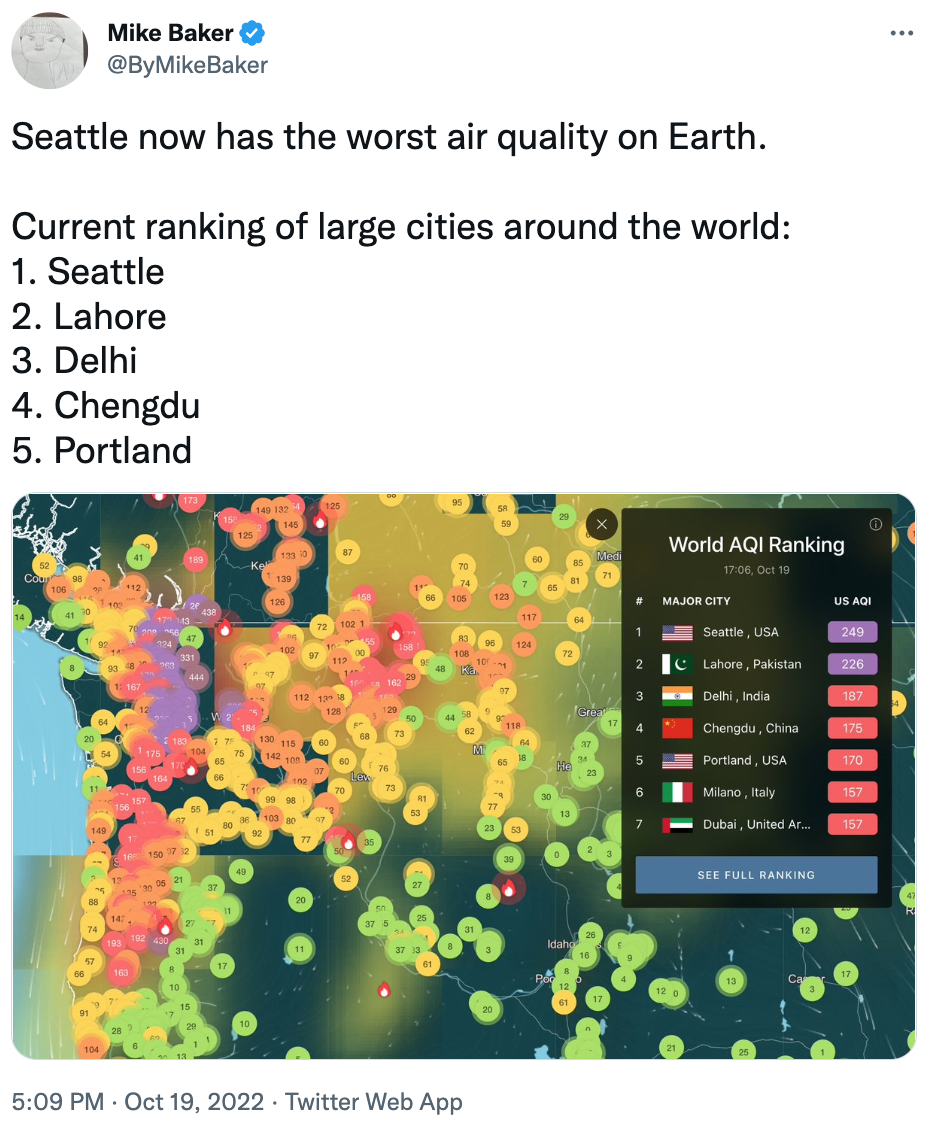
By October 19th, Seattle had the worst air quality on the planet:
Conditions did not improve the next day. The Space Needle has a webcam (more precisely a “panocam”, as it provides a 360-degree view). Go take a look at it now; this is the grey pall that we embrace for much of the year. Despite this pewter drape, one can still see the surrounding buildings, lakes, and trees. Compare this to the view on October 20th:
(“Is the Mountain Out?” refers to glorious Mt. Rainier, the 14,410-foot tall stratovolcano that looms over the region.)
The rain finally arrived on October 21 and displaced the smoke:
In addition to headaches, congestion, and watery eyes, people also experience psychological effects due to wildfires. I came across this paper in Nature Human Behavior from July 2022 that reports on one aspect of this: Exposures and behavioural responses to wildfire smoke (no paywall as of this writing). While the paper doesn’t quite answer the question I want to answer, it did report:
… during large wildfire smoke events, individuals in wealthy locations increasingly search for information about air quality and health protection, stay at home more and are unhappier. Residents of lower-income neighbourhoods exhibit similar patterns in searches for air quality information but not for health protection, spend less time at home and have more muted sentiment responses.
(For those who consider how your digital data gets used, the data for this paper came from Twitter, Google searches, and a real-time air quality monitor called PurpleAir, along with geographic income data.)
As we also have seen during the pandemic, people with lower incomes have less choices, even if they have access to similar information (emphasis mine):
Why do wealthier locations respond differently to smoke exposure? The measured differences do not appear to reflect differences in exposure information or in overall internet activity, given the consistent response of air-quality-related searches across income groups. Rather, the responses are consistent with lower incomes constraining choice sets and behaviours, including less flexibility in working from home, fewer resources with which to consider purchasing protective technology and (regarding the sentiment results) having other more pressing matters to worry about.
The Seattle Times published an article on October 20th that highlighted “constraining choice sets”. The King County Regional Homelessness Authority opened a “smoke shelter“, though few people used it. Why?
“The long-term effects of breathing in smoke is not going to be like the most highest of priority,” said an outreach worker. This is consistent with the findings from the article: While people living outside may have access to the internet, they likely are not seeking air quality monitors or information about filtration, as they do not have their own windows to close or own spaces to filter.
One of the conclusions of the article about wildfires could very well be applied to the pandemic: a “policy approach of promoting private provision of protection could be biased against disadvantaged groups”. I also suspect that the unhappiness the wealthier respondents reported as a result of wildfire smoke is not dissimilar from the ongoing unhappiness we all are seeing as a result of the pandemic and its social consequences. (It is likely that people who are poor are also experiencing unhappiness; they simply may not have the time, energy, or resources to feel it.)
As an aside, it may be shocking to note that psychiatrists prescribe only 21% of the antidepressants in the U.S., with the other 79% of prescriptions usually coming from primary care providers!
Much of the burden of psychiatric services falls to primary care and emergency medicine. Some data suggest that nearly 60% of US counties do not have a single psychiatrist. While primary care and emergency medicine physicians can and do provide psychiatric services, they can be put into positions where they are addressing psychological issues beyond their scope of expertise. I mean no disrespect in writing that. Just as it is a terrible idea for me, a psychiatrist, to manage complex diabetes, it is unideal for non-psychiatrists to manage complex psychiatric conditions.
Sometimes people end up developing complex psychiatric symptoms and conditions because they are unable to access support, care, and services earlier. As a result, larger numbers of people end up accessing services in urgent or emergent ways (e.g., emergency departments and criminal-legal systems). Local jurisdictions then receive increasing demands to build crisis response systems. For example, Seattle-King County recently announced a future ballot measure to build five mental health crisis centers in the region.
There will always be a role for crisis centers, as life is unpredictable and collisions of fate and bad luck can result in crises. However, if the crisis system has the most open doors and is the most robust part of the system, then this will only increase the number of people who will use that system.
We can pick any point in a theoretical journey through the crisis system, but let’s start with the crisis center. Let’s say that all five centers have been established and that these centers receive the most dedicated funding and attention. Maybe John Doe is able to access the crisis center directly, which is a boon to first responders and emergency departments—it’s one less person they need to provide care for (and they’re often are not the best suited to give support, anyway). Once John Doe is not as overwhelmed, what are the next steps?
If the crisis centers have received the most dedicated funding and resources (staffing, advertising, etc.), that probably means that other resources—like step-down units or outpatient clinics—will not have the same level of support. Thus, it might be weeks or maybe even a few months before John can get into a clinic.
John can do the best that he can to make it until that appointment, but what if something else happens and he need urgent care? His choices might be limited to an emergency department (which, no offense to my ED colleagues, are not therapeutic places to be) or to return to a crisis center. He might call a first responder, but that might entail an encounter with law enforcement (which is often not people’s first preference). Unless other resources are made available—unless there are other pathways he can take—he will continue riding the merry-go-round that is the crisis response system.
This is why it is essential to build and sustain prevention and early intervention system while also building crisis response structures. The tired phrase is “moving upstream”, but that is the most stable way to get people out of the crisis system.
I agree (to a point) with the New York Times’s editorial board: The Solution to America’s Mental Health Crisis Already Exists. This article provides an accurate history of how a vision of community-based care for some of the most psychiatrically ill and vulnerable people in our communities got degraded. Do I think it is the solution? Only when I feel particularly optimistic. Do I think it is a solution that could yield great rewards? Yes, though ideally this would be paired with other non-medical, community-driven prevention and early intervention efforts.
Prevention and early intervention systems don’t need to formally reside with medical or legal structures. In fact, it is better for the whole community if they don’t. (Let’s not kid ourselves: The vast majority of people don’t want to spend time in the health care system, particularly with psychiatrists. The health care system can do amazing things, but it is also rigid, expensive, and requires people to jump through a lot of hoops.)
Nathan Allebach recently created a TikTok video that describes the decline of “third places” (and I am relieved that he recognizes that car-dependent suburban sprawl isn’t the sole cause community erosion). I’m not saying that community erosion is the primary cause of psychiatric symptoms and distress. However, the presence of social bonds and community could not only alleviate symptoms, but could also prevent some psychological problems. What if interpersonal social networks were robust and included both more and different kinds of people and perspectives? What if fewer people felt lonely and “Good Neighbor Day” didn’t have to be a thing? (Full disclosure: I have a professional crush on Dr. Vivek Murthy.)
If it is true that at least some psychiatric conditions are “medicalized” sociological problems, then this is an arena where non-medical (though not necessarily political!) interventions could be invaluable. Fewer people would believe that their only option is to ask Dr. McCormick for antidepressant medication for anxiety and depression. Non-medical, community-based activities might be sufficient. Fewer people would need to go to emergency departments or crisis centers because resources and options in the community would be inviting and easily accessible. Maybe two crisis centers, instead of five, would suffice. And people would spend less time with (and money on) health care professionals and services, and more with people they want to spend time with… people in their chosen communities.
Here’s another piece in the New York Times’s series on mental health and society: Mental Health is Political. (Forgive the generous quoting and quotation marks that follow.) Dr. Carr says:
In medicine, examples of reification [the process by which the effects of a political arrangement of power and resources start to seem like objective, inevitable facts about the world] are so abundant that sociologists have a special term for it: “medicalization,” or the process by which something gets framed as primarily a medical problem. Medicalization shifts the terms in which we try to figure out what caused a problem, and what can be done to fix it. Often, it puts the focus on the individual as a biological body, at the expense of factoring in systemic and infrastructural conditions.
She goes on to say:
When it comes to mental health, the best treatment for the biological conditions underlying many symptoms might be ensuring that more people can live less stressful lives.
… after clarifying that she is
not arguing that mental illnesses are fake, or somehow nonbiological. Pointing out the medicalization of social and political problems does not mean denying that such problems produce real biological conditions; it means asking serious questions about what is causing those conditions.
The crux of her argument is this (emphasis mine):
This principle is what some health researchers mean by the idea that there are social determinants of health — that effective long-term solutions for many medicalized problems require nonmedical — this is to say, political — means.
I think I understand what she is arguing here: There are systems in our culture that contribute to mental distress and illnesses. I generally agree with this. If entry level jobs consistently paid wages that allowed people to rent apartments in cities where they work, that would reduce psychological pressure. The stress of long commutes, public transportation, and car and gasoline costs would disappear. People would have more time to enjoy healthful activities instead of commuting. If people are spending more on housing than they can afford, this leads to the tension of living paycheck to paycheck. Insecurities related to eviction and homelessness grow. None of this contributes to psychological wellness.
However, I also wonder how she defines “political” throughout this piece. Is all psychological distress really “political” in nature? For people who experience auditory hallucinations and delusions, is their psychological distress “political”? (Recall that there are people with a diagnosis of schizophrenia who are not indigent: They sustain employment, pay their rent on time, and lavish their pets with treats.)
Are all nonmedical interventions for mental illnesses—whether “medicalized” or not—“political” interventions? At various times and places, there has been alignment between the political beliefs of the community and those in political power. Did rates of mental distress and illnesses significantly decline? (I don’t know the answer to this; if you do, let me know.) If alcohol use disorders are mental illnesses, does this mean that Alcoholics Anonymous and other 12-step groups are “political” interventions? If people who have lost loved ones to suicide and convene as a group to express grief and support, is this a “political” act?
Should we still describe our psychological distress as “political” when life is inherently stressful? Is the act of commiserating with other medical professionals for support during the pandemic a political act? Maybe it is; maybe we must turn to each other because we recognize that health authorities apparently cannot and will not provide more support to us. But maybe it’s not; maybe this is a community of care we intentionally cultivated over time.
an application of “the personal is political” so expanded in scope that, for a certain kind of person, personal problems, anxieties, and dissatisfactions are illegible or illegitimate unless described as political problems.
She further notes that
[the] invocation [of capitalism] immediately establishes a phenomenon in the realm of the political, without any further work required.
… if only political problems are legitimate, only political solutions are admissible. This has the odd effect of filtering all attempts at self-integration through a political lens.
By describing problems (like capitalism) and solutions as political, perhaps this absolves us of the work we can (and sometimes need) to do. How can one person’s action have any meaningful impact on a political problem like capitalism? Aren’t systems, by definition, much larger than individual people? She then points out:
But in fact there is no one to adjudicate between you and capital, no one to say yes, that really is too much, let’s reassign this project. …
There is no political program that will release you from the necessity of doing more than you should have to or feel capable of doing, in politics as in every other part of life.
I appreciate her exhortation:
This is your life. You do not have time to wait for the revolution to begin living it. You will always be able to find someone to give you permission not to live it. But no one is coming along to live it for you.
To be clear, I am not at all suggesting that we can eradicate mental distress and illnesses by simply yanking on those bootstraps. The statement that “mental health is political”—to me, at least—removes any agency we have as individuals. Yes, political interventions and actions can improve population (mental) health. However, some political interventions will have little to no impact on individual psychological health. There are choices we all can make, on our own, that can help improve our own psychological wellbeing. Furthermore, we each can make choices everyday that can improve the psychological health of the people within our six-foot radius. Our actions don’t have to be political statements.
Given the work that I do, I don’t need much persuasion to believe that systems have many direct and indirect adverse effects on people’s health. It also seems unreasonable, though, that politics will always provide solutions for mental distress and illness.