Categories
Policy Public health psychiatry Systems

Writing Down Words.

It’s been five months since I’ve posted anything… and not because I had nothing to say. As Gloria Estefan and the Miami Sound Machine sang:

But the words get in the way
There’s so much I want to say
But it’s locked deep inside

… except it was Covid that was breaking my heart. I still feel like I have aphasia when people ask me what happened and how I am doing. At least now I am able to blurt out some emotion words (“I was angry, but it’s really because I was profoundly sad”).


In the meantime, work I did during my tenure as a medical director at King County got some press: Why King County mental health facilities decline 27% of referrals. (The only reason why I agreed to have my photo taken for the Seattle Times piece was to give my dad something to smile at.) Here’s what I learned from this experience:

Write stuff down and share it. I left my position at King County in 2019. I wrote a report on this data every year between 2015 and 2019. I sent it out to relevant organizations and officials, whether they welcomed it or not. The Seattle Times journalist somehow discovered the 2019 edition of this report earlier this year. I am grateful that she found it interesting enough to publish it in the local paper of record. If you think it’s important, write it down and share it. Someone will eventually find it useful. (I suppose this is an underlying tenet of those of us who still write in blogs.)

Sometimes it’s easier to talk about stuff once you’re outside of the organization. Government, at all levels, has its communication protocols. Depending on where you sit in the hierarchy and what your status is, you may not be permitted to talk to the press. Or you are counseled to adhere to specific talking points. (I recall sitting for an interview with a local weekly publication; I was only allowed to speak to the journalist if one of the county communication officers sat next to me.) For this, my speech was more free.

People want to learn. The photographer and I met at a public staircase. I said, “I probably shouldn’t smile, since this isn’t a joyful topic.” She had a general sense of the article and asked questions. By the end of our time together, she learned about psychiatric hospital data and I learned about the experiences of newspaper photographers.


Ezra Klein interviewed Dr. Thomas Insel, a former director of the National Institute of Mental Health, on his podcast (“The psychiatrist and public health expert Thomas Insel discusses how mental illness is a medical problem that requires social solutions.” Dr. Insel’s formulation here is catchy, though oversimplified.) I appreciated Ezra asking Dr. Insel to clarify and elaborate on some of his statements. Dr. Insel and I, though both psychiatrists, have had different professional experiences. As a result, I offered the following reactions to Ezra and his team:

There is an overlap between people with serious mental illnesses and poverty, which is where social solutions may be the most effective. People with serious mental illnesses (e.g., schizophrenia, bipolar disorder, etc.) are often at greater risk of poverty. For example, someone with a diagnosis of schizophrenia may be unable to sustain employment, accrue hospital bills that they cannot pay, and end up receiving more attention from law enforcement. Conversely, poverty can exacerbate serious mental illnesses. For example, adolescents may run away from home due to domestic violence or other dangers at home. If these teenagers do develop psychiatric symptoms, they often have limited support to seek and access services (health care or otherwise). Social solutions (e.g., housing, supported employment, etc.) may only work for individuals who experience both serious mental illness and poverty. Many of the interventions Dr. Insel listed–clubhouses, job training, supportive housing–are available only to those who have Medicaid insurance, which, as you know, requires low income.

Psychiatric treatments in the US, for better or worse, occur within an American/European frame. Dr. Insel extolled the virtues of medications and psychotherapy (and, to be clear, he’s not wrong—the current evidence base supports the use of both for many psychiatric conditions), except these interventions have Western European origins (hence his reference to Freud). Different ethnic cultures and American subcultures may be uncomfortable with or outright reject the American system of diagnoses and treatments. There is evidence that indicates that Black people are more likely be receive diagnoses of schizophrenia and antisocial personality disorder, which remain two of the most stigmatizing diagnoses in psychiatry. This isn’t limited to race only; women seem more likely to be diagnosed with anxiety and depression. (Is this a remnant of antiquated ideas related to wandering uteruses? or because women are more likely to seek medical help for their concerns?) The traditional health care system has expectations about how people will present and express their concerns; it also has expectations about how people will receive and accept care. From an intersectional perspective, this may contribute to why certain populations are less likely to seek and accept psychiatric services.

Policies and culture are intertwined. I appreciated Ezra’s commentary about the role (or lack thereof) of policy as it relates to isolation and serious mental illnesses. I agree that that policies can only go so far to help promote social support and connection. Perhaps Ezra and Dr. Insel were trying to discern how current US culture reflects a lonelier society, and how policies can or cannot influence US culture to help reverse this? Policies come out of the current culture, but policies can also impact culture (e.g., women’s suffrage, civil rights, abortion bans, etc.).

Though it’s hard to prove the success of prevention, that may be the best way to address all three issues above. Because most of my work has been in the “deep end” of the system, I have become an ardent supporter of prevention and early intervention. (At the risk of sounding really self-righteous, I’d love to work myself out of a job!) So many people I’ve had the privilege of caring for have experienced terrible physical, mental, and sexual trauma as children and adolescents. What would it be like if people weren’t molested or assaulted when they were kids? What would it be like if pregnant people didn’t experience violence from their partners? What would happen if youth who identify as LGBTQ+ experienced acceptance and support from their families? What if emotional self-regulation skills were part of prenatal care and school curricula? These prevention efforts can be folded into policy, which can influence culture. Reducing (minimizing? eliminating?) poverty through policy could improve outcomes not only for mental health, but for physical health. (The Spirit Level by Wilkinson and Pickett provide some compelling data about this.) Ensuring that psychiatric interventions and treatments from non-American/European frames are funded and evaluated for efficacy not only increases treatment options, but these non-Western treatments may also appeal to different populations.

Funding for the mental health and substance use disorder systems is complicated; it took me years as a medical director to understand how it works at the county level. Funding systems should follow the clinical delivery of services, but, unfortunately, the delivery of psychiatric services (as with the rest of health care) is based on funding systems. This makes implementing services, accessing care, and improving outcomes needlessly challenging for actual human beings. While the 988 line is an encouraging development, I worry that, if the crisis system is the most robust part of the psychiatric care system, then crisis care will be the only place where one can get quality care. And no one should have to experience one of the worst days in their life to receive good care.

I can’t help but observe how my reactions above can also apply to how the US has responded (or not) to the Covid pandemic. I continue to grasp at words.
Categories
COVID-19 Nonfiction Policy Public health psychiatry Reading

Public Mental Health Implementation Failure.

Throughout the pandemic, I have routinely reviewed the major psychiatric journals in the United States, hoping for commentary about and guidance related to the prevention or minimization of psychiatric conditions due to the Covid-19 pandemic. Surely there are practices or protocols we could implement to prevent bad outcomes that we knew would happen! While the work we do with individuals might have some potential benefit, the scale of the pandemic meant that population-level interventions would have better effects for a greater number of people. From my point of view, if my finite time and energy could help more than the sole person in front of me, that would be better for all involved.

Three thousand years ago, back in December 2020, I commented that “collective problems require collective solutions; expertise must be decentralized and shared” while reflecting on the need to Protect Mental Health During a Pandemic. Now that three thousand years have passed, it seems that anyone at the federal level who tried to implement the Pan American Health Organization or World Health Organization recommendations from the flu or ebola epidemics was foiled. I lamented then that

We’ve already witnessed psychological stumbling across the population; none of us want to see ourselves, our neighbors, our communities, and those beyond beyond fall further.

We’ve graduated to chronic psychological lurching, floundering, and tottering. Most of the psychiatry journal articles have only described consequences from the current pandemic: who was more likely to get Covid-19? how did it affect the use of substances? how was the pandemic affecting the workforce?

Where were the articles with broad vision, that take the perspective of public health psychiatry?

The Lancet Psychiatry recently published an article that I found refreshing: Public mental health: required actions to address implementation failure in the context of COVID-19:

  1. It acknowledges how the mental health system—one of many—has failed during the pandemic (people may have opinions about whether it was succeeding prior to the pandemic);
  2. It lists specific failures and how to fix these problems (and there are a lot of problems to fix);
  3. It reinforced the need to direct attention and resources to all stages of the lifespan and the various roles, from individuals to national governments, each could play to prevent future failure.

The authors rightly comment

This failure of [public mental health] implementation results in population-scale preventable suffering of individuals and their families, a broad range of impacts…, and large economic costs. The failure also represents a breach of values and the right to health.

Panel 5 lays out how the implementation failures of public mental health:

  1. Insufficient public mental health knowledge
  2. Insufficient mental health policy or policy implementation
  3. Insufficient resources
  4. Insufficient political will
  5. Political nature of some [public mental health] activities
  6. Insufficient appreciation of cultural differences
  7. Causes of mental disorder treatment gap

Oof. It’s a valid list and, indeed, some of the responsibility falls upon mental health and substance use disorder clinicians ourselves. (Different posts for different days.) It’s also striking that, despite the United States being a high income country, we suffer from the same problems listed above that apply to low income countries. (We, however, continue to learn the many ways how the US was and is never different from “those” low income countries.)

As I noted a few weeks ago, “We continue to focus on the viral pandemic; the psychological pandemic has already arrived.” Because of our missteps, the psychological pandemic will also outlast the viral pandemic. The authors note that

The COVID-19 pandemic has widened the implementation gap but has also increased mental health awareness and highlighted the need for a [public mental health] approach.

Now that we are minding the gap, I hope that we can indeed close it.

Categories
Homelessness Nonfiction Policy Public health psychiatry Seattle

Shelter “Isolation” and “Quarantine”.

Though the room layout follows pandemic guidance, it still feels crowded.

Dozens of beds are placed six feet apart. In a homeless shelter, each twin mattress is multipurpose furniture: Yes, it is a bed where people sleep. It is also a table upon which they eat simple meals stuffed into brown paper bags. It is a living space of 38 by 75 inches that offers no privacy and no isolation.

Say someone living in the shelter falls ill with Covid. Should this person be allowed to stay in the shelter, but risk infecting others? Or should the shelter ask this person to leave and recover in the chill and darkness of January?

Seattle-King County has been a leader in implementing isolation and quarantine (I&Q) sites for people who don’t have their own place to live. These are hotels that allow people who were exposed to or infected with Covid-19 to rest and recover away from others. The hotels have specialty staff who provide physical and behavioral health care. Once recovered, people can return to shelter or similar congregate settings. It is difficult to prove the success of prevention, though removing people from congregate settings likely reduced infections. This, in turn, reduced hospitalizations and deaths.

Last winter, there were four I&Q sites. This winter, there are only two.

This reduction isn’t for lack of need. As with the general population, the omicron variant has caused a crush of infections in shelters. The I&Q sites, like most health care agencies, cannot hire enough people to provide services. This reduction in I&Q sites is entirely due to an insufficient number of staff.

Because fewer health care workers now work at the I&Q sites, the county has had to enact more exclusion criteria to preserve this service. Providing support for people with multiple health conditions requires professionals with expertise and experience; physical space and supplies are not the only considerations.

This means that people living in shelters who are ill with Covid will be denied admission to I&Q sites.

That means that people who are sick with Covid may only have bad options to choose from. If they’re lucky, they may be able to stay in a shelter. However, their living space of 38 by 75 inches has no walls. Sights, sounds, and air are all shared.

The average age of someone experiencing homelessness for the first time is now 50 years old. People who live in shelters, cars, or outside are more likely to have chronic health conditions like high blood pressure, diabetes, depression, and anxiety. These conditions are risk factors can result in more severe cases of Covid illness. These same factors also increase the risk of disease and death if people are sent outside.

With the attrition of health care and essential workers, the burden of illness and disease will fall upon the most vulnerable people in our communities.

This also means that staff who are still able and willing to work at the shelters–all essential workers–are at increased risk. Most shelters do not have access to medical expertise or consultation. If there is nowhere to send people who are ill with Covid, shelter workers will have to decide what to do if someone in the shelter gets sick. We cannot expect all shelter staff to have the skills, knowledge, and desire to provide isolation and quarantine support. If shelter workers send someone out, that will only put more burden on the safety net of first responders and emergency departments. This safety net is already fraying and breaking after two years of crisis.

Systems cannot rely on single individuals, though this has been happening more and more as the pandemic has dragged on. As various systems falter and crumble, we see the demoralization and exhaustion of all who provide essential services. More distressing are the detrimental effects these system failures have on vulnerable people we want to serve well, but cannot.

This is unfair to all involved. Inside and outside of the crowded room of the shelter, it is with horror that we realize that all of our options are bad.

Categories
COVID-19 Homelessness Nonfiction Public health psychiatry Seattle Systems

Faltering and Failing.

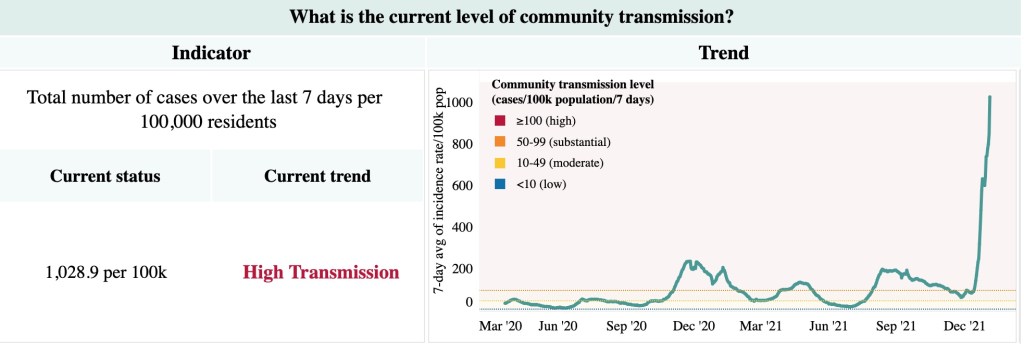
The omicron variant has resulted in a surge of cases here in Seattle-King County:

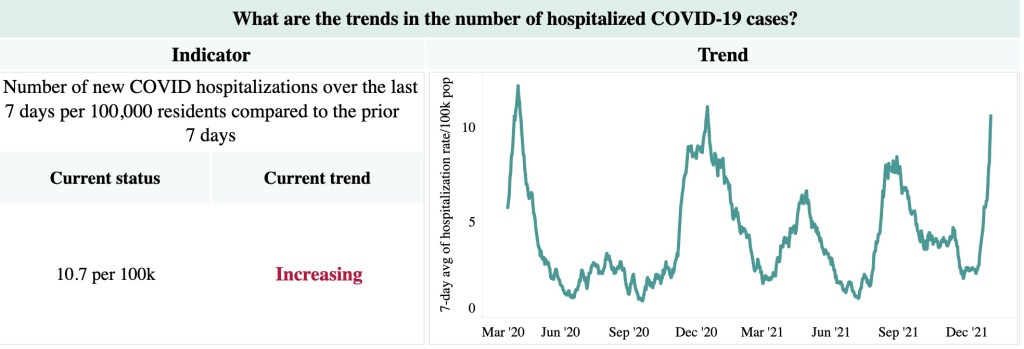
Our hospitals have not been spared. They, like in other areas, are in a crisis situation:

There are similar surges in Covid cases in homeless shelters and other congregate settings. This, combined with an insufficient number of people who are willing and able to work at isolation and quarantine (I&Q) sites, has led the I&Q sites to limit the number of admissions. The admission criteria now are the most stringent they have been at any point during the pandemic:

What this means in practice is that people living in shelters who are sick with Covid may have nowhere else to go. If they are lucky, they will be able to stay in the shelter. Their only other option may be staying outside in the chill and darkness of January.

Which is worse? Covid infections sweeping through a homeless shelter? Or people exiled outside because they are sick? (They may end up seeking help at an emergency department, all of which are already strained and overburdened.)

To be clear, I do not blame the county for this. Health care workers are fleeing their jobs due to the crush of the pandemic. Everyone is struggling with hiring health care and essential workers.

We cannot look away from the horror of systems faltering and failing. We must witness that the most vulnerable people in our community will bear the greatest brunt of these failures.

Categories
COVID-19 Education Public health psychiatry

Reactions and Behavioral Health Symptoms in Disasters.

The Washington State Department of Health started posting Behavioral Health Monthly Forecasts in April 2020. Two disaster psychologists, along with other staff, compile and share useful information such as the anticipated course of psychiatric symptoms across the population, how different populations might manifest their distress (e.g., children), and data related to changes in substance use and firearm purchases. It makes for interesting reading, though it’s frequently a bummer.

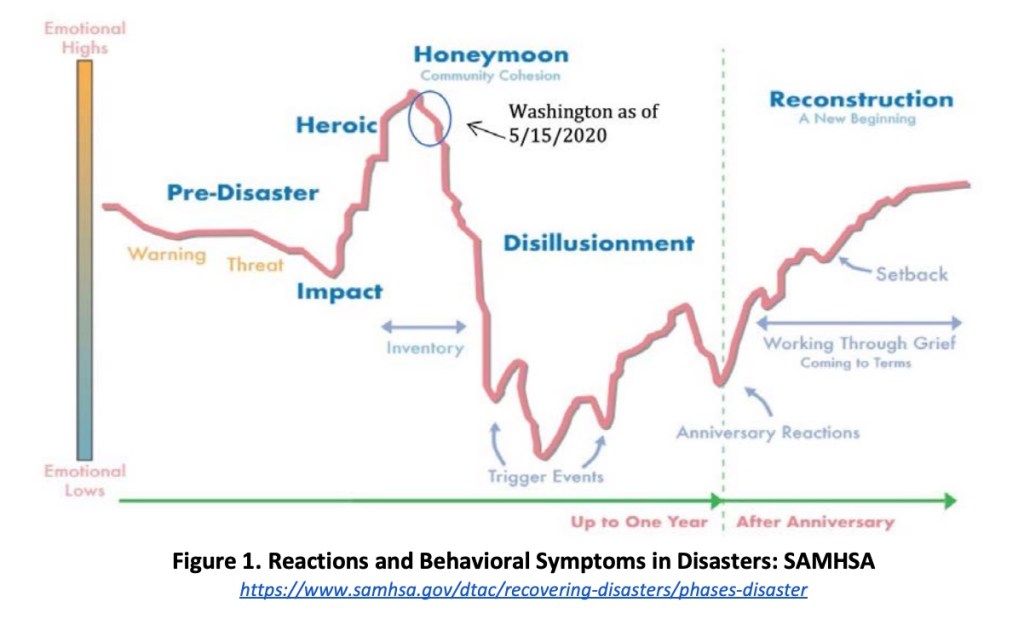
One chart that appears every month is “Reactions and Behavioral Health Symptoms in Disasters”. In the inaugural issue in April 2020, the forecast oriented readers to general model from SAMHSA[1. SAMHSA is the Substance Abuse and Mental Health Services Administration. What a shame that it is a distinct department from the Centers of Disease Control and Prevention (CDC). The mind remains split from the body in our administrative and health care systems, which is why there is no formal framework for public health psychiatry.] of reactions in disasters:

Note that there is no indicator here about where Washingtonians were at that time. The Y axis uses color to depict emotional states and the X axis, so optimistic, has only a notation to mark one year.

In May 2020, the forecast made a proclamation about where Washingtonians were. It was a warning: We were on the precipice of disillusionment:

We braced ourselves for this. Yes, we had witnessed heroism from so many, whether health care workers or first responders or neighbors dropping off food for those who were medically vulnerable or distilleries producing hand sanitizer or seamsters and seamstresses joining brigades to make cloth masks. Of course this level of concern and anxiety was unsustainable. How bad could it get?

Well.

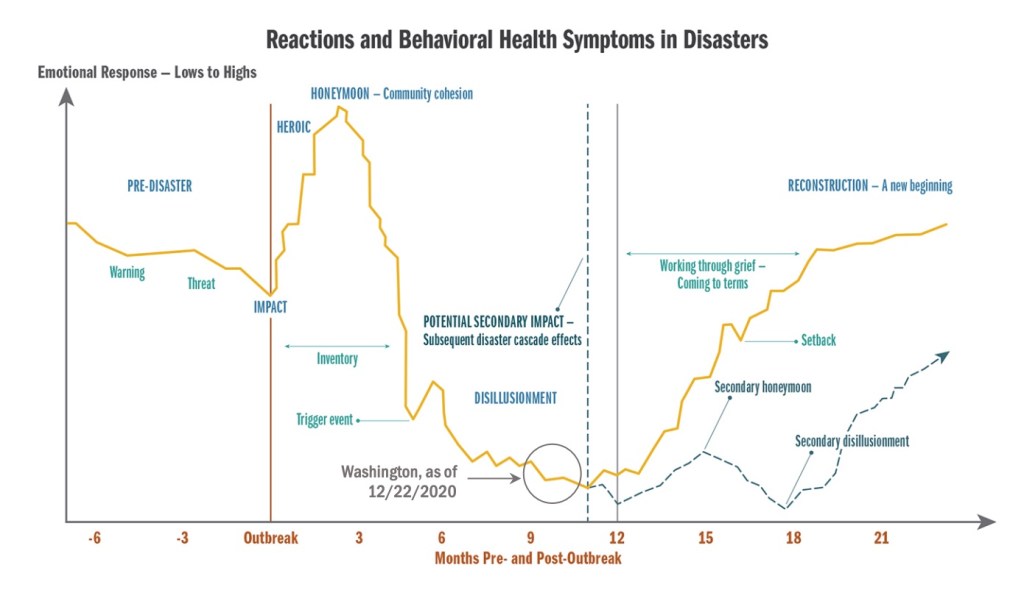
By December 2020, we were in a trough of disillusionment and it felt like it:

Thousands of people were dying a day in the US and other countries around the world. Hospitals were overrun with sick people. People were starting to leave their jobs due to overwhelm. When would the vaccines become available? I remember looking at this graph and thinking, “I thought the graph last month had us in the nadir of disillusionment.” But there was a branching of lines! Maybe we, as a state, would follow the yellow line and things would improve for us all, regardless of station in life.

Well.

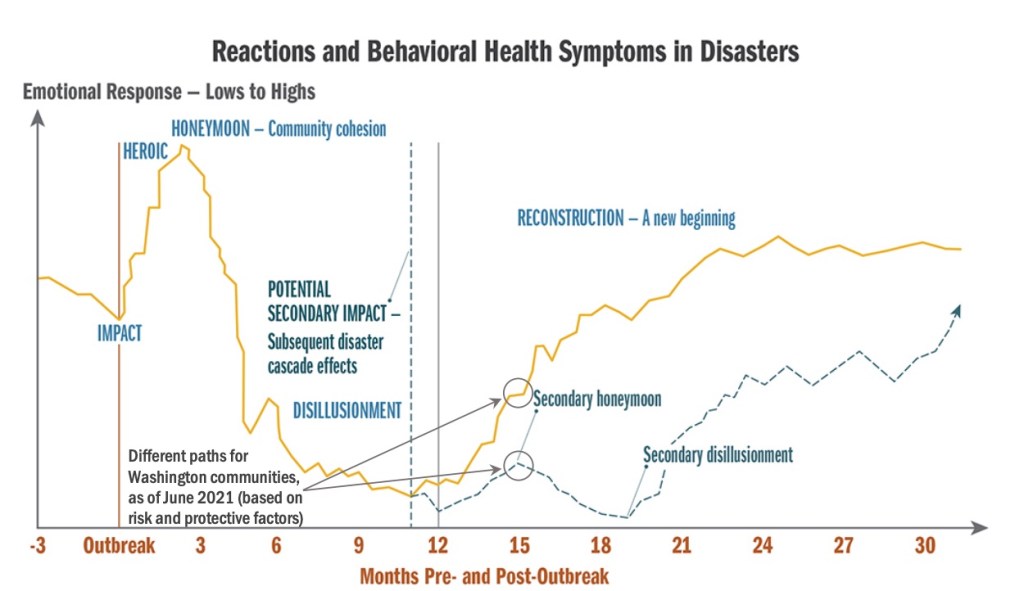
A terrible winter passed. The days got longer, there were more opportunities to be outside, many people got vaccinated… but the yellow line never manifested for those in my professional and personal communities. By June 2021, we were still in a trough:

In retrospect, that “secondary honeymoon” was accurate. All the numbers we hoped would drop, did: Reproductive number, cases, hospitalizations, and deaths. People in the Seattle-King County area were getting vaccinated. But so many of the people under our care were dying from overdoses, suicide, and chronic medical diseases.

Then came Delta, Omicron, more cases, hospitalizations, and deaths. Health care workers and others left their jobs out of frustration and demoralization. A contingent of people continued to decline vaccinations, despite knowing the possible outcomes… including chronic disease and impairment that still has no effective treatment.

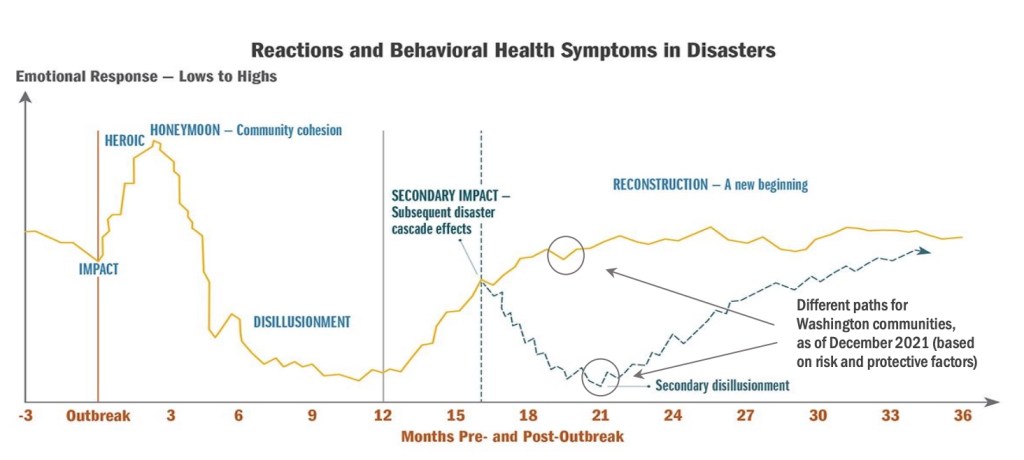
When the December 2021 graph came out, someone observed, “The trough just keeps getting longer.” I wondered who on Earth was experiencing the benefits of “reconstruction”.

I have never had so many people under my care die during a comparable period of time. At least 10 of my patients have died since the beginning of the pandemic; the first death occurred in July 2020. The most recent death (that I am aware of) happened in November 2021. None of these people died from Covid. They either died by suicide, overdose, or their chronic illness collided with an acute, fatal event.

We know from history that pandemics do not last forever. The 1918 flu pandemic lasted just over two years. The 2002 SARS outbreak was declared over in less than two years. The 2013 Ebola epidemic persisted for less than three years. All things change, all things end.

I, like so many others, hope that we all will exit this trough sooner than we anticipate. I worry about the psychological consequences of this pandemic in the years to come. We continue to focus on the viral pandemic; the psychological pandemic has already arrived. We have yet to see an organized response to that.