Categories
COVID-19 Education Public health psychiatry

Reactions and Behavioral Health Symptoms in Disasters.

The Washington State Department of Health started posting Behavioral Health Monthly Forecasts in April 2020. Two disaster psychologists, along with other staff, compile and share useful information such as the anticipated course of psychiatric symptoms across the population, how different populations might manifest their distress (e.g., children), and data related to changes in substance use and firearm purchases. It makes for interesting reading, though it’s frequently a bummer.

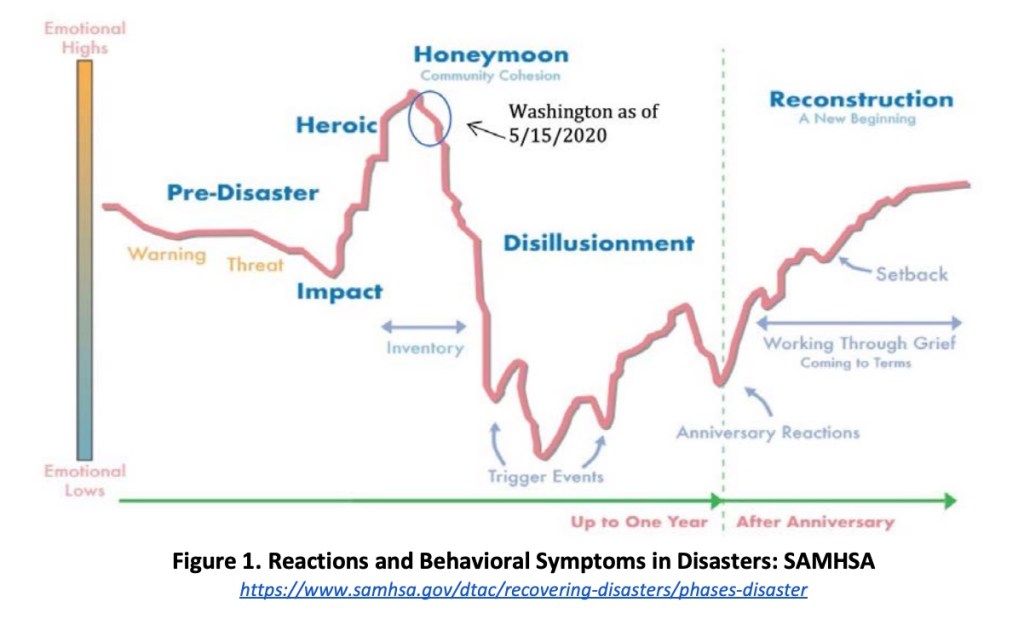
One chart that appears every month is “Reactions and Behavioral Health Symptoms in Disasters”. In the inaugural issue in April 2020, the forecast oriented readers to general model from SAMHSA[1. SAMHSA is the Substance Abuse and Mental Health Services Administration. What a shame that it is a distinct department from the Centers of Disease Control and Prevention (CDC). The mind remains split from the body in our administrative and health care systems, which is why there is no formal framework for public health psychiatry.] of reactions in disasters:

Note that there is no indicator here about where Washingtonians were at that time. The Y axis uses color to depict emotional states and the X axis, so optimistic, has only a notation to mark one year.

In May 2020, the forecast made a proclamation about where Washingtonians were. It was a warning: We were on the precipice of disillusionment:

We braced ourselves for this. Yes, we had witnessed heroism from so many, whether health care workers or first responders or neighbors dropping off food for those who were medically vulnerable or distilleries producing hand sanitizer or seamsters and seamstresses joining brigades to make cloth masks. Of course this level of concern and anxiety was unsustainable. How bad could it get?

Well.

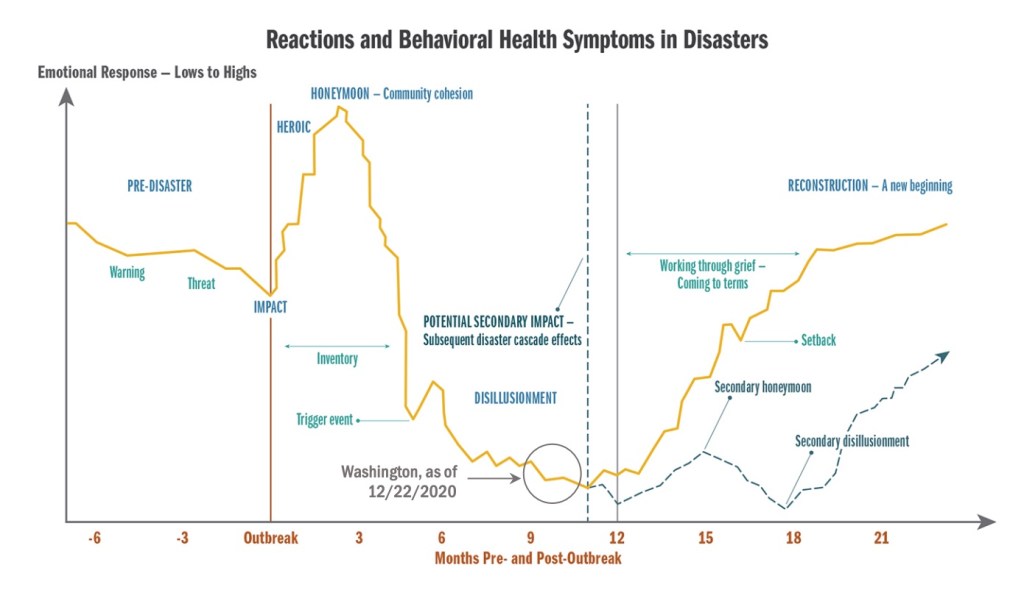
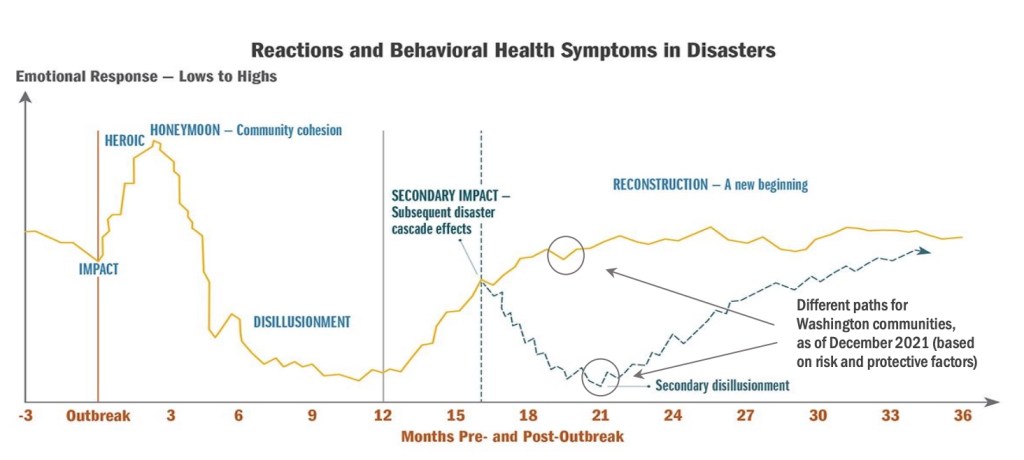
By December 2020, we were in a trough of disillusionment and it felt like it:

Thousands of people were dying a day in the US and other countries around the world. Hospitals were overrun with sick people. People were starting to leave their jobs due to overwhelm. When would the vaccines become available? I remember looking at this graph and thinking, “I thought the graph last month had us in the nadir of disillusionment.” But there was a branching of lines! Maybe we, as a state, would follow the yellow line and things would improve for us all, regardless of station in life.

Well.

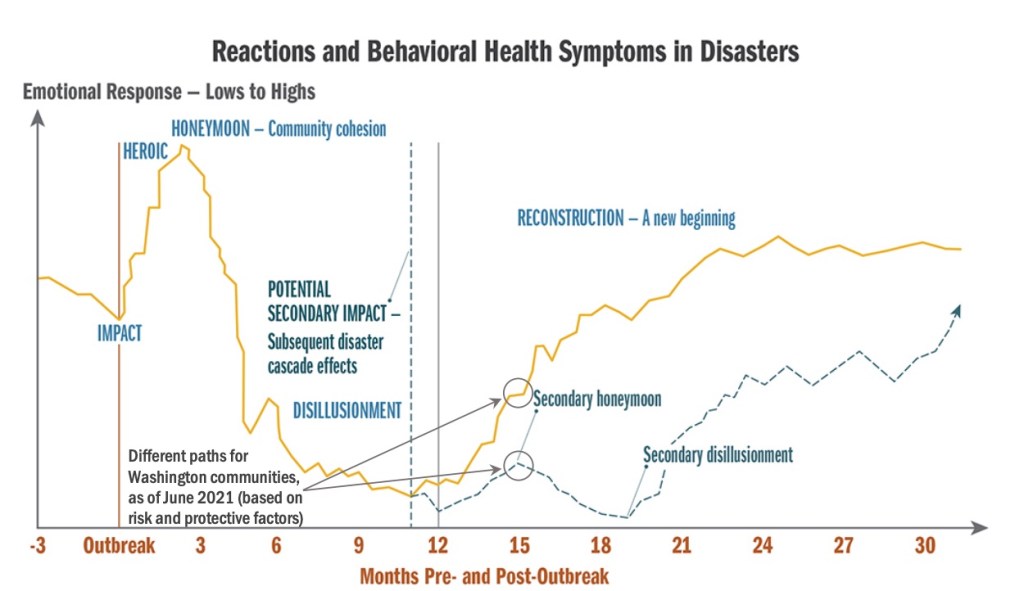
A terrible winter passed. The days got longer, there were more opportunities to be outside, many people got vaccinated… but the yellow line never manifested for those in my professional and personal communities. By June 2021, we were still in a trough:

In retrospect, that “secondary honeymoon” was accurate. All the numbers we hoped would drop, did: Reproductive number, cases, hospitalizations, and deaths. People in the Seattle-King County area were getting vaccinated. But so many of the people under our care were dying from overdoses, suicide, and chronic medical diseases.

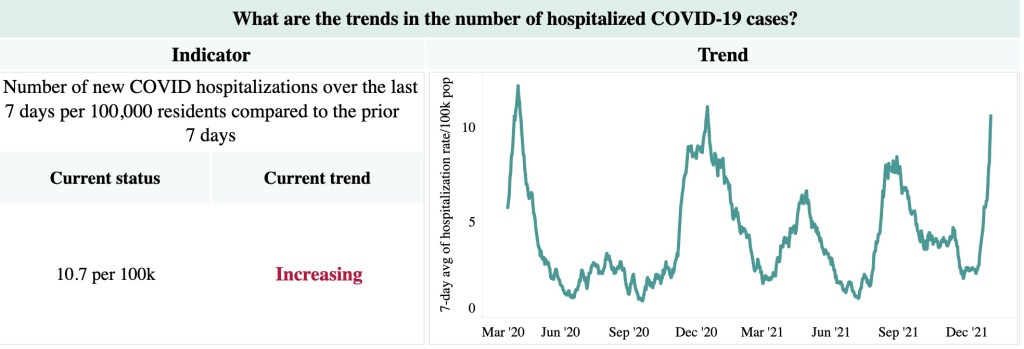
Then came Delta, Omicron, more cases, hospitalizations, and deaths. Health care workers and others left their jobs out of frustration and demoralization. A contingent of people continued to decline vaccinations, despite knowing the possible outcomes… including chronic disease and impairment that still has no effective treatment.

When the December 2021 graph came out, someone observed, “The trough just keeps getting longer.” I wondered who on Earth was experiencing the benefits of “reconstruction”.

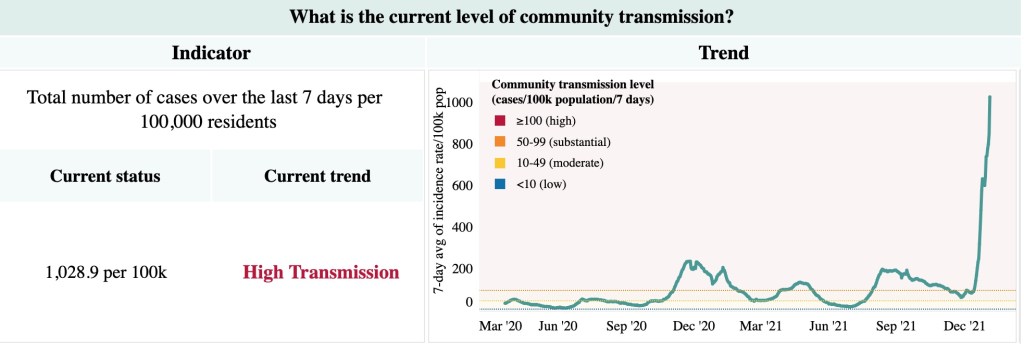
I have never had so many people under my care die during a comparable period of time. At least 10 of my patients have died since the beginning of the pandemic; the first death occurred in July 2020. The most recent death (that I am aware of) happened in November 2021. None of these people died from Covid. They either died by suicide, overdose, or their chronic illness collided with an acute, fatal event.

We know from history that pandemics do not last forever. The 1918 flu pandemic lasted just over two years. The 2002 SARS outbreak was declared over in less than two years. The 2013 Ebola epidemic persisted for less than three years. All things change, all things end.

I, like so many others, hope that we all will exit this trough sooner than we anticipate. I worry about the psychological consequences of this pandemic in the years to come. We continue to focus on the viral pandemic; the psychological pandemic has already arrived. We have yet to see an organized response to that.


Categories
COVID-19 Nonfiction Public health psychiatry Seattle

God Help Us All.

It’s like watching something happen in slow motion, but there is somehow not enough time to stop what is happening.

I don’t know either emergency department medical director well, though we are friendly enough to send greetings a few times a year. We all already knew that hospitals across the state are over capacity. One wrote about the “brutal impacts” across the state due to the additional number of patients. And this precedes the anticipated “all time highs for Covid in about two weeks”. The other, more economical with his words, noted that his team is “maintaining”, but “that the recent surge is further stressing the teams”, adding to “moral injury”.

A friend who works for a third hospital system shared with me that an emergency department had to close down because there weren’t enough staff to operate the place. This emergency department is in a suburb, not a rural town.

It’s not just emergency departments. My colleagues in primary care are reporting that they have had more people under their care die in the past year. They’re not dying from Covid. They’re dying from chronic medical problems.

I myself have never had so many people under my care die in such a short amount of time. They, too, did not die from Covid. Instead, they died from suicide, overdoses, and chronic medical problems.

Like others, I’m watching the number of Covid cases soar. There was a time when daily deaths from Covid were only a few dozen. Now we’re somehow back in the hundreds.

During the late winter, when thousands of people were dying each day in the US from Covid, the grief would overcome me without warning. These days, I feel the mass of dread growing in my body. My chest caves in from the misshapen weight; my jaws are tight, as if they are holding back anguish that transcends words.

God help us all.

Categories
COVID-19 Nonfiction Policy Public health psychiatry Systems

Pandemic of Demoralization.

I haven’t posted much recently because I don’t want to be a bummer. There’s enough of that in the world right now: disasters on a global scale and quiet tragedies just down the block.

I worry about the health care workforce. While it is indeed a privilege to go to school to learn about illness and health and then apply those skills to people who somehow trust us, this pandemic has squeezed and stretched us in ways none of us could anticipate. Not only do we see people who get sick with Covid-19, but we also see all the people who get sick from everything else because of the system pressures and failures due to Covid-19.

I see the fatigue on my colleagues’ faces; I see their struggles in trying to provide the best care they can when they themselves are not thinking or feeling their best—now going on for over a year.

We all remain focused on the Covid pandemic, though the demoralization[1. “Demoralization is a feeling state of dejection, hopelessness, and a sense of personal “incompetence” that may be tied to a loss of or threat to one’s own goals or values.”] pandemic has already descended upon us. While the pandemic has fostered more conversations about mental distress and illness, no robust system has emerged to take care of those who take care of others.[2. It is not only health care workers who would benefit from care from people and systems.] (How could we expect a robust system to emerge when the system—if there was one—was fragile prior to this pandemic?) This distress manifests in dreams and dissociation, prickliness and physical pain, withdrawal and wretchedness.

I never formulated my specific work as “public health psychiatry”, though, in the months before the pandemic, this idea crystalized in my mind. Most of my career has focused on the “deep end” of the system: homelessness, crisis, jails, and poverty. While people can and do get better, the challenges are great when one is reacting to, rather than navigating through, these barriers and systems.

So much of what I do is tertiary prevention (“managing disease post diagnosis to slow or stop disease progression“). Fewer people would need “deep end” services if there were more agile and reliable primary and secondary prevention systems. How much healthier would people be if they were never sexually assaulted as children? if parents were able to feed themselves and their children with confidence? if everyone had a stable and safe place to live?

For our health care workforce now, it is too late to prevent demoralization and exhaustion. It seems that the best that we can do is prevent more harm from happening. Tertiary prevention is still prevention, though this is hard to reconcile with the realities of our daily work: Will tertiary prevention buoy us enough so that we can give good enough care to our patients?