Categories
COVID-19 Nonfiction Policy Public health psychiatry Reading

Public Mental Health Implementation Failure.

Throughout the pandemic, I have routinely reviewed the major psychiatric journals in the United States, hoping for commentary about and guidance related to the prevention or minimization of psychiatric conditions due to the Covid-19 pandemic. Surely there are practices or protocols we could implement to prevent bad outcomes that we knew would happen! While the work we do with individuals might have some potential benefit, the scale of the pandemic meant that population-level interventions would have better effects for a greater number of people. From my point of view, if my finite time and energy could help more than the sole person in front of me, that would be better for all involved.

Three thousand years ago, back in December 2020, I commented that “collective problems require collective solutions; expertise must be decentralized and shared” while reflecting on the need to Protect Mental Health During a Pandemic. Now that three thousand years have passed, it seems that anyone at the federal level who tried to implement the Pan American Health Organization or World Health Organization recommendations from the flu or ebola epidemics was foiled. I lamented then that

We’ve already witnessed psychological stumbling across the population; none of us want to see ourselves, our neighbors, our communities, and those beyond beyond fall further.

We’ve graduated to chronic psychological lurching, floundering, and tottering. Most of the psychiatry journal articles have only described consequences from the current pandemic: who was more likely to get Covid-19? how did it affect the use of substances? how was the pandemic affecting the workforce?

Where were the articles with broad vision, that take the perspective of public health psychiatry?

The Lancet Psychiatry recently published an article that I found refreshing: Public mental health: required actions to address implementation failure in the context of COVID-19:

  1. It acknowledges how the mental health system—one of many—has failed during the pandemic (people may have opinions about whether it was succeeding prior to the pandemic);
  2. It lists specific failures and how to fix these problems (and there are a lot of problems to fix);
  3. It reinforced the need to direct attention and resources to all stages of the lifespan and the various roles, from individuals to national governments, each could play to prevent future failure.

The authors rightly comment

This failure of [public mental health] implementation results in population-scale preventable suffering of individuals and their families, a broad range of impacts…, and large economic costs. The failure also represents a breach of values and the right to health.

Panel 5 lays out how the implementation failures of public mental health:

  1. Insufficient public mental health knowledge
  2. Insufficient mental health policy or policy implementation
  3. Insufficient resources
  4. Insufficient political will
  5. Political nature of some [public mental health] activities
  6. Insufficient appreciation of cultural differences
  7. Causes of mental disorder treatment gap

Oof. It’s a valid list and, indeed, some of the responsibility falls upon mental health and substance use disorder clinicians ourselves. (Different posts for different days.) It’s also striking that, despite the United States being a high income country, we suffer from the same problems listed above that apply to low income countries. (We, however, continue to learn the many ways how the US was and is never different from “those” low income countries.)

As I noted a few weeks ago, “We continue to focus on the viral pandemic; the psychological pandemic has already arrived.” Because of our missteps, the psychological pandemic will also outlast the viral pandemic. The authors note that

The COVID-19 pandemic has widened the implementation gap but has also increased mental health awareness and highlighted the need for a [public mental health] approach.

Now that we are minding the gap, I hope that we can indeed close it.

Categories
COVID-19 Nonfiction Reading Reflection

Pictures in Time.

The rocks of the mountain beneath your feet broke apart before you were born. Glaciers carved the valley before your eyes before your grandparents were alive. Trees towering overhead on this west coast sprouted before the ships from far away landed on the east coast. All of this was here long before you arrived and will persist long after you are gone.

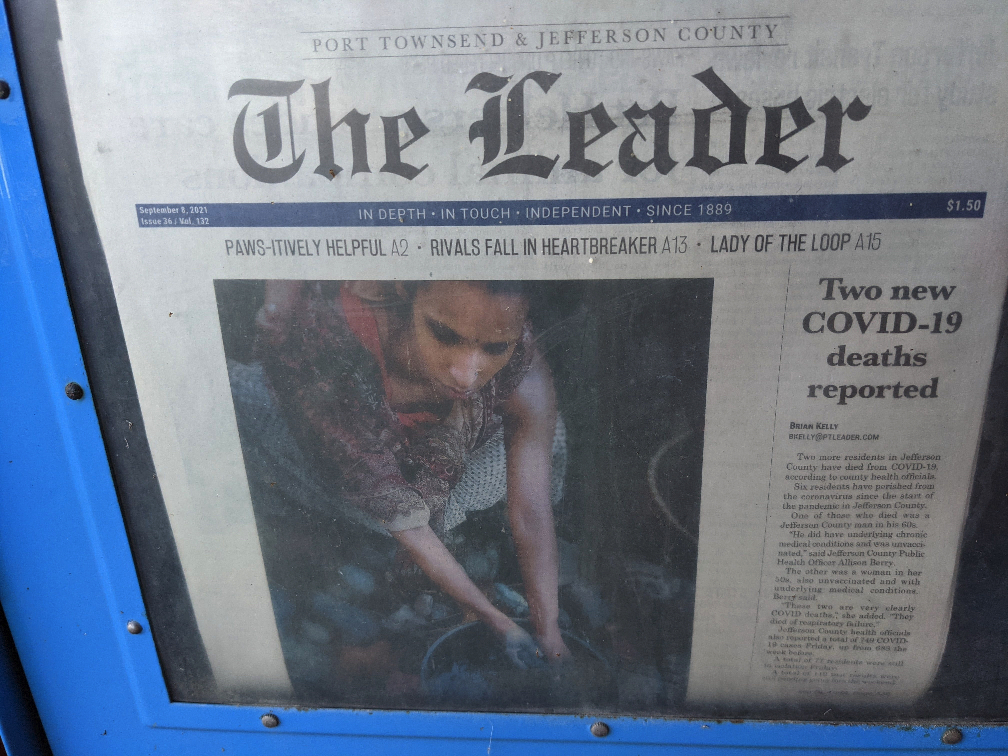
History precedes you and the future remains unknown while you live in the present, where a pandemic persists. This tiny county that holds giant mountains reported two new deaths from Covid-19 this past week, leading to a total of 13 deaths over the course of this cursed pandemic. This number seems paltry compared to the 1,812 deaths in the county you live in, but for each death, many mourn.

Someone offered this idea to me a few years ago: You know those days when you feel sad, though there are no obvious, logical reasons as to why you feel sad? Maybe someone, somewhere, has died and there is no one left to grieve that death. Your sadness is a mourning of that death.

Maybe that, in part, is what we’re all experiencing now.

(I also did not realize that newspaper boxes are mirrors. Exhausted health care workers don’t expect to see exhausted health care workers on the front page of the local paper.)

Though we are exhausted—in varying degrees—and may wonder why we “spend” “our” time doing this work, perhaps this is how time is choosing to use us. Oliver Burkeman’s book Four Thousand Weeks is a gentle yet firm reminder that our time is finite, that only planning for the future logically means that we should only plan for death. That is what awaits all of us in our futures, right?

I highly recommend this book. (Bonus reason, beyond the content of the book: Mr. Burkeman sent a personal reply when I sent him a thank you note!) This choice did not diminish me; it enlarged me.

Sometimes reading about the past brings clarity to the present. The model Wilkerson puts forth in Caste about the relative status of Americans resonates with me (i.e., the actual issue is a caste system, where “race” is often the indicator). Her model better explains the interpersonal and inter-group dynamics of the US compared to solely race-based models. I also highly recommend this book.

Categories
Reading

Other Things to Read.

Yes, I’ve been writing, though I don’t know what to say. So, instead, here are some items I’ve read recently that you may find interesting, too.

Do wild animals get PTSD? Scientists probe its evolutionary roots. (Knowable) “These findings add to a growing body of evidence showing that fearful experiences can have long-lasting effects on wildlife and suggesting that post-traumatic stress disorder, with its intrusive flashback memories, hypervigilance and anxiety, is part of an ancient, evolved response to danger.”

Walk as Spreadsheet. (Craig Mod) This inspired me to create a boba tea spreadsheet. I don’t indulge in boba tea often, though, so my spreadsheet has few entries.

Direct and Indirect Mental Health Consequences of the COVID-19 Pandemic Parallel Prior Pandemics. (America Journal of Public Health) “Failure to recognize that COVID-19 is among the infectious diseases that may directly cause psychiatric conditions has led some policymakers to incorrectly conclude that adverse mental health con- sequences of the pandemic are driven solely by mitigation, creating a false choice between COVID-19 containment and preserving mental health. Similarly, failure to appreciate that fear, bereavement, and pandemic-associated life disruption can have adverse mental health consequences could lead policymakers to allocate mental health resources only to those who have had SARS-CoV-2 infection.”

Why Some People in Chinatown Oppose a Museum Dedicated to Their Culture. (New York Times) “Bringing in too much aesthetic of a certain class means it will lose the authenticity, that feeling you get when you go there that you’re in someone’s community that is meaningful, and you’re being allowed to share that experience.”

Finding a Way Back from Suicide. (New Yorker) A journey of recovery through electroconvulsive therapy.

Meditating on Your Death Could Make You Happier. (Vice) “When faced with the reality of death, what seems important?”

Why We Can’t Wait (Martin Luther King, Jr.) and God-Level Knowledge Darts (Desus and Mero). An unusual, yet complementary pairing.

Categories
Consult-Liaison Education Medicine Reading Reflection Systems

The Challenge of Going Off Psychiatric Drugs for Psychiatry.

Here are my initial reactions to the New Yorker’s The Challenge of Going Off Psychiatric Drugs:

Which populations are most likely to receive large numbers of psychiatric medications?

The woman described in the article comes from a family of money and privilege. These individuals (and families) have both the time and money to seek out psychiatrists who practice “precision psychopharmacology”. These psychiatrists then order complicated medication regimens that ostensibly address and “correct” neuroreceptors. As a consequence, people end up taking multiple medications.

There are also individuals who do not have money or privilege, but are subjected to psychiatric services due to the concerns of the public. They may be behaving in ways that endanger their own lives or the lives of others. As a consequence, they receive medications—sometimes willingly, sometimes through coercion—that aim to reduce certain behaviors. If one medication doesn’t reduce the behavior, then more are added.

What these two populations have in common are (a) the lack of clarity around diagnosis, which often stems from (b) missing information about the person and the context in which s/he lives.

I completely agree with Dr. Frances’s comment from the article:

[There is a] “cruel paradox: there’s a large population on the severe end of the spectrum who really need the medicine” and either don’t have access to treatment or avoid it because it is stigmatized in their community. At the same time, many others are “being overprescribed and then stay on the medications for years.”

The meanings of diagnosis and treatment, particularly medications.

Some people feel relief upon learning that their symptoms belong to a diagnosis, that what they have is “real”. Others don’t want the “label” of a psychiatric diagnosis; they are not damaged human beings.

For various reasons (e.g., the current primacy of biological psychiatry, insurance reimbursement, psychiatry’s seeming inferiority complex within medicine), treatment in psychiatry is often focused on medications. This is not ideal. Medications are a biological solution, though our understanding of the biology of the brain and mind remains limited.

In the meantime, doctors recommend that people take pills. Some people view pills as a necessary intervention to keep them healthy and well. Some people view pills as a shameful reminder that there is something wrong with them that will never improve. The more pills someone has to take, the more potent the reminder that they are beyond hope or repair. Some people view pills as an external validator of their pain and suffering: “Someone else believes and understands my pain and these pills remind them and me that my pain is real.”

The pills may not be treating what psychiatrists think they are treating.

The problems with psychiatric diagnosis.

The Diagnostic and Statistical Manual of Mental Disorders (DSM) focuses only on the “what”, not the “why”.

It doesn’t matter why someone has a depressed mood, takes no pleasure in work or play, can’t sleep, won’t eat, and feels hopeless. The underlying reason could be the cardiologist’s realization that he should have pursued his dream of becoming an architect… or it could be the threat of eviction after losing one’s job.

This affects the way psychiatrists gather a history from people seeking care. Instead of learning the context behind one’s symptoms, psychiatrists now focus on whether certain symptoms are present or absent. What matters more is that she feels paranoid, not that the paranoia started when she learned that her father was molesting her sister.

To be clear, there are some instances in which the underlying “why” doesn’t matter. If someone is terrified of flying on a plane, there are treatments (e.g., exposure therapy) that can help people tolerate plane rides without getting into the reasons why this fear appeared in the first place.

In other instances, though, the “why” is often relevant. Since our understanding of the biology of the brain and mind are limited, we don’t know if the biological properties of Medication A are more useful in military veterans who have fought in combat or if those of Medication B are more useful in women who experience major depression after the birth of a baby. Even if evidence suggests that medications aren’t the best treatment for either population, it is often the easiest intervention to deliver. This is due to the context and underlying “whys” of the health care system.

All of the other psychiatrists.

It’s true that there is scant evidence about how to taper and stop medications. It is a shame that psychiatry, as a field, has nothing to say about deprescribing. The scientific literature has plenty to say about adding medications, but nothing that extols the virtues of taking them away. There are risks to stopping medications, yes, but why are psychiatrists unimpressed with the risks of starting them? In this way we have failed not only the people who receive care from us, but we also fail the people who step in to help in our absence: Other physicians, nurses, family members, friends.

When I consider the psychiatrists I have worked with with, many of them have helped people come off of medications. They work with their patients and go through the trial-and-error process together. While they may not work in ivory towers of acclaim, they are still doing the work of helping people make informed choices about their care so they can lead healthy and meaningful lives. These are the quiet anecdotes that will never make it into the New Yorker.

Psychiatry as an agent of social control.

This is not the first time I’ve written about psychiatry as an agent of social control.

What does it mean that “antidepressants are taken by one in five white American women”? Is this a reflection of white American women? Or a reflection of the society and systems that want to contain white American women?

What does it mean that African- and Latinx-Americans are more likely to receive diagnoses of psychotic disorders? Is this a reflection of these populations of color? Or a reflection of the society and systems that want to contain these populations?

Perhaps there needs to be a “Challenge of Going Off Psychiatric Drugs” for the field of psychiatry. To be clear, there is definitely a role for medications in the treatment of psychiatric disorders, though: first, do no harm. When The Royal We have more humility about what we do and do not know, and exercise more care in current pharmacological tools, then perhaps getting on or going off of psychiatric drugs won’t be a “challenge”.

Categories
Consult-Liaison Reading Reflection

Antisocial Behaviors.

The anxieties and discord within my tiny world and the world at large have felt heavier as of late. Thus, my words do not flow today with the relative ease that they have under different conditions. (To be clear, I’m fine. Perhaps I am just more sensitive to the energies and emotions of others.)

I recently learned about “adulthood antisocial behavioral syndrome”. If you’re familiar with the definition of antisocial personality disorder, it’s essentially that without the requirement for conduct disorder before the age of 15. (If you’re not familiar with antisocial personality disorder, allow me to refer you to my 2013 post (!) that describes the condition.)

The prevalence of these two conditions (derived from surveys of the general public) surprised me: In the United States, about 4% of the population have antisocial personality disorder, and a striking 20% apparently have adulthood antisocial behavioral syndrome. If the prevalence is 20%, should we consider that a disorder? (Is that why it’s called a “syndrome”?) That means if you invite four of your friends over to your home, one person in that group has adulthood antisocial behavioral syndrome. (Maybe it’s you!)

For many reasons (it’s exhausting, I have insufficient data, I can’t do anything to help, etc.), I avoid the intellectual exercise of considering what psychiatric conditions certain public figures may have. That being said, regardless of who is President and which political party has the majority, it is common in psychiatric education to note that there are people in power who likely have antisocial personality disorder. These individuals just haven’t gotten caught (or have the resources to avoid punishment… or there are institutional factors that protect them).

But, for “fun”, let’s run the numbers. If 4% of the US population meet criteria for antisocial personality disorder, that means

  • four Senators and
  • 17 House Representativies

demonstrate a “pervasive pattern of disregard for and violation of the rights of others occurring since age 15 years”. (I’ll let you discuss amongst yourselves as to the identities of these individuals.) There are 15 Cabinet members and nine Supreme Court justices, so the chances are low that one person in either one of those groups has antisocial personality disorder.

If 20% of the US population meet criteria for adulthood antisocial behavioral syndrome, that means

  • 20 Senators
  • 87 House Representatives
  • one Supreme Court justice and
  • three Cabinet members

demonstrate a “pervasive pattern of disregard for and violation of the rights of others”… but did not do so before the age of 15.

The paper that describes the survey also notes that these two antisocial conditions are

highest among male, white, Native American, younger, and unmarried respondents, those with high school or less education, lower incomes, and Western residence

When we consider mass shootings (most certainly an antisocial behavior) in the US, most of them were committed by men… but also note that the vast majority of men don’t ever kill people.

The odds ratio for Native Americans struck me: What does that mean? Is this simply due to the low numbers of Native Americans in this country (i.e., small numbers inflate percentages)? What are the other confounders?

And what about the contexts? Aren’t there occasions when antisocial behaviors are adaptive? If someone threatens your life on a routine basis, is it (1) unreasonable to lie, (2) put your safety at risk when you try to escape the situation, and (3) perform poorly at work due to the stress in your life? You only need to meet three criteria to receive a diagnosis of antisocial personality disorder.

I’m also curious about the prevalences of adulthood antisocial behavioral syndrome in other countries. Does a 20% prevalence in the US mean anything? Do we demonstrate more antisocial behaviors than others on this planet? Maybe this is just human nature?

Some people say that intellectualization is a mature defense mechanism. I’ll let you decide if this post is simply a manifestation of whatever unconscious conflict roils in my psyche.