I gave the presentation earlier this week and ended up presenting (a) homelessnessdata specific to Seattle-King County, (b) general data in in published research about rates of different psychiatric conditions in people experiencing homelessness (there’s actually not a lot of data about this; my understanding is that there is a national study underway right now to assess people experiencing homelessness through structured psychiatric interviews), and (c) the topic of “Involuntarily Removing Mentally Ill People from Streets“. I asked the group—students within various health professions schools—for their thoughts about New York City’s plan.
Many of the students were unfamiliar with involuntary detention for psychiatric reasons, along with the process for how that happens (the laws in Washington State differ from those in most other states in the nation; namely, physicians and other mental health professionals in Washington State cannot detain people directly; we must call a third party, called Designated Crisis Responders, and refer someone for detention). The initial group consensus favored civil liberties; they spoke of loss of dignity, the psychological and physical trauma that can result from involuntary detention, and the importance of autonomy.
When the scenario was adjusted so that the person who was experiencing homelessness and major psychiatric symptoms was someone that the students knew and loved, they quickly changed their arguments to support involuntary detention. When we love someone, we are more comfortable taking away their rights.
Like many complex issues, “right” answers escape us as more facets of the problem are illuminated. Involuntary detention itself is a complicated issue and, because most people are not experiencing homelessness, the majority of people who are detained are people who have an indoor place they call home.
Some research indicates that around 76% of people experiencing homelessness also have a psychiatric disorder, though the association is complex and likely goes in both directions: Some people have a psychiatric condition that contributes to poverty and then homelessness (e.g., losing a job); others become homeless and then develop a psychiatric condition due to the challenges of not knowing where you will sleep at night.
I continue to learn the complexities of working at the intersections of poverty and mental health. I am grateful that more people are interested in this work, too. I hope that things don’t have to get worse before we can offer better help and care to these individuals, who are ultimately our neighbors.
Items related to systems of health care that I learned and thought about this week:
National Medical Association. I am embarrassed to confess that, nearly 20 years after graduating from medical school, I learned only this week about the National Medical Association. This came about while I was learning some of the history of the American Medical Association (AMA). In short, the National Medical Association was created because the AMA would not admit Black physicians into the organization. (I have never been a member of the AMA. My reasons have been squishy; I never truly believed that the AMA represented me or my interests. That hasn’t stopped the AMA from sending me invitations in the mail to join! It seems that over 80% of physicians are not AMA members, so I’m certainly not alone.)
Alexander Graham Bell and Eugenics. This Journal of the American Medical Association(emphasis mine) editorial from 1908 reports:
The subject of the production of better men and women was brought before the American Breeders’ Association by Professor Alexander Graham Bell, the inventor of the telephone, who for many years has been interested in certain social questions, especially those relating to the condition of the deaf and the result on the next generation of the consanguinity of parents as regards the production of deaf and blind children.
No one ever brought this up when we learned that he invented the telephone.
It appears that Bell’s interest in “breeding” was his observation, though the collection of some statistics, that parents who are related to each other seem more likely to bear children who are deaf. Bell made “an appeal for the collection of statistics by trained men who are interested and who have the opportunity to secure the definite detailed information” related to “the production of better children”. The unnamed author(s) of the editorial go on:
We are securing survivals to a much greater degree than before, and now it becomes a duty to secure, so far as it is possible, the origin of members of the race who will be worthy of survival. After all, the most important problem in evolution is not so much the survival of the fittest as the origin of the fittest.
Over 100 years have passed and this ugly question of “breeding” persists.
The Chinese Exclusion Act. I’ve commented on this Act before (here and here), but here’s an opportunity to pile on the AMA even more. In 1901, the Journal of the American Medical Association published a “minor comment” about “The Exclusion of the Chinese“, which you can view in its entirety in the link above.
Reading this made me think of vile rhetoric that has revived during this Covid-19 pandemic. Recall recent references to “disregard of sanitation” due to “[maintainence] to the fullest extent their oriental habits and traditions”. The Chinese, they just won’t do as we do.
“That this is a Christian country and we regard them as heathen, should not make us altruistic to our harm.”
Prescriptive Authority for Psychologists. There is a House bill in the Washington State Legislature that will give prescriptive authority to psychologists. Five US states currently allow psychologists to prescribe medications.
While it is easy to stumble into a debate about whether this should happen or not, I think this is a distraction. This debate is a manifestation of failure in public health policy.
Instead of trying to increase the number of people who can perform a highly specialized task, why not increase the availability of community supports and services so people don’t need highly specialized treatment?
Consider the decrease in anxiety and depression that would result if people were confident they could pay their rent? feed their families? take time off to care for their newborn? secure an education or training–whether college or vocational school–that supports stable employment?
Think of the decrease in stress and trauma if people had better options than to sell drugs or sex? if neighborhoods had more green spaces and less air and noise pollution? if they had adequate and essential protections as “essential” workers?
Medical Mistrust and Meeting People Where They Are At. This paper about medical mistrust, racism, and health prevention describes an elegant way to recruit study participants: “collection of data [occurred] primarily in barbershops, venues with documented recent success in reducing blood pressure in African-American men”. It is elegant because it is simple, effective, and successful.
When I read this, I recalled a suggestion my father had around the time the Covid-19 vaccines were released. He lives near several Asian grocers, many of which are more like bodegas than grocery stores.
“Why don’t they set up vaccination stations outside these grocery stores? Everyone needs to eat. Elderly people go to these stores all the time. Laborers get snacks and cigarettes. Make it easy for people.”
Sometimes (often?) the best and most effective health care happens outside of medical spaces.
In trying to think through this myself, I turn to two mental models: First, what problem are “we” trying to solve? Second, can health care ethics provide guidance here?
What problem are “we” trying to solve? This requires reading the mind of New York City Mayor Eric Adams, which I cannot do. He has argued that The Royal We have a “moral obligation” to solve the problem of “assist[ing] those who are suffering from mental illness”. If we take him at his word, then we can fold his argument within the framework of medical ethics.
If, however, Mayor Adams is trying to solve a different problem (e.g., make homelessness invisible; reduce the number of complaints from the public about people exhibiting unusual or dangerous behaviors; demonstrate that he is “doing something” about homelessness, etc.), then the framework of medical ethics may not apply. If he is trying to solve a different problem, then instead of assisting those who suffer from mental illness, he is using those who suffer from mental illness to assist him and his actual agenda.
Of course, he may be trying to solve multiple problems through the guise of only one.
Can health care (or medical) ethics provide guidance here? One model used in medical ethics is called the four box model. Of note, the four boxes focuses on individual patients, not on populations of people.
Medical Indications (Beneficence and Nonmaleficence)
Patient Preferences (Respect for Autonomy)
Quality of Life (Beneficence, Nonmaleficence, and Respect for Autonomy)
Contextual Features (Justice and Fairness)
Medical indications asks what benefits and harms the patient might experience from interventions. Would involuntary psychiatric hospitalization help people with mental illness who are homeless? Some of them, yes. Would it help all of them? Maybe, maybe not. Could involuntary psychiatric hospitalization cause harm? That is not the intention, but sometimes it does. For reasons valid and invalid, it might discourage people from engaging in psychiatric services ever again. Anything involuntary always involves some degree of coercion, which people generally dislike.
Just because people are behaving in unusual ways and are living outside does not mean that psychiatric hospitalization is guaranteed to “fix” them. I do not mean to diminish the care people receive in psychiatric hospitals. People often need more than involuntary psychiatric hospitalization to get and stay well. Sometimes there is no medical indication for psychiatric hospitalization (involuntary or otherwise) for people with mental illness who are experiencing homelessness. Sometimes they just need a stable place to live.
Patient preferences refers to the dignity and choices people should have in living their lives. Some people would rather take pills by mouth every day than receive a monthly injection of medicine. Some people would prefer not to take any medicine at all. Patient preferences matter.
Some people who are living outside and behaving in unusual ways may not want to be in a hospital. Or maybe they are willing to be in a hospital, but not at that moment—maybe they have other things to take care of that day. Or maybe they are only willing to go to certain hospitals on their own, not at the behest of law enforcement. By definition, involuntary removal of people from the streets disregards patient preferences. Options other than psychiatric hospitalization, such as crisis centers, partial hospital programs, or day programs, can help preserve patient preferences and hence their dignity.
Quality of life describes the patient’s quality of life. Interventions should provide benefit, minimize harm, and maximize the dignity and choices of patients. This does not refer to the quality of life of the general public. If involuntary removal and psychiatric hospitalization are the means to the end of improved quality of life, how can these improvements be sustained following hospitalization?
It is absolutely true that psychiatric hospitalization can be life-saving and life-improving. However, people need and benefit from ongoing care and services following hospitalization. Mayor Adams’s target population also need places to live to maintain their gains. If you’ve ever been hospitalized for any reason, can you imagine the course of your recovery if you had no place to go upon leaving the hospital? How are you supposed to rest when you don’t know where you will sleep that night? Quality of life requires planning and sustained care; acute interventions alone rarely produce improvements in quality of life.
Contextual features are the intersections of a patient’s care with the rest of the world. There are a multitude of contextual features in Mayor Adams’s plan (and it makes me wonder if the mayor consulted with any partners prior to making his announcement). Here are a smattering of contextual features that come to my mind:
How will first responders decide if someone has a mental illness? What if they think someone has an “attitude problem” and instead refers them to jail? How severe do psychiatric symptoms have to be? Will only those who attract the attention of law enforcement be involuntarily removed? (What about the elderly woman who keeps to herself and has been homeless for decades and won’t move indoors because the voices tell her that she will die if she does?)
How will hospital psychiatrists react to people who, in their professional opinion, do not need hospital-level care, though the law argues otherwise? Will psychiatrists become agents of social control on behalf of the jurisdiction? There are some parallels here to the overturning of Roe v. Wade: Some gynecologists are not performing abortions, even though there are medical indications to do so, because of the law. Here, psychiatrists may proceed with involuntary treatment even though there are no medical indications to do so… because of the law.
Let’s say someone experiencing homelessness is involuntarily removed from the street and is psychiatrically hospitalized. Where will they go upon discharge? What if they prefer returning to the street instead of a shelter? What if they have no sources of income and there is insufficient affordable housing? (This is not actually a “what if” question.)
What about all the people who are homeless, but do not demonstrate symptoms of mental illness? Are there any opportunities to prevent or reduce the chances of mental illness in this population? (Yes, by increasing access to stable housing.)
What about all the people with severe mental illness who are not homeless? Are there any opportunities to prevent or reduce the chances of homelessness in this population? (Yes, by increasing access to and flexibility of psychiatric services.)
The four box model here highlights some ethical problems with Mayor Adams’s plan, though there are solutions to increase beneficence, autonomy, and justice while reducing non-maleficence. My hope is that Mayor Adams and leaders of other jurisdictions with similar ideas will take heed.
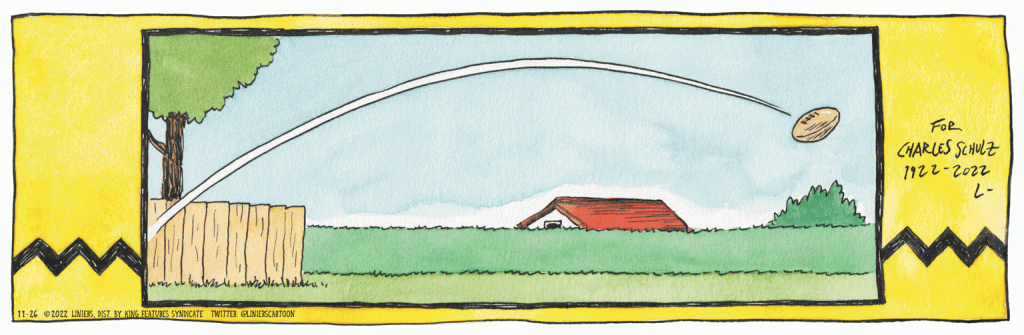
Happy 100th Birthday Charles M. “Sparky” Schulz! Charles Schulz was the creator of the world-renowned Peanuts comic strip. In honor of the centennial of his birth, many cartoonists created a comic strip for this weekend. You can view the tributes here. (Some side comments: As most people read newspapers online now, are there far fewer readers of newspaper comic strips now? I used to read the Sunday funnies throughout my youth; I recognize few of the cartoonists on that tribute page. My favorite strips included Peanuts, Calvin and Hobbes, Non Sequitur, and The Boondocks. For anyone who has even a mild interest in Peanuts, I highly recommend a visit to the Charles M. Schulz Museum in Santa Rosa, California. There are fun exhibits, thousands of comic strips on display, and interesting history about Mr. Schulz.)
Egg Drop from Space. I am one of the millions of subscribers to Mark Rober’s YouTube channel. His most recent video, Egg Drop from Space, is compelling because he shares his major failures in this project. Perhaps he knew that this would make for great storytelling, though he did not have to be this honest and share so many vulnerabilities. (I also completely missed that he was, in essence, trying to design a guided missile.) This isn’t the first time he has brought up failure in his videos, though the extents of his failures make him relatable and his resulting persistence is inspiring. I continue to hope that people will be willing to share their failures, since we’ve all experienced them and will continue to do so. (In that vein, in 2016 I shared a post about My CV of Failures. The formatting is weird because I am unable to use a WordPress footnotes plugin now that I was able to use then.)
“Personal Knowledge Management.” Though I’ve had an interest in technology for much of my life, I would not describe myself as someone who is technologically savvy. There are technologies I routinely use, though I have not uncovered their (or my) full potential. One tool that I have used for several months now is Logseq, which has the accurate description of being a “privacy-first, open-source knowledge base”. (I had dabbled in Obsidian—which I learned about as a loyal Dynalist user for several years—for a while, though personally find Logseq to be more powerful and flexible. As I get older, my appreciation for open-source projects has also grown… though I understand essentially nothing about or in Github.) I’ve not used Notion or Roam Research, but have used Notational Velocity and Tiddlywiki, which are similar “knowledge bases”. If you have used these programs in the past (or even if you haven’t), consider trying Logseq (not a paid endorsement, just someone who is at or near the peak of Mt. Stupid).
On medicine being agents of social control. These three news articles highlight the misuse of authority within the context of medicine:
Delta ‘weaponized’ mental health rules against a pilot. She fought back. In short, a woman named Karlene Petitt was (and remains) a pilot for Delta airlines. In response to a general exhortation from Delta leadership to speak up about safety issues, she submitted reports that did just that. In return, Delta leadership sought to silence her and initiated a process to deem her “too mentally unstable” to be a pilot. Delta recruited a psychiatrist who provided a diagnosis to support this argument. (The psychiatrist apparently diagnosed her with bipolar disorder because of her many accomplishments—“well beyond what any woman [he’s] ever met could do”.) She contested this and took legal action. She won.
How a Chinese Doctor Who Warned of Covid-19 Spent His Final Days. This 16-minute video investigation includes remarks from a physician who provided care to Dr. Li Wenliang, the ophthalmologist in China who tried to alert the public about Covid-19 before he died from the infection himself. Around minute 11 of the video, both the narrator and the physician comment that hospital administrators wanted the health care team to provide an intervention (ECMO) that was not clinically indicated. However, it would buy the hospital administrators time and allow the hospital to report that the health care team “did everything”. The physician states that using ECMO would have been both a violation of medical care and medical ethics. This is an example of “reputation management” superseding clinical judgment.
Woman’s legal quest illuminates the rights of hospital patients who want to leave. Here, a woman voluntarily agreed to enter a psychiatric hospital for care, but was not permitted to leave upon request. Available documentation suggests that she was not at risk of harming herself or others at the time of her request to leave. Under these circumstances, that means the hospital was essentially holding her captive. (This is reminiscent of “On Being Sane in Insane Places“, where context affects how we evaluate situations.) Even worse:
“All patients admitted to the facility,” the manager said, meet the criteria to be involuntarily committed, “even voluntarily admitted patients.”
The manager told DOH investigators that staff “do not orally notify voluntary patients” of their right to be released immediately, despite a state law requiring this disclosure. If they did, he said, “Everybody would be asking to leave.”
Those two short paragraphs reflect poorly on the hospital in question.
On the death penalty. The first two articles present opposing perspectives on the death penalty. The third article provides a first-person account of being in prison, which adds context to the first two articles.
Society embraces four major justifications for punishment: deterrence, rehabilitation, incapacitation and retribution.
I’ve not seen it described this way and appreciate the framework. This might be a red herring: The author also argues that the Parkland shooter’s “human dignity requires his just punishment [with the death penalty] as an end in itself”. I struggled to wrap my head around this one: We usually cite people’s humanity and dignity as reasons to keep them alive, not to kill them.
I Wish the Jury Had Not Sentenced My Family’s Killer to Death. In contrast, the author here argues how the death penalty, while maybe just, doesn’t actually solve any problems. It instead only prolongs suffering for the families of victims. Also, “death by incarceration” is still death. (I also appreciated her firm recommendations about how to support people who experience unspeakable tragedies.) While the author of the previous pro-death penalty piece focuses more on theory and logic, the author here focuses more on practicalities and emotions. Both models have value. Both articles made me consider my own stance on the death penalty.
Prisoners Like Me Are Being Held Hostage to Price Hikes. The author of this piece is currently in prison. Though I have never worked in prison, I have worked in jail. His descriptions about commissaries, food items, and access to various items seem similar to what I have observed in jail settings. (It also continues to baffle me how businesses are allowed to make money off of people in jail—including medical care!!!) Nobody is spared from inflation and price hikes.
To end this on a lighter note: This artwork from Andy J. Pizza made me feel a variety of invisible things: